


What Forms Do You Need to File for Divorce in California?
The forms for filing for divorce in California can feel overwhelming — but knowing exactly which documents you need makes the process much more manageable. Here’s a quick overview of the core forms most people need:
| Form | Name | When You Need It |
|---|---|---|
| FL-100 | Petition for Dissolution of Marriage | Always — this starts your case |
| FL-110 | Summons | Always — filed with FL-100 |
| FL-105 | Declaration Under UCCJEA | Required if you have minor children |
| FL-120 | Response — Marriage/Domestic Partnership | Required if you are responding to a petition |
| FL-115 | Proof of Service of Summons | After serving your spouse |
| FL-140 | Declaration of Disclosure | Required financial disclosure |
| FL-150 | Income and Expense Declaration | Required financial disclosure |
| FL-142 | Schedule of Assets and Debts | Required financial disclosure |
| FL-180 | Judgment | To finalize the divorce |
| FL-190 | Notice of Entry of Judgment | Filed when judgment is complete |
| FL-800 | Joint Petition for Summary Dissolution | Only if you qualify for simplified divorce |
Divorce is one of the most stressful legal processes a person can go through — especially when children, shared assets, or conflict are involved. In Orange County alone, roughly 33 people file for divorce every single day. That’s thousands of families each year trying to navigate confusing court paperwork, strict deadlines, and local procedures they’ve never dealt with before.
Getting the forms right matters. A missed form or a filing error can delay your case by months — or worse, result in a default judgment that strips away your rights entirely.
This guide walks you through every major form you’ll need, from the initial petition all the way to the final judgment. Whether you’re the one filing or you’ve just been served papers, you’ll know exactly what to do next.
Not sure where to start? Pinkham & Associates, APLC offers free consultations to help you understand your options before you file a single form.
Introduction

Before you pick up a pen, you must meet the residency requirements. To file for a dissolution of marriage in California, at least one spouse must have lived in the state for the last six months and in the county where you are filing (such as Orange County) for the last three months.
In every case, there is a Petitioner (the person who starts the case) and a Respondent (the person who receives the papers). It is important to remember that California is a “no-fault” state. You don’t need to prove your spouse did something wrong; you only need to state that there are “irreconcilable differences.”
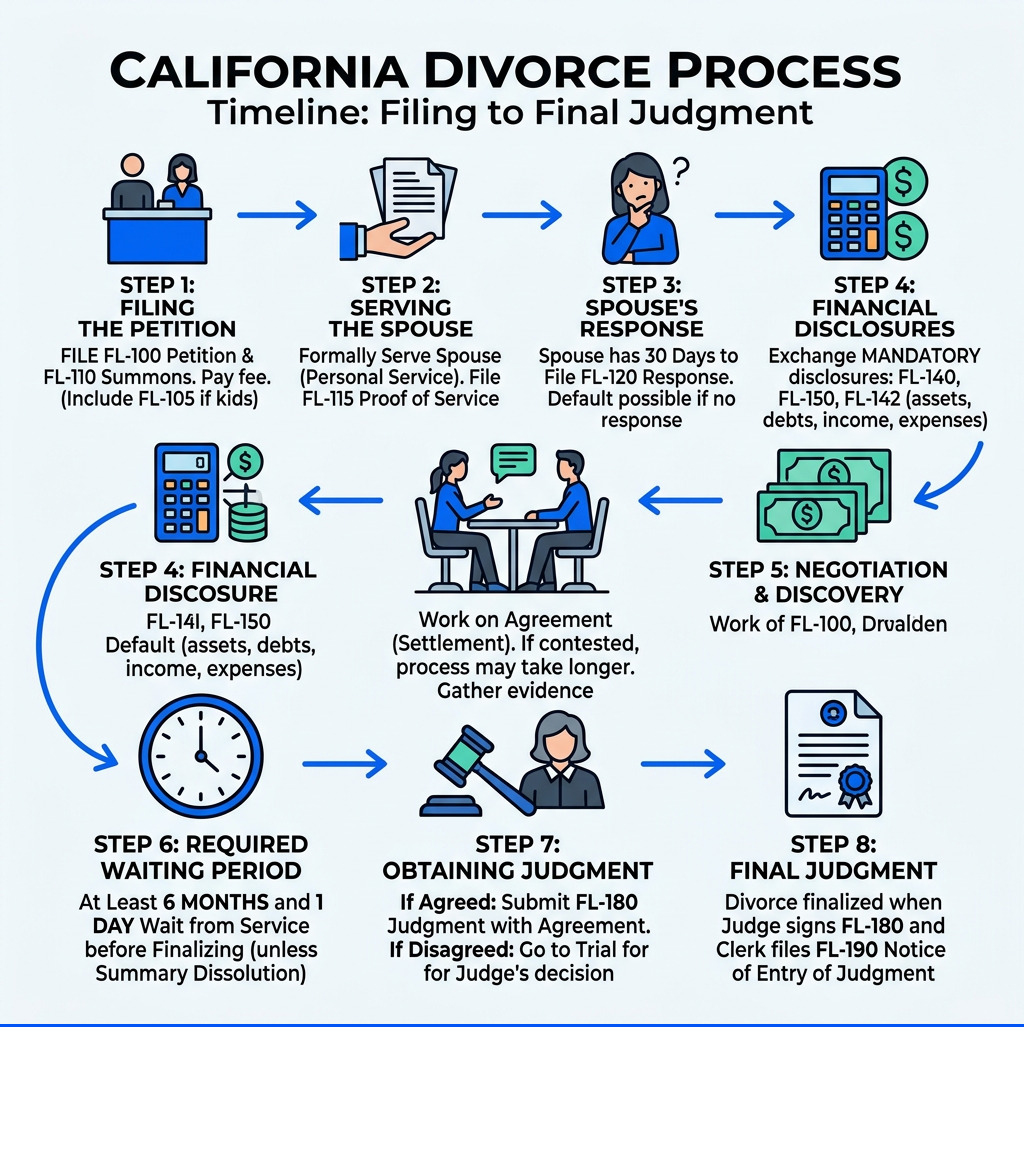
Once you file, the clock starts ticking. California law mandates a six-month waiting period from the date the Respondent is served before the divorce can be finalized. This cooling-off period is mandatory, even if both parties agree on everything from day one.
Step 1: Starting the Case with Initial Forms for Filing for Divorce in California
To get the ball rolling, the Petitioner must complete a specific set of forms for filing for divorce in California. These forms tell the court who you are, how long you’ve been married, and what you want the court to do regarding your property and debts.
- FL-100: Also known as the Petition for Dissolution of Marriage (form FL-100). This is the foundation of your case. You will list the date of marriage, the date of separation, and your requests for custody or support.
- FL-110: The Summons (form FL-110) contains “Automatic Temporary Restraining Orders” (ATROs). These prevent either spouse from hiding assets, changing insurance policies, or taking the children out of state without permission once the case starts.
- Local Form L1120: If you are filing in the Orange County Superior Court, you must also include the Family Law Declaration Regarding Related Cases. This ensures the court knows if there are other active cases (like domestic violence or probate) involving your family.
When you take these to the clerk’s office, you’ll need the original and two copies. Be prepared for the filing fee, which is currently between $435 and $450 in California. If you cannot afford this, you can submit forms FW-001 and FW-003 to request a fee waiver based on low income or public assistance.
Mandatory Forms for Filing for Divorce in California with Children
If you and your spouse have minor children (under 18), the court needs extra information to ensure their safety and determine jurisdiction.
You must include FL-105, the Declaration Under Uniform Child Custody Jurisdiction and Enforcement Act (form FL-105). This form (often called the UCCJEA) tells the judge where the children have lived for the last five years. It helps the court decide if California has the legal authority to make child custody and visitation orders. Without this form, the court cannot move forward with any requests regarding your kids.
Step 2: Service of Process and the Respondent’s Response
Filing the papers is only half the battle. You must then legally “serve” them to your spouse. This is called Service of Process. You cannot hand the papers to your spouse yourself. You must have someone over 18 who is not a party to the case (a friend, relative, or professional process server) do it for you.
Once served, the server fills out FL-115, the Proof of Service of Summons. If your spouse is willing to cooperate, they can sign FL-117, the Notice and Acknowledgment of Receipt, which simplifies the process.
The Respondent has a strict 30-day deadline to file their FL-120 (Response). This is their chance to agree or disagree with what was requested in the Petition.
What if your spouse disappears? What Happens if My Spouse Refuses to Sign Divorce Papers in California? If they refuse to sign or cannot be found, you aren’t stuck. You can ask the court for permission to use Service by Publication, where you run a notice in a local newspaper for four weeks. This is a last resort and requires proving you’ve made a “diligent effort” to find them.
Step 3: Mandatory Financial Disclosure Requirements
In California, you cannot get a divorce without being honest about your money. Both parties must exchange “Declarations of Disclosure.” This is a two-stage process: Preliminary and Final.
- FL-140: The cover sheet for your disclosure package.
- FL-142: The Schedule of Assets and Debts (form FL-142). You must list everything you own and everything you owe, including “Community Property” (assets acquired during marriage) and “Separate Property” (assets owned before marriage or received as an inheritance).
- FL-141: This is the form you actually file with the court to prove you sent your disclosures to your spouse. You do not file your actual bank statements or asset lists with the court to protect your privacy.
- FL-144: If you and your spouse agree on everything, you can often sign a waiver to skip the “Final” disclosure and just stick with the “Preliminary” one.
Completing Financial Forms for Filing for Divorce in California
One of the most critical documents in this phase is FL-150 or FL150 Your Income and Expense Declaration. This form is used by the judge to calculate child support and spousal support. You’ll need to attach your last two months of pay stubs.
If you find this part stressful, you aren’t alone. The No-Stress Guide to California Divorce Forms suggests gathering your tax returns from the last two years before you start, as you’ll need them to fill out these forms accurately. Asset division is often the most contested part of a divorce, so precision here is vital.
Step 4: Finalizing the Judgment and Summary Dissolution
Once the 30-day response period has passed and disclosures are exchanged, you can move toward the finish line.
If the Respondent never filed a response, the Petitioner can file FL-165 to request a Default Judgment. This essentially tells the court, “My spouse isn’t participating, so please grant the divorce based on my requests.”
To officially end the marriage, you must submit:
- FL-180: The Judgment. This is the final order the judge signs.
- FL-190: The Notice of Entry of Judgment. The court mails this to both parties once the judge has signed the FL-180.
Is there a faster way? If you have been married for less than five years, have no children, don’t own real estate, and have very limited assets and debts, you might qualify for a Summary Dissolution. This uses the Joint Petition for Summary Dissolution (form FL-800). While it’s simpler, you still have to pay a Summary Dissolution California Fee and wait the six-month period.
Frequently Asked Questions about California Divorce Paperwork
How much are the filing fees for divorce in California?
The standard filing fee for a petition or a response in California is usually between $435 and $450. In the Orange County Superior Court, these fees are mandatory unless you qualify for a fee waiver (Forms FW-001 and FW-003). That there may be additional small fees for things like court reporters or specific local forms.
What is the difference between contested and uncontested divorce forms?
An uncontested divorce means both parties agree on every single issue, from child custody to how to split the retirement accounts. In these cases, you usually file a written agreement (a “Stipulated Judgment”) along with your FL-180.
A contested divorce means you disagree on at least one thing. If you can’t settle, you may have to file an “At Issue Memorandum” (Local Form L-0031 in Orange County) to tell the court you are ready for a trial. Do I Need a Lawyer for an Uncontested Divorce? While you aren’t required to have one, an attorney can ensure your agreement is legally sound and won’t be rejected by the judge.
Where can I get free help with my divorce forms in Orange County?
If you’re doing this on your own, there are several resources available:
- Self-Help Centers: Located at the Orange County Superior Court, they offer basic guidance on which forms to use.
- Family Law Facilitator: They can help with child support and spousal support calculations.
- Legal Aid Society Advice Clinic: They provide free workshops for low-income residents.
If you’re feeling overwhelmed, reading How to File Divorce Documents Even If You’ve Never Tried It Before can help break the process down into manageable bites.
Conclusion
Navigating the forms for filing for divorce in California is a marathon, not a sprint. With over 25 years of exclusive focus on family law in Orange County, Pinkham & Associates, APLC understands the local nuances that can make or break a case. Whether you are in Irvine, Newport Beach, or Tustin, having a fearless advocate on your side ensures that your assets are protected and your children’s best interests are prioritized.
Don’t leave your future to chance with a filing error. If you need help with Professional Divorce Document Filing Services or a personalized legal strategy, contact Pinkham & Associates, APLC today. We offer free consultations to help you start this new chapter with confidence.