



What Is the Divorce Rate in California Right Now?
The divorce rate in California is approximately 7.45% — one of the lowest in the United States. Here’s a quick snapshot of where things stand:
| Metric | Figure |
|---|---|
| 2023 divorce rate | 7.45% (75 per 1,000 residents) |
| 2024 total filings | 108,403 (20-year low) |
| Change since 2005 | Down ~30% |
| U.S. ranking | ~45th out of 50 states |
| 2014 rate (for comparison) | 9.8% |
California’s numbers have been falling steadily for over a decade — and 2024 marked a historic low, with fewer divorce filings than even the pandemic year of 2020.
So what’s actually driving these numbers? And what do they mean if you’re facing a divorce in Southern California right now?
The picture is more nuanced than a single percentage can show. California’s sheer size, its cultural diversity, and the way the state tracks (and doesn’t track) divorce data all shape what these statistics actually mean.
For example, California is one of five states that does not report divorce data to the National Center for Health Statistics — which means national comparisons require careful interpretation.
Whether you’re trying to understand your legal options or just want to know where California stands compared to the rest of the country, this breakdown covers the key numbers, trends, and factors you need to know.
Current Trends: The Divorce Rate in California Hits Historic Lows
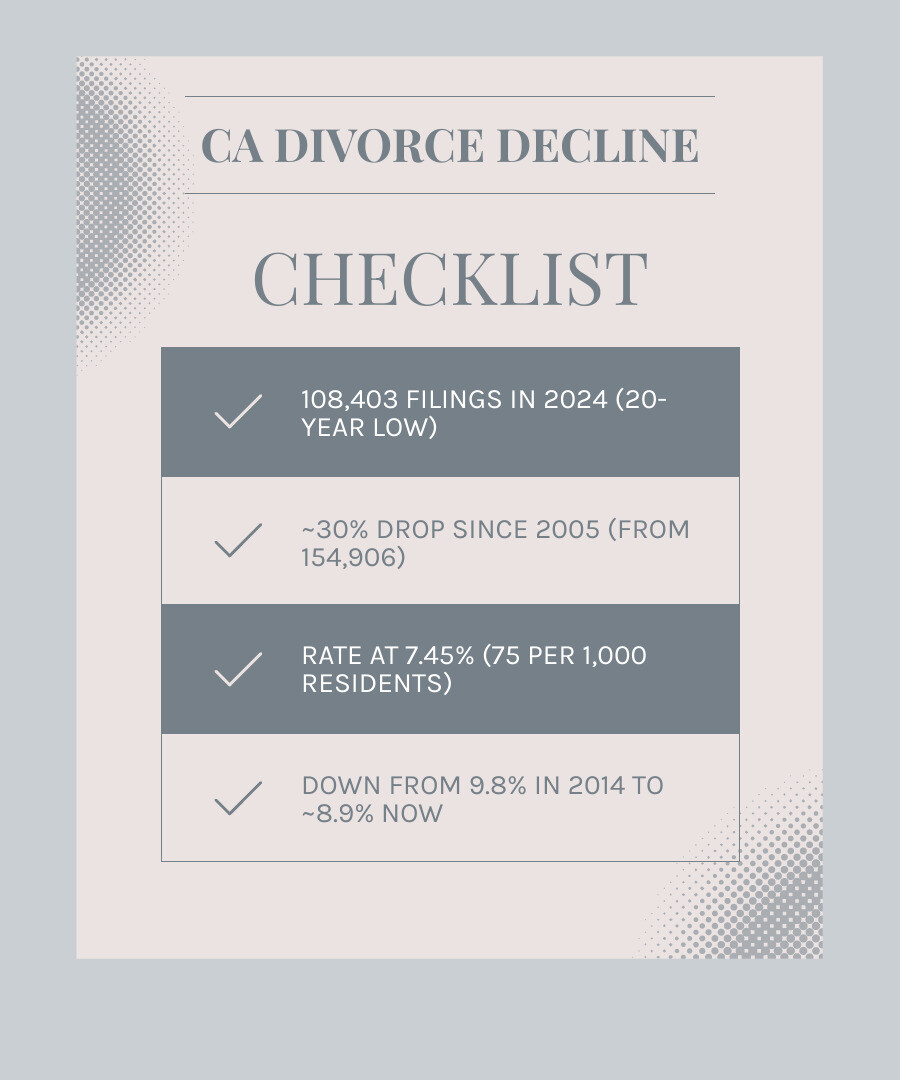
In 2024, California reached a significant milestone in its marital history. With 108,403 divorce filings recorded statewide, the divorce rate in California hit a 20-year low. To put that in perspective, this represents a nearly 30% decline from the 154,906 filings seen in 2005. While the population of the Golden State has grown, the number of couples choosing to legally end their marriages has moved in the opposite direction.
Data from the U.S. Census Bureau American Community Survey shows that the percentage of the population that is currently divorced has dipped from 9.8% in 2014 to roughly 8.9% in more recent years. This downward trend suggests a stabilizing shift in how Californians approach marriage and long-term commitment.
Comparison of Divorce Filings in California (2005–2024)
The peak of marital dissolution in California occurred in 2006, with 157,719 filings. Since then, the numbers have followed a jagged but persistent downward path.
| Year | Total Divorce Filings | Trend Note |
|---|---|---|
| 2005 | 154,906 | Early 2000s baseline |
| 2006 | 157,719 | 20-year peak |
| 2010 | 144,342 | Post-recession dip |
| 2015 | 132,120 | Steady decline continues |
| 2020 | 110,544 | Pandemic court closures |
| 2024 | 108,403 | Historic 20-year low |
For those living in Southern California, these statewide trends are mirrored locally. You can find more info about Orange County divorce statistics to see how our local courts compare to the state averages.
Why the divorce rate in California is lower than the national average
It might surprise many to learn that California consistently ranks as one of the states with the lowest divorce rates, often placing around 45th out of 50. Several factors contribute to this “marital stability” in the West.
First, Californians are waiting longer to tie the knot. The median age for a first marriage in California is now 31.1 years for men and 29.4 years for women—some of the highest ages in the country. Scientific research on geographic variation in divorce consistently shows that couples who marry later in life, often after completing higher education and establishing financial stability, are statistically less likely to divorce.
The impact of “Grey Divorce” on state statistics
While the overall divorce rate in California is falling, one specific demographic is bucking the trend: the “silver splitters.” “Grey divorce”—referring to dissolutions among couples over the age of 50—is actually on the rise.
According to reports from the American Academy of Matrimonial Lawyers (AAML), baby boomers are increasingly seeking divorces after decades of marriage. These cases often involve complex alimony disputes and the division of significant retirement assets. For these couples, the “biggest fight” isn’t usually over custody, but rather over spousal support and how to maintain two separate households on a fixed retirement income.
Regional Deep Dive: Highs and Lows Across the Golden State
The divorce rate in California is not uniform; it varies wildly depending on which county you call home. For example, Shasta County has one of the highest percentages of divorced residents at 14.3%, while Santa Clara County sits at the bottom with just 7.3%.
In terms of sheer volume, Los Angeles County is the heavyweight. In 2024, LA County saw 25,682 divorce filings—accounting for roughly 25% of the entire state’s total. However, even in LA, filings have dropped by 35% since 2005.

Orange County remains a high-activity hub for family law. Approximately 33 people file for divorce every single day in the OC. Despite the high volume, the process isn’t always fast. Understanding waiting for the D Word and how long California divorces actually take is essential for anyone entering the system, as the state mandates a strict six-month waiting period.
Socio-economic factors and the divorce rate in California by county
Why do some counties have more divorces than others? Socio-economics play a massive role. In areas like Riverside County, housing affordability and long commutes can put immense strain on a marriage. Conversely, in high-income areas like Newport Beach or Yorba Linda, the “cost of divorce” itself can sometimes act as a barrier, or high financial stability may reduce the common stressor of money.
Family structure also plays a role in these regional statistics. KidsData on living arrangements for children indicates that about 63.7% of California children live with two parents, but in certain counties, the number of children living in single-parent households is significantly higher, often correlating with higher local divorce rates.
Demographic Influences: Ethnicity, Religion, and Politics
California’s diversity is reflected in its divorce data. Ethnicity and cultural background often influence how long marriages last. Nationally and within the state, Asian communities tend to have the lowest divorce rates (around 7-9%), while Black/African-American communities see higher rates (around 22-24%).
Interestingly, California is a leader in interracial marriage. In the Los Angeles metropolitan area, approximately 22% of all marriages are between spouses of different ethnic groups. These unions often reflect the state’s melting-pot culture, though they can sometimes face unique challenges related to merging different family traditions or expectations.
Religious and political affiliations also move the needle. According to Pew Research on marital status and religion, groups like Hindus and Mormons tend to have lower divorce rates, while those who identify as “unaffiliated” or certain Protestant denominations may see higher rates. Politically, some studies suggest that Republicans report slightly higher levels of marital happiness than Democrats, though California’s overall lower divorce rate suggests that the state’s Democratic-leaning population is finding ways to keep marriages together longer than in “redder” states like Arkansas.
If you aren’t ready for a full dissolution, it may be worth exploring how legal separation vs divorce in Orange County explained can offer a middle ground for couples with religious or financial concerns.
How children impact the divorce rate in California
Does having kids keep a marriage together? Statistically, yes. Couples with children are roughly 40% less likely to divorce than those without. This is often attributed to the “barrier effect”—the desire to maintain a stable environment for the kids and the sheer complexity of navigating California child custody laws 2025: what you need to know.
In California, courts prioritize the “best interests of the child,” usually leaning toward joint custody arrangements that keep both parents involved. This legal hurdle often encourages couples to try mediation or counseling before pulling the trigger on a filing.
Same-sex marriage and dissolution trends
Since the legalization of same-sex marriage, California has seen a steady rise in these unions. Between 2020 and 2021 alone, same-sex marriages in the state increased by 23.6%. Interestingly, same-sex couples often show lower divorce rates initially, which researchers link to the fact that these couples often marry at an older age and possess higher levels of education.
Bowling Green State University research on marriage age notes that the maturity brought to these marriages often leads to more stable foundations, though the average duration of same-sex marriages that do end in divorce is currently shorter (around 7 years) compared to opposite-sex marriages.
California is a “no-fault” divorce state. This means you don’t have to prove your spouse did something wrong (like adultery or abandonment) to get a divorce. You simply cite “irreconcilable differences.”
One of the most critical aspects of California law is community property. In a 50/50 split state, almost everything acquired during the marriage is considered owned equally by both spouses. This can make the division of assets—from the family home in Costa Mesa to a 401(k) earned while working in Irvine—quite complex.
Choosing between an uncontested vs contested divorce: which is right for you? is the first major decision. Uncontested divorces, where both parties agree on all terms, are faster and cheaper. However, if there are disagreements over assets or kids, you might find yourself asking, “Do I need a divorce lawyer?” The answer is usually yes if you want to protect your long-term financial health.
Residency requirements and the six-month waiting period
You can’t just move to California and file for divorce the next day. According to California Family Code Section 2320, at least one spouse must have lived in California for six months and in the specific county where they are filing for three months.
Once you file, the “cooling-off” period begins. California law mandates that a divorce cannot be finalized until at least six months have passed from the date the respondent was served with papers. This is a non-negotiable waiting period designed to give couples one last chance to reconsider.
Frequently Asked Questions about California Divorce Statistics
Why doesn’t California report divorce statistics to the NCHS?
If you look at federal reports, you’ll often see a footnote next to California. The state stopped reporting its detailed divorce statistics to the National Center for Health Statistics (NCHS) decades ago. This is primarily due to the way California collects “vital statistics” at the county level; the state doesn’t aggregate the data in the specific format the federal government requires. For a look at how the federal government handles this missing data, you can view the NCHS provisional data report.
What is the average length of a marriage in California before divorce?
On average, marriages in California that end in divorce last about 8.9 years. This is slightly shorter than the national average, which hovers closer to 19 years when including all marriages, but it aligns with the “seven-year itch” phenomenon often discussed in sociology. U.S. Census Bureau 1-Year Estimates show that while many marriages are enduring longer, the first decade remains the highest-risk period for dissolution.
What are the primary risk factors for divorce in the state?
According to a Forbes survey on divorce causes, the number one reason cited for divorce isn’t actually infidelity—it’s a lack of family support. In a high-pressure state like California, other major risk factors include:
- Financial Stress: Disagreements over money, especially in high-cost areas like Orange County.
- Age at Marriage: Marrying before age 25 significantly increases divorce risk.
- Previous Marriages: Second marriages have a 60% failure rate; third marriages hit 73%.
- Communication Breakdown: A fundamental inability to resolve conflict over time.
Conclusion
Understanding the divorce rate in California helps put your own situation into context. While the numbers are at a historic low, every divorce is a deeply personal journey that requires more than just a passing knowledge of statistics. It requires a strategy.
At Pinkham & Associates, APLC, we bring over 25 years of exclusive focus on family law to the table. Whether you are in Irvine, Tustin, or Newport Beach, our firm provides the fearless advocacy and personalized strategies needed to navigate child custody, asset division, and the complexities of community property. We understand that behind every statistic is a person looking for a fresh start.
Don’t navigate the complexities of the California legal system alone. Our team is trusted by other lawyers for our high success rate and dedicated approach. We offer free consultations to help you understand your rights and start your next chapter with confidence.
Schedule a consultation for California divorce services today and let us help you protect what matters most.