


Is Filing an Online Divorce Application Right for You?
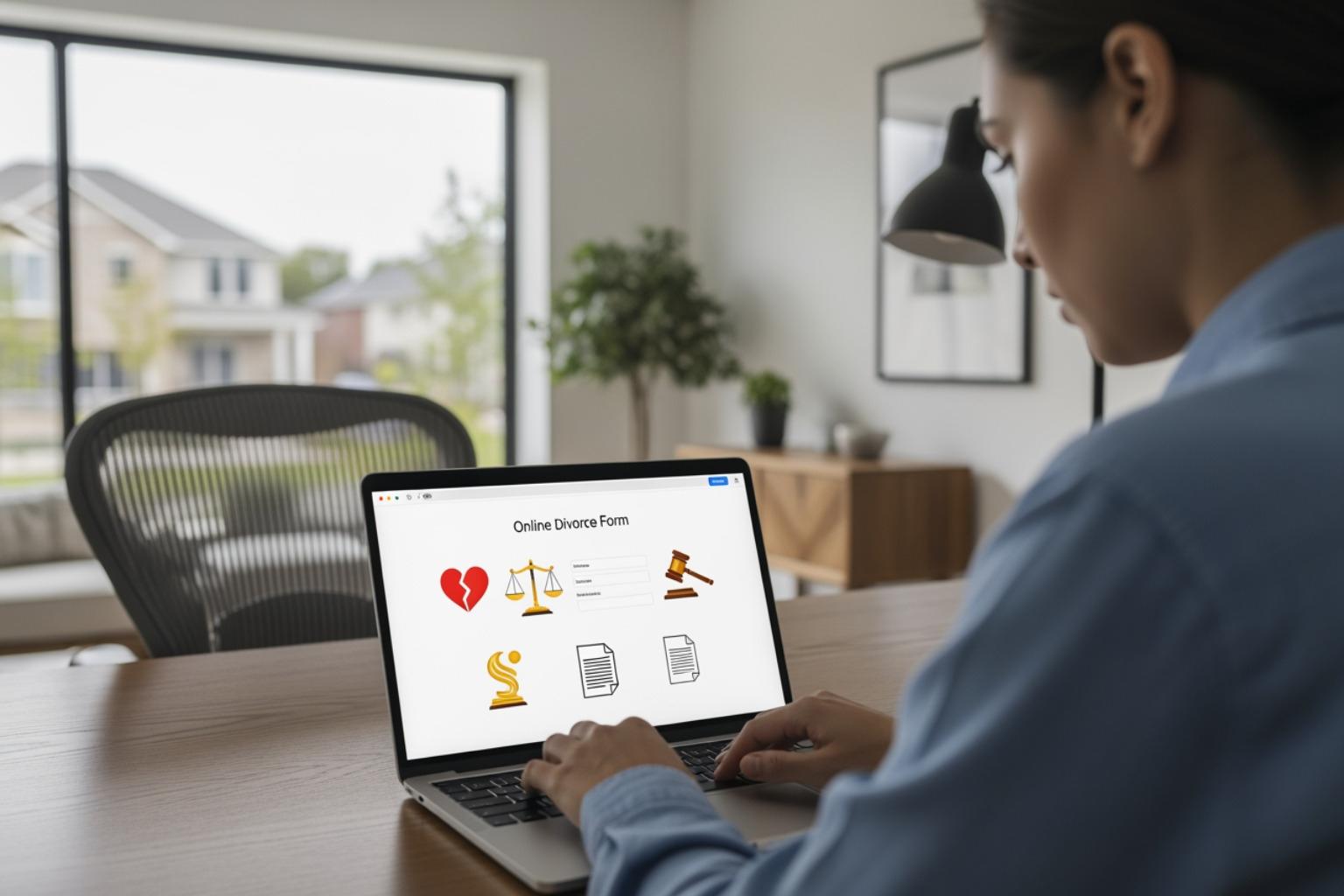
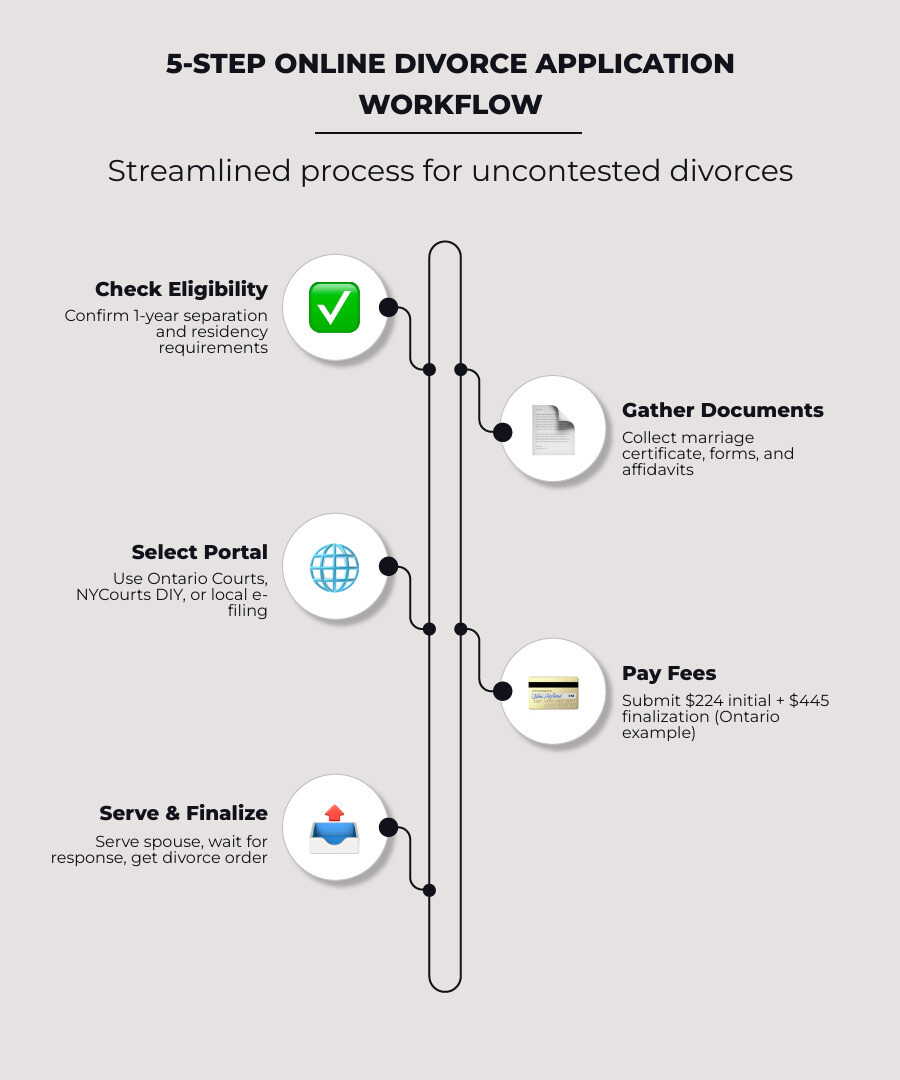
Online divorce application filing is now available in many jurisdictions, letting eligible couples complete and submit divorce paperwork without visiting a courthouse. Here’s a quick overview of how it works:
- Check eligibility – You generally need to have been separated for at least one year and meet your jurisdiction’s residency requirement.
- Gather documents – You’ll need your original marriage certificate, completed court forms, and supporting affidavits.
- Choose the right portal – Ontario uses the Ontario Courts Public Portal (Toronto) or Family Submissions Online (outside Toronto); New York offers the NYCourts DIY Uncontested Divorce Program; the UK uses gov.uk/apply-for-divorce.
- Pay filing fees – Fees vary by location (Ontario charges $224 to start and $445 to finalize a simple divorce).
- Serve your spouse and finalize – Someone over 18 (not you) must serve documents; after the response window closes, you submit final forms for the judge’s signature.
Important: Online filing only works for uncontested divorces where both spouses agree on all issues. If children, property disputes, or support disagreements are involved, the process becomes more complex.
Divorce is already one of the hardest things a family goes through. For Southern California parents juggling child custody concerns, support questions, and the stress of splitting assets, the last thing anyone wants is a complicated legal process on top of everything else.
That’s why so many people are searching for a simpler path — and online divorce filing promises exactly that. The idea is appealing: answer some questions, upload your documents, pay a fee, and let the court handle the rest.
But the reality is more nuanced. Not every divorce qualifies. Not every jurisdiction works the same way. And a single filing mistake can delay your case or get it rejected entirely.
This guide breaks down how online divorce applications actually work — across Ontario, New York, Washington State, the UK, and California — so you can make an informed decision before you click “submit.” If you’re unsure whether your situation qualifies, Pinkham & Associates, APLC offers free consultations to help you figure out the right path forward.
Understanding the Online Divorce Application Process

The move toward digital legal services has transformed how families approach ending a marriage. An online divorce application essentially allows a petitioner to bypass the traditional “bricks and mortar” courthouse filing line by using secure government or approved third-party portals. However, before starting, it is vital to understand the terminology used by the courts.
Most online systems are designed specifically for an Uncontested vs Contested Divorce: Which is Right for You? If a couple is in total agreement on every single issue—from who gets the family dog to how the retirement accounts are split—they may file a joint application. In other cases, a simple divorce (often called a “divorce-only” application) is used when the only thing being asked of the court is the legal dissolution of the marriage, with no claims for support or property division.
Several jurisdictions have become leaders in this digital transformation:
- Ontario, Canada: Offers robust online filing through two distinct portals depending on the region.
- New York: Features a “DIY” program for uncontested cases without children under 21.
- United Kingdom: Provides a centralized “Apply for a Divorce” service on the gov.uk website.
- Washington State: Utilizes attorney-backed online questionnaires to prepare court-ready petitions.
- California: While individual counties like Orange County offer electronic record access and e-filing for certain documents, the process often requires careful navigation of local court rules.
Preparing Your Online Divorce Application Documents
Filing online does not mean you can skip the paperwork. In fact, digital systems are often less forgiving of missing information than a human court clerk might be. To start an online divorce application, you generally need the following:
- Original Marriage Certificate: You cannot simply use a photocopy. If you were married in Ontario and lost your certificate, you can order a new one online.
- Certified Translations: If your marriage certificate is not in English (or French, in Canada), you must obtain a translation from a certified professional, such as a member of the Association of Translators and Interpreters of Ontario.
- Official Forms: In Ontario, this includes Form 8A: Application (Divorce) and eventually Form 36: Affidavit for Divorce.
- The Continuing Record: This is the “master file” of your case. It requires a specific Continuing Record Cover Sheet and a Table of Contents that must be updated every time a document is added.
Modern courts are increasingly accepting electronic signatures. For example, California Rules of Court Rule 2.251(b)(1)(B) permits electronic signatures on divorce paperwork using the “/s/” format followed by a typed name. However, most documents must still be saved in PDF or Word format to be uploaded to the portals.
Each jurisdiction has its own “digital front door.” Navigating them requires patience and a stable internet connection.
- Ontario: Starting October 14, 2025, all online filings for the Toronto region must be submitted using the Ontario Courts Public Portal. For regions outside of Toronto, the Family Submissions Online portal remains the standard. Be warned: your session will expire if you are inactive for 20 to 40 minutes, so have your files ready!
- New York: The NYCourts DIY Program guides users through a series of questions on LawHelp Interactive to generate the necessary forms.
- Washington: Services like Washington Divorce Online allow users to create their case via a questionnaire, which is then reviewed by a licensed attorney.
- California (Orange County): Residents can use the Orange County eClerk website for remote access to records and case history, though the initial filing often involves specific local forms.
Eligibility and Residency Requirements
You cannot simply file for divorce in any jurisdiction you choose. Every region has strict residency requirements to ensure the court has the legal authority (jurisdiction) to end your marriage.
In Canada, the Federal Divorce Act generally requires at least one spouse to have lived in the province for a full year before filing. An exception exists under the Civil Marriage Act for non-residents who married in Canada but live in a country that does not recognize their marriage (often applying to same-sex couples).
For those in the United States:
- California: You must have lived in the state for six months and the specific county (like Orange County) for three months before filing.
- Pennsylvania: A 90-day residency is typically required.
The Separation Period Most jurisdictions require a period of “marriage breakdown.” In Ontario, this usually means living “separate and apart” for one full year. Interestingly, you can attempt a reconciliation for up to 90 days during that year without “resetting” the clock. If you live together for 91 days and then split again, the one-year wait starts over.
Step-by-Step Guide to Filing and Fees
Filing an online divorce application is not free. While the digital process saves you a trip to the courthouse, the government still collects its dues.
| Jurisdiction | Initial Filing Fee | Finalization Fee | Other Mandatory Fees |
|---|---|---|---|
| Ontario | $224 | $445 | $10 (Federal Central Registry) |
| New York | Varies by County | Varies | $210 (Index Number) |
| California | ~$435 (Base) | N/A | Varies by county/service |
In Ontario, the $10 fee for the Central Registry of Divorce Proceedings is mandatory and cannot be waived. However, for the larger court fees, low-income applicants can submit a Fee Waiver Request Form.
The Workflow:
- Submit: Upload your documents to the portal and pay via credit or debit card.
- Review: Court staff will review your documents within 3 business days. Note: You cannot submit online if you have a deadline 3 business days or less away.
- MIP: In Ontario, most parties must attend a Mandatory Information Program (MIP) session, which provides essential info on the legal process and the impact of divorce on children.
- Issuance: Once accepted, the court “issues” the application, giving it a court seal and a file number.
Limitations and When to Seek Professional Advice
While an online divorce application is a fantastic tool for simple cases, it has significant limitations. It is essentially a “self-service” lane. If your case involves complex property division, business valuations, or high-conflict child custody, the DIY approach can lead to expensive mistakes.
You should consider speaking with a professional if:
- Issues are Contested: If your spouse disagrees on support or asset splits, you are no longer in “simple” territory.
- Children are Involved: Cases involving parenting time and decision-making responsibility require detailed affidavits like Form 35.1.
- Urgent Deadlines: Online portals are not for emergencies. If you need a restraining order or have an immediate deadline, you must visit the court in person.
- Privacy Concerns: Many family court filings are public records. A lawyer can advise on how to handle sensitive information.
- Digital Evidence (ESI): In modern divorce, “Electronic Stored Information”—or what experts call the “800 megabyte gorilla”—is everywhere. From text messages to social media posts, knowing how to discover and admit this evidence is a specialized skill.
Before deciding to go it alone, ask yourself: Do I Need a Lawyer for an Uncontested Divorce? Often, a consultation can save you months of back-and-forth with court clerks.
Finalizing Your Online Divorce Application and Next Steps
Once your application is issued, the clock starts ticking. You must serve the documents on your spouse. You cannot do this yourself; it must be done by someone over 18 or a professional process server.
- The Response Window: Once served in Canada or the US, the respondent has 30 days to file an “Answer.” If they are served outside North America, they have 60 days.
- Proof of Service: You must file Form 6B: Affidavit of Service to prove to the court that your spouse received the papers.
- The Final Package: If no answer is filed within 30 days, you can submit your final papers, including the Form 25A: Divorce Order. This is the draft the judge will sign.
In Ontario, your divorce becomes official on the 31st day after the judge signs the Divorce Order. This 30-day waiting period is intended to allow for any last-minute appeals. Only after this date can you request a Certificate of Divorce, which you’ll need if you ever plan to remarry.
Frequently Asked Questions about Online Divorce
How long does the online divorce process typically take?
While the act of filing an online divorce application takes only a few hours, the legal process takes longer. Most uncontested divorces are resolved within 45 to 90 days. However, mandatory waiting periods can extend this. For example, California has a strict 6-month waiting period from the date the respondent is served before the divorce can be finalized.
Can I use an online application if we have children?
Yes, but it is much more complicated. In New York, the DIY program is unavailable if you have children under 21. In Ontario, you must file a Form 35.1: Affidavit (decision-making responsibility, parenting time, contact) and ensure child support follows the federal guidelines. The court will not grant a divorce until it is satisfied that “reasonable arrangements” have been made for the children.
What happens if my online filing is rejected?
If court staff find an error—such as a missing signature or an incorrect form—you will receive an email notification. The good news is that you aren’t charged a fee for a rejected filing. You can simply correct the mistake and resubmit via the “My Filings” section of your portal. Common mistakes include uploading poor-quality scans or failing to include the original marriage certificate.
Conclusion
Navigating an online divorce application can feel like a breath of fresh air compared to traditional litigation, but it requires meticulous attention to detail. One wrong checkbox can result in a rejected filing, or worse, a legal order that doesn’t actually protect your interests.
At Pinkham & Associates, APLC, they bring over 25 years of exclusive family law focus to the table. Whether you are in Irvine, Newport Beach, or Yorba Linda, their team provides the fearless advocacy and personalized strategy needed to ensure your paperwork is perfect and your future is secure.
Don’t leave your “simple” divorce to chance. If you need assistance with Legal Services: Divorce Document Filing or simply want to ensure your strategy is sound, contact Pinkham & Associates, APLC today for a free consultation. They are trusted by lawyers and families alike across Orange County, California, to handle the most delicate transitions with precision and care.