



Same-Sex Divorce in 2026: What You Need to Know
Divorce for same sex couples follows the same basic legal process as any other divorce in the United States — but there are real complications that can make it more complex than a standard split.
Here’s a quick overview of how it works:
The short answer:
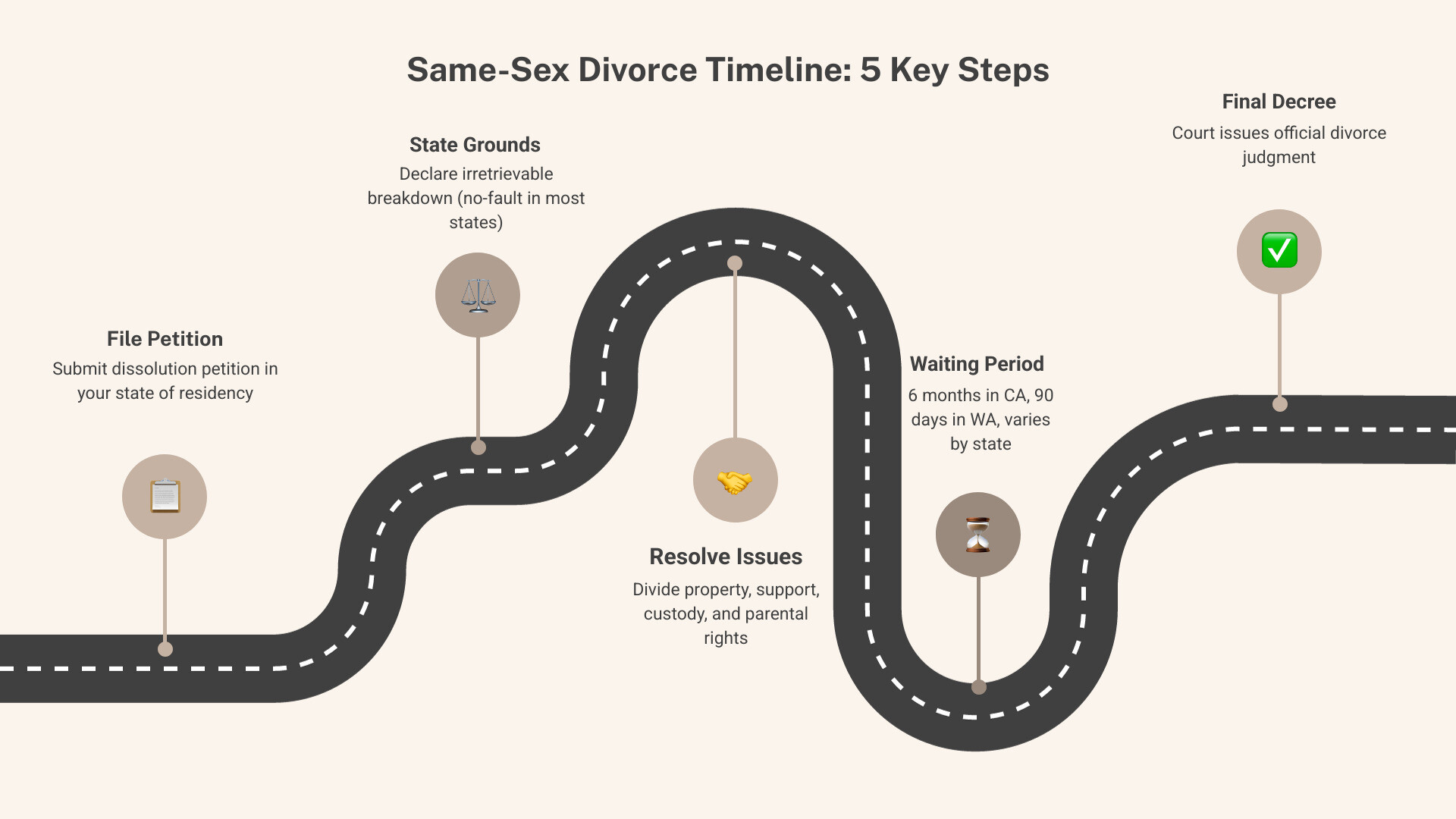
- File a petition for dissolution of marriage in the state where you meet residency requirements
- State irretrievable breakdown (or irreconcilable differences) as grounds — no fault required in most states
- Resolve key issues — property division, spousal support, child custody, and parental rights
- Wait out mandatory periods (e.g., 6 months in California, 90 days in Washington)
- Receive your final divorce decree
The process sounds straightforward. But for many same-sex couples, the details get complicated fast.
Why? Because many couples lived together, bought homes, raised children, and built lives long before marriage equality became the law of the land in 2015. That history doesn’t always fit neatly into standard divorce law — especially when it comes to property division, spousal support calculations, and parental rights for non-biological parents.
These aren’t small issues. They can determine where your kids live, how much support you receive, and whether you walk away with a fair share of what you built together.
At Pinkham & Associates, APLC, we help Southern California families navigate exactly these kinds of challenges — with experienced, compassionate guidance tailored to your situation. We offer a free consultation to help you understand where you stand.
The Legal Landscape of Divorce for Same Sex Couples

In April 2026, the legal framework for divorce for same sex couples is more robust than ever, yet it still carries the weight of history. Since the landmark ruling in Obergefell v. Hodges, every state in the U.S. is required to issue marriage licenses to same-sex couples and recognize those marriages for all purposes, including divorce.
In California, we operate under a “no-fault” system. This means the court doesn’t need to hear about who did what to whom. You simply state that the marriage has suffered an “irretrievable breakdown” or “irreconcilable differences.” While this simplifies the “why” of the divorce, the “how” remains technical.
Residency requirements are the first hurdle. To file for divorce in Orange County, California, at least one spouse must have lived in the state for six months and in the county for three months. If you were married in California but now live in a jurisdiction that doesn’t recognize your marriage (though this is increasingly rare post-2015), California law allows you to file for divorce here even if you no longer reside in the state.
Regardless of where you are, understanding the Legal Services – Divorce available to you is the first step toward a new chapter.
Landmark Cases and Legal Evolution
The road to 2026 was paved by courageous couples and significant court battles. While Obergefell v. Hodges (2015) is the most famous, other cases like Kerrigan v. Commissioner in Connecticut helped set the stage for state-level equality.
These cases weren’t just about wedding bells; they were about the Due Process and Equal Protection Clauses of the Fourteenth Amendment. They ensured that federal recognition follows the couple, impacting everything from taxes to Social Security benefits. More recently, cases like Pavan v. Smith have reinforced that same-sex parents must be treated the same as opposite-sex parents on birth certificates, which is a massive win for parental rights during a divorce.
Dissolving Prior Civil Unions and Domestic Partnerships
Before 2015, many couples in Irvine, CA, and across the state entered into Registered Domestic Partnerships (RDPs) or civil unions. When marriage became legal, some states automatically converted these into marriages, while others required a separate ceremony.
This creates a “double-decker” legal situation. If you have both an RDP and a marriage, you generally need to dissolve both. In California, you can usually do this in a single legal proceeding. This is vital because the date your RDP began often serves as the “start date” for community property and spousal support calculations, even if you didn’t marry until years later. Understanding the nuance of Legal Separation vs Divorce in Orange County Explained can help you decide which path fits your specific history.
Unique Challenges in Property Division and Spousal Support
When it comes to money, divorce for same sex couples can get tricky. California is a community property state, meaning anything acquired during the marriage is split 50/50. But what happens if you were together for 20 years and only married for 10?
The law generally looks at the date of the legal marriage. However, if you were in a Registered Domestic Partnership before the marriage, that time counts. If you weren’t in an RDP but cohabitated and shared finances, you might need to look into “Marvin claims”—which are essentially non-marital contract claims for property division based on an implied or express agreement to share assets.
These specific hurdles require careful legal analysis to ensure that your contributions to the partnership are recognized and protected under California law.
Calculating Marriage Length for Alimony
Spousal support (alimony) is often tied to the length of the marriage. In California, a marriage of 10 years or more is considered “long duration,” which gives the court more flexibility to order support for a longer period.
For same-sex couples who were denied the right to marry for decades, a “5-year marriage” might actually be a 25-year partnership. An experienced Same-Sex Divorce Attorney can argue that the court should consider the entire length of the relationship, especially if there was a registered partnership or a clear financial interdependence established long ago.
Asset Division and Pre-Marriage Assets
Commingling is the enemy of a clean divorce. If you used your “separate” savings from before the marriage to pay the mortgage on your “community” home, you might be entitled to a reimbursement.
Retirement accounts like 401(k)s and pensions are also community property for the portion earned during the marriage. Dividing these requires a Qualified Domestic Relations Order (QDRO). Because federal law (ERISA) governs many retirement plans, same-sex couples now enjoy the same rights to these assets as any other couple. To get started on the paperwork, check out the California Divorce Forms Complete Guide.
Child Custody and Parental Rights in Same-Sex Divorce
Nothing is more sensitive than the kids. In any divorce for same sex couples, the court’s north star is the “best interests of the child.” However, same-sex families often have one biological parent and one non-biological parent, which can lead to “landmines” if parental rights weren’t properly established early on.
While the law is catching up, non-biological parents should never assume their rights are automatic, as legal protections can vary significantly depending on the jurisdiction.
Establishing Parentage for Non-Biological Parents
The simplest way to protect your relationship with your child is to ensure both spouses are legal parents before the divorce starts. This can be done through:
- Second-parent adoption: The gold standard for legal security.
- Voluntary Declaration of Parentage (VDOP): A form signed at the hospital or later that establishes legal parentage.
- Judgment of Parentage: A court order confirming you are the legal parent.
If you haven’t done these, you may have to rely on the “de facto parent” doctrine, proving you have acted as a parent and have a deep bond with the child. This is much harder to prove in court, which is why Legal Services – Document Filing is so important during the marriage.
Child Support Obligations in a Divorce for Same Sex Couples
If you are a legal parent, you have a financial responsibility to support your child. California uses the “income shares” model, which calculates support based on both parents’ incomes and the amount of time the child spends with each parent.
Even if you aren’t the biological parent, if you have established legal parentage, you are entitled to seek custody and are obligated to pay support. For more on the paperwork involved, see Everything You Need to Know About Divorce Forms and Final Decrees.
Understanding Divorce Rates and Social Dynamics
There are many myths about same-sex divorce. Some claim lesbian couples have astronomical divorce rates, while others say same-sex marriages are more stable. The truth, according to 2026 data, is more nuanced.
Emotional Challenges and Minority Stress
Same-sex couples often face “minority stress”—the chronic stress faced by members of stigmatized groups. This can manifest as lack of family acceptance or social stigma, which adds an extra layer of pressure to a marriage. When a divorce for same sex couples occurs, these couples may also lose part of their support network if they relied heavily on a specific LGBTQ+ community that “takes sides.”
Factors Influencing Marriage Stability
Research shows several interesting trends:
- Gender Dynamics: Studies in Europe (Sweden, Norway, Denmark) have historically shown that female couples may have a higher risk of divorce than male or opposite-sex couples, possibly due to higher expectations of relationship quality or unobserved minority stress.
- Income: Like all couples, higher income for the primary breadwinner tends to stabilize the marriage. Interestingly, income equality often stabilizes male same-sex marriages more than others.
- Religion: Religious dissimilarity can be a bigger destabilizer for male same-sex couples than for female or heterosexual ones.
For those interested in the deep data, the Scientific research on same-sex marriage stability provides a global perspective.
Divorce doesn’t have to be a war. In fact, for many LGBTQ+ couples, mediation is a preferred route. Because some judges may still lack experience with the nuances of same-sex family structures, staying out of the courtroom and using a mediator can lead to more creative and fair solutions.
Mediation allows you to discuss things like “pre-marriage cohabitation” in a way a strict judge might not. You can find more tips in our guide on Tips for a Low-Conflict Divorce in California.
Choosing the Right Legal Strategy
Is your divorce contested or uncontested?
- Uncontested: You both agree on everything. This is faster, cheaper, and involves less paperwork.
- Contested: You disagree on at least one major issue (kids, money, the dog). This requires a more robust legal strategy.
Deciding Uncontested vs Contested Divorce: Which is Right for You? is a major crossroads. Even if you agree on most things, you might still wonder, Do I Need a Lawyer for an Uncontested Divorce? Usually, having a professional review the final agreement is a smart move to prevent future headaches.
Protecting Your Future Post-Divorce
Once the papers are signed, your work isn’t quite done. You need to:
- Update your Estate Plan: You probably don’t want your ex-spouse making medical decisions for you.
- Health Insurance: If you were on your spouse’s plan, you’ll need to look into COBRA or a new policy.
- Name Changes: If you changed your name when you married, the divorce decree is your golden ticket to changing it back.
Before you make any big moves, like moving out of the county, consider Should You Move First to File for a Divorce in California? to ensure you don’t mess up your residency status.
Frequently Asked Questions about Same-Sex Divorce
Do same-sex couples have higher divorce rates than opposite-sex couples?
Recent U.S. data suggests that same-sex divorce rates are roughly 2% annually, which is on par with opposite-sex couples. While some international studies showed higher rates for female couples, many experts believe this gap is closing as social acceptance grows and “minority stress” decreases.
Can I get a divorce in a state where I don’t live if I was married there?
Generally, you must meet the residency requirements of the state where you file (usually 6 months). However, California has a special provision: if you were married here and now live in a state or country that refuses to grant you a divorce because they don’t recognize same-sex marriage, you can file in the California county where you were married.
How is property divided if we lived together for 20 years but were only married for 10?
In California, the court officially divides “community property” acquired during the 10-year marriage. However, time spent in a Registered Domestic Partnership (RDP) is usually added to that 10-year total. For the other 10 years of cohabitation, you might need to file a “Marvin Claim” to argue that you had an agreement to share assets, or use equitable doctrines like “constructive trust” to ensure a fair split.
Conclusion
Divorce for same sex couples in 2026 is legally identical to any other divorce, yet the historical context of the LGBTQ+ community creates unique challenges that require a specialized touch. Whether you are dealing with the complexities of a 20-year relationship that only became a “legal marriage” recently, or you are fighting to protect your parental rights as a non-biological parent, you don’t have to navigate this alone.
At Pinkham & Associates, APLC, we bring over 25 years of exclusive focus on family law to the table. We provide personalized strategies and fearless advocacy for our clients in Irvine, Newport Beach, Costa Mesa, and throughout Orange County. We understand that your family is unique, and your legal strategy should be, too.
If you’re ready to take the next step toward clarity and security, contact a Same-Sex Divorce Attorney at our firm today. We offer free consultations to help you understand your rights and build a plan for your future.