



Understanding the True Costs of Ending Your Marriage
If you’re considering ending your marriage in California, summary dissolution california fee is one of the first practical questions you’ll need answered. Here’s what you need to know:
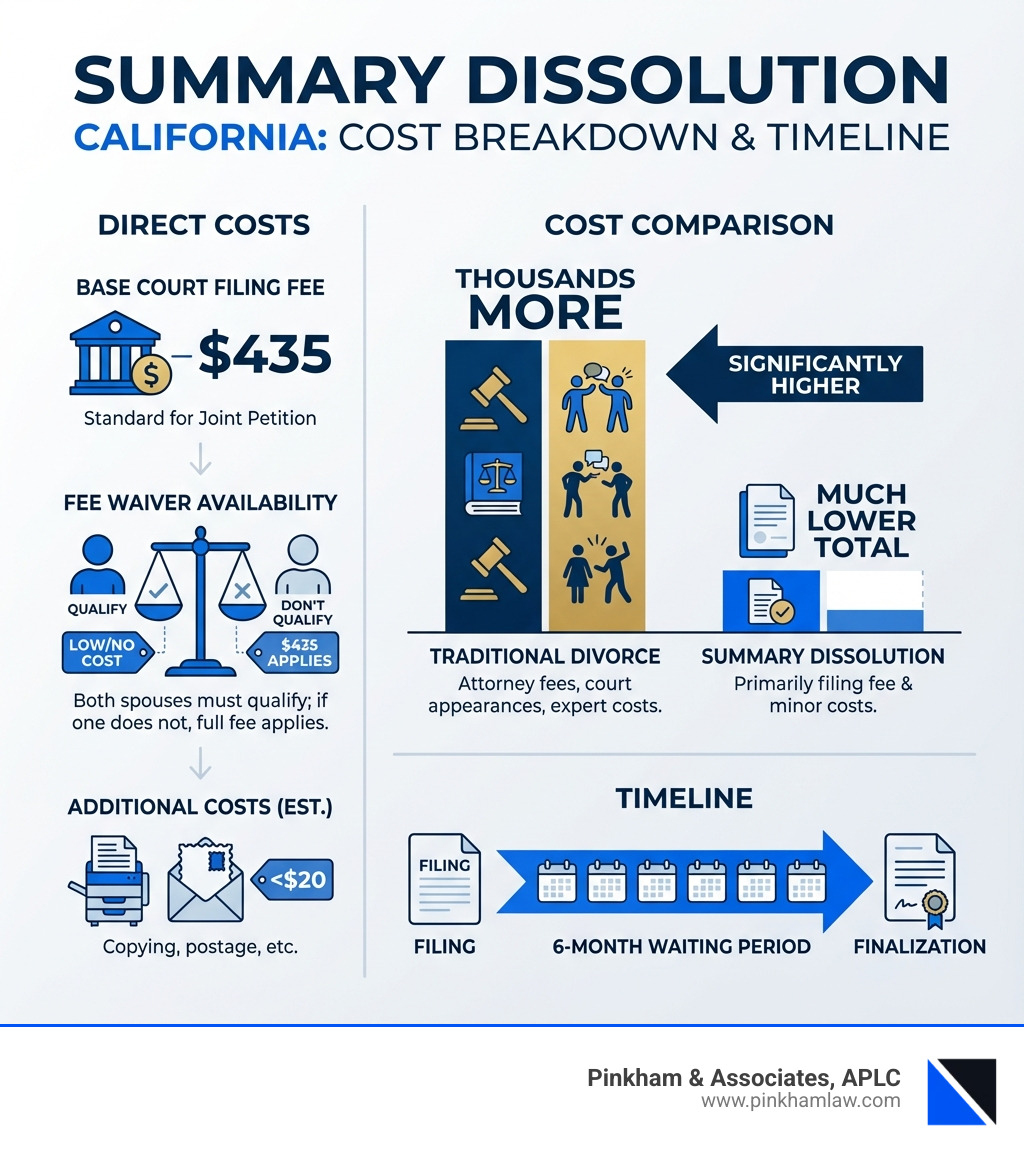
The base court filing fee for a summary dissolution in California is $435. This is the standard cost to file a Joint Petition for Summary Dissolution with the Superior Court. However, this isn’t necessarily the final amount you’ll pay:
- Fee waivers are available if you receive public benefits, your income falls below certain levels, or you cannot afford the fee while meeting basic needs
- Both spouses must qualify for the fee waiver – if only one person qualifies, the other must pay the full $435
- Additional costs may include copying fees ($0.50 per page), postage for self-addressed stamped envelopes, and optional services like form review by a family law facilitator
- Total costs are significantly lower than traditional divorce, which can involve thousands in attorney fees, court appearances, and expert witnesses
The thought of filing for divorce can feel overwhelming, especially when you’re trying to understand the financial commitment involved. Many couples who meet the strict eligibility requirements for summary dissolution find it’s the most straightforward and affordable way to legally end their marriage.
I’m Douglas Pinkham, and over my career, I’ve helped finalize over 300 family law cases, many involving couples navigating the summary dissolution california fee and eligibility requirements to find the most cost-effective path forward. My experience has shown that understanding your options from the start can save both money and emotional stress during an already difficult transition.
The Primary Cost: The Court Filing Fee
When considering a summary dissolution in California, the most significant and often unavoidable cost is the court filing fee. This fee is a standard charge by the California Superior Courts to process your legal documents and initiate your case.
What is the exact filing fee for a summary dissolution in California?
For most individuals seeking a summary dissolution in California, the initial filing fee for a Joint Petition for Summary Dissolution is $435. This is considered the “first paper” filing fee for dissolution of marriage or domestic partnership. Our local courts in Orange County, including those serving Placentia, Newport Beach, Yorba Linda, Irvine, and Tustin, adhere to this statewide fee.
This fee is set by the Statewide Civil Fee Schedule, which is updated periodically. For example, the schedule effective January 1, 2024, confirms this amount. While some counties like Riverside, San Bernardino, and San Francisco might have slight variations due to local surcharges for courthouse construction, the $435 fee is generally consistent across California for initiating a dissolution case. You can always refer to the official fee schedule for California courts for the most current information.
This fee contributes to the operation and maintenance of the court system, ensuring that your paperwork is processed and your case can move forward. It’s important to be prepared to pay this fee at the time you submit your Joint Petition for Summary Dissolution.
Can the summary dissolution california fee be waived?
Absolutely. We understand that the cost of court fees can be a barrier for many individuals, and the California court system has provisions in place to ensure that financial hardship does not prevent access to justice. If you cannot afford the summary dissolution california fee, you may be eligible for a fee waiver.
To apply for a fee waiver, you will need to complete a form called Request to Waive Court Fees (Form FW-001). This form asks for information about your income, expenses, and whether you receive public benefits. You might qualify for a fee waiver if:
- You receive public benefits (such as Medi-Cal, Food Stamps, SSI, etc.).
- Your gross monthly household income is below a certain threshold (usually 125% of the federal poverty guidelines).
- You cannot afford to pay the court fees and still meet your household’s basic needs (food, housing, utilities, etc.).
You would submit this form to the court clerk along with your other summary dissolution paperwork. The court will then review your application and inform you whether your fee waiver has been granted. If approved, you won’t have to pay the $435 filing fee.
What happens if one spouse qualifies for a fee waiver but the other does not?
This is a common question, and the court’s policy is quite clear: if you are filing a Joint Petition for Summary Dissolution, and only one spouse qualifies for a fee waiver, the other spouse will be responsible for paying the full summary dissolution california fee. There is no option for a partial fee waiver in this scenario.
The court treats the filing as a joint action, and thus, the fee is a joint responsibility. If one party can afford the fee, even if the other cannot, the court expects the fee to be paid. This policy ensures that the court’s operational costs are covered while still providing relief to those facing genuine financial hardship.
This means that before you file, it’s a good idea for both parties to assess their financial situation and determine if either or both might qualify for a fee waiver. If one spouse clearly does not qualify, they should be prepared to cover the entire $435 filing fee. You can find more details on this on the California Courts website regarding fee waivers.
Are There Other Costs Associated with a Summary Dissolution?
While the $435 filing fee is the main court cost, it’s wise to budget for a few other potential expenses. Summary dissolution is designed to be a streamlined, low-cost process, but some minor costs might arise.

Additional Court Costs and Potential Expenses
Beyond the initial summary dissolution california fee, here are some other costs you might encounter:
- Copying Fees: When you file your documents with the court, you’ll need to provide the original forms plus at least two copies (one for each spouse). If you don’t have access to a copier or prefer the court to make the copies for you, they typically charge $0.50 per page. This can add a few dollars to your total, depending on the length of your forms.
- Postage: The court will return stamped copies of your filed documents and the final judgment to you and your spouse by mail. To facilitate this, you’ll need to provide two self-addressed, stamped envelopes to the clerk at the time of filing. Ensure these have sufficient postage for legal documents.
- Notary Fees: While many forms for summary dissolution do not require notarization, some documents, particularly property agreements or specific declarations, might. Notary fees can vary but are usually around $15 per signature.
- Form Review: The California courts offer free resources to help you ensure your forms are filled out correctly. Your local court’s family law facilitator or self-help center can review your paperwork before you file it. While this service is free, it’s an invaluable step that can prevent delays or rejections due to errors.
- Registered Domestic Partner Dissolution (Secretary of State): For registered domestic partners who meet the summary dissolution criteria, there is a separate process through the California Secretary of State. The good news here is that there is no fee to dissolve a domestic partnership through this route, unlike the court-based process for married couples.
These additional costs are generally minimal, especially when compared to the expenses associated with a traditional divorce.
How does the total cost compare to a traditional divorce?
The financial difference between a summary dissolution and a traditional divorce is substantial. This is one of the primary reasons couples who qualify for summary dissolution choose this path.
- Cost Savings: The total cost for a summary dissolution, including the summary dissolution california fee and any minor additional expenses, is typically limited to a few hundred dollars. This is a fraction of what a traditional divorce can cost.
- Attorney Fees: In a traditional divorce, attorney fees are often the largest expense. Even an uncontested traditional divorce can involve several hours of attorney time for drafting documents, negotiations, and court filings. Contested divorces, where spouses disagree on issues like property division, child custody, or spousal support, can escalate quickly, leading to thousands, or even tens of thousands, of dollars in legal fees. While we always recommend consulting with an attorney even for summary dissolution, the amount of legal work required is significantly less than a traditional divorce.
- Contested vs. Uncontested: Summary dissolution is inherently an uncontested process; both parties must agree on all terms. Traditional divorces can be either uncontested or contested. An uncontested traditional divorce will still be more expensive than a summary dissolution due to the more extensive paperwork and process, but much less than a contested one.
- Court Appearances: A major advantage of summary dissolution is that it typically does not require court appearances. In contrast, traditional divorces, especially contested ones, often involve multiple court hearings, status conferences, and potentially a trial, each adding to legal costs.
- Financial Experts: In complex traditional divorces, couples may need to hire financial experts, forensic accountants, or property appraisers to value assets, uncover hidden assets, or analyze business interests. These experts charge hourly rates that can quickly increase the overall cost. For summary dissolution, the limited assets and debts make such experts unnecessary.
Our experience at Pinkham & Associates, APLC, helping clients in Orange County, Placentia, Newport Beach, Yorba Linda, Irvine, and Tustin, shows that choosing summary dissolution when eligible can save our clients a significant amount of money and reduce financial stress. We can guide you through the process efficiently, ensuring you meet all requirements without incurring unnecessary expenses.
Understanding the Summary Dissolution California Fee and Process
Summary dissolution is a specific legal pathway designed to make ending a marriage or domestic partnership simpler and more affordable for couples who meet very strict criteria. It’s crucial to understand these requirements and the procedural steps involved.
Who Is Eligible for This Simplified Process?
Not everyone qualifies for a summary dissolution. The eligibility requirements are stringent because the process bypasses many of the steps involved in a traditional divorce, such as court hearings and extensive financial disclosures. Both spouses must meet all of the following conditions:
- Marriage/Partnership Duration: You must have been married or registered as domestic partners for five years or less from the date of marriage/registration to the date of separation.
- No Children: You must not have any minor children together (born or adopted) and neither party can be pregnant.
- No Real Estate: You must not own any real estate or lease property (other than a residence) together. This means no homes, land, or other real property.
- Limited Assets: The total value of your community property (assets acquired during the marriage, excluding cars) must be less than $57,000. Additionally, neither spouse can have separate property (assets owned before marriage or acquired by gift/inheritance during marriage, excluding cars) worth more than $57,000.
- Limited Debts: The total amount of community obligations (debts acquired during the marriage, excluding car loans) must be $7,000 or less.
- Mutual Agreement: Both spouses must agree on how to divide all community property and community obligations, and neither party can be seeking spousal support.
- Residency Requirements: At least one spouse must have lived in California for the past six months and in the county where you file (e.g., Orange County) for the past three months.
- Read the Booklet: Both spouses must read and understand the court’s booklet explaining summary dissolution and declare under penalty of perjury that they have done so.
- Agree to Waive Rights: Both parties must agree to waive their rights to appeal or request a new trial.
If you don’t meet every single one of these requirements, you will not be eligible for summary dissolution and will need to pursue a traditional divorce.
Filing Process for Married Couples vs. Domestic Partners
The filing process for summary dissolution differs slightly depending on whether you are a married couple or registered domestic partners.
- For Married Couples:
- You will file a Joint Petition for Summary Dissolution (Form FL-800) with the Superior Court in the county where one of you meets the residency requirements (e.g., Orange County).
- This petition, along with other required forms like the Judgment of Dissolution and Notice of Entry of Judgment (FL-825), property agreements, and financial disclosures, will be submitted to the court clerk.
- You will pay the summary dissolution california fee of $435 at the time of filing, unless a fee waiver is granted.
- The court clerk will process your forms, and after a mandatory six-month waiting period, your divorce will become final.
- For Registered Domestic Partners:
- If you meet the eligibility requirements for summary dissolution, you can terminate your domestic partnership through the California Secretary of State.
- This involves filling out a Notice of Termination of Domestic Partnership form.
- A significant advantage for domestic partners using this method is that there is no filing fee with the Secretary of State.
- The process generally requires both partners to sign the notice, often with notarized signatures, and mail it to the Secretary of State.
- You can find more information about terminating a California Registered Domestic Partnership on the Secretary of State’s website.
- If you are both married and registered domestic partners, you typically follow the married couple’s process through the court.
Regardless of your status, we encourage you to use your local court’s self-help center or family law facilitator to review your forms before filing. This can prevent common errors and ensure a smoother process.
Is the Filing Fee Refundable if We Reconcile?
Unfortunately, the summary dissolution california fee is generally non-refundable. Once you pay the $435 filing fee and submit your documents to the court, that money has been used to initiate your case and cover administrative costs. If you decide to reconcile and stop the dissolution process, you will not get your filing fee back.
However, if you do reconcile or simply change your mind, you can revoke the petition for summary dissolution. California law includes a mandatory six-month waiting period from the date you file your Joint Petition for Summary Dissolution until your divorce becomes final. During this six-month period, either spouse can file a Notice of Revocation of Petition for Summary Dissolution (Form FL-830).
If a Notice of Revocation is filed, the summary dissolution process immediately stops. Your marriage or domestic partnership will not be dissolved through this process. If you still wish to pursue a dissolution later, you would need to start a new case, which would likely involve paying a new filing fee.
Frequently Asked Questions about Summary Dissolution Costs
Navigating the legal system can bring up many questions, especially concerning costs and procedures. Here are some common questions we encounter regarding summary dissolution fees and the overall process.
What is the purpose of the court filing fee?
The court filing fee, including the summary dissolution california fee, serves several important purposes within the judicial system:
- Funding Court Operations: These fees are a primary source of funding for the daily operations of the California Superior Courts. This includes everything from maintaining court facilities in Orange County to paying court staff, judges, and clerks.
- Access to Justice: While fees can be a barrier, fee waiver programs are in place to ensure that financial status does not completely prevent individuals from accessing the courts. The fees collected help support the overall system that provides this access.
- Administrative Costs: Processing legal paperwork, maintaining case files, and providing necessary administrative support all incur costs. The filing fee helps cover these essential administrative functions.
- Processing Paperwork: Each filing requires time and resources from court personnel to review, docket, and manage. The fee helps compensate for this labor.
- Maintaining the Court System: These fees contribute to the broader goal of maintaining a functioning and accessible court system that can handle a wide array of legal matters, from family law to criminal cases.
How long does a summary dissolution take to become final?
One of the key aspects of summary dissolution in California is the mandatory six-month waiting period. Your divorce or domestic partnership dissolution will become final six months and one day from the date you file your Joint Petition for Summary Dissolution with the court.
For example, if you file your paperwork on January 1st, your dissolution cannot be final until July 2nd. This waiting period is a legal requirement in California, designed to give couples time to reconsider their decision. No matter how quickly your paperwork is processed or how amicable you are, the court cannot finalize your dissolution before this period has elapsed.
You are still legally married or partnered during this six-month period. You cannot remarry or enter into a new domestic partnership until the judge has signed your final Judgment of Dissolution and the six-month period has passed. The date your dissolution becomes final will be indicated on the judge-signed Judgment of Dissolution.
Do I need a lawyer for a summary dissolution?
The summary dissolution process is specifically designed to be a self-help option, meaning you are not legally required to hire a lawyer. Many couples successfully complete the process on their own, especially with the help of court self-help centers and family law facilitators.
However, we believe it is always wise to consult with an attorney, even if you qualify for summary dissolution. Here’s why:
- Ensuring Eligibility: An attorney can thoroughly review your situation to confirm you meet all the strict eligibility requirements. Missing even one detail could lead to your petition being rejected.
- Complex Assets/Debts: While summary dissolution is for couples with limited assets and debts, valuing these items can sometimes be tricky. What if you have a small business, intellectual property, or unique collectibles? We can help you accurately assess the fair market value of your property and ensure your agreement is legally sound.
- Protecting Your Rights: Even in an amicable split, it’s crucial to understand your legal rights and responsibilities. We can ensure that your property agreement is fair and that you are not inadvertently waiving rights that could be important to your future.
- Avoiding Future Problems: A poorly drafted property agreement, even in a summary dissolution, can lead to disputes down the road. We can help you create a clear, comprehensive agreement that minimizes the chances of future conflict.
- Peace of Mind: For many, the legal process is intimidating. Having an experienced family law attorney from Pinkham & Associates, APLC, guide you through the paperwork and answer your questions can provide invaluable peace of mind during an already stressful time. We have over 25 years of specialized experience in Orange County family law and can help you steer the process with confidence.
While you don’t need a lawyer, seeking guidance from us can help ensure the process is handled correctly and efficiently, protecting your interests every step of the way.
Get Clarity on Your Orange County Divorce Options
Ending a marriage is a significant life event, and understanding your options is the first step toward a smoother transition. Whether you’re exploring the simplicity of a summary dissolution or facing the complexities of a traditional divorce, having clear, accurate information is paramount.
Let Us Help You Understand Your Path Forward
At Pinkham & Associates, APLC, we are a dedicated Divorce and Family Law firm in Orange County, California. With over 25 years of specialized experience, we offer fearless advocacy and personalized legal strategies to clients in Placentia, Newport Beach, Yorba Linda, Irvine, Tustin, and throughout Orange County. We are often trusted by other lawyers for complex cases, but we also pride ourselves on helping individuals steer straightforward processes like summary dissolution.
We can help you:
- Assess Summary Dissolution Suitability: We’ll carefully review your circumstances to determine if you meet all the strict eligibility requirements for a summary dissolution. We’ll clarify any ambiguities regarding your assets, debts, and other criteria, ensuring that pursuing this path is truly the right fit for your situation.
- Steer the Traditional Divorce Process: If summary dissolution isn’t an option, we can explain the traditional divorce process, outlining the steps, potential timelines, and costs involved. We’ll help you prepare for what to expect, whether your divorce is uncontested or likely to be contested.
- Provide Legal Guidance: Our team is here to answer your questions about the summary dissolution california fee, fee waivers, property division, spousal support, and any other legal concerns you may have. We’ll ensure you understand your rights and responsibilities throughout the process.
- Protect Your Rights: Even in an amicable summary dissolution, protect your long-term interests. We can review your property settlement agreement and other documents to ensure they are fair, legally sound, and minimize the potential for future disputes.
Making informed decisions during a divorce is crucial for your financial and emotional well-being. We are committed to providing you with the clarity and support you need to choose the best path forward.
If you’re in Orange County and considering a summary dissolution or any other divorce option, don’t hesitate to contact us for a consultation. We are here to provide the expert guidance and personalized attention you deserve. You can also explore our Divorce services to learn more about how we can assist you.