


What You Need to Know About California Divorce Forms
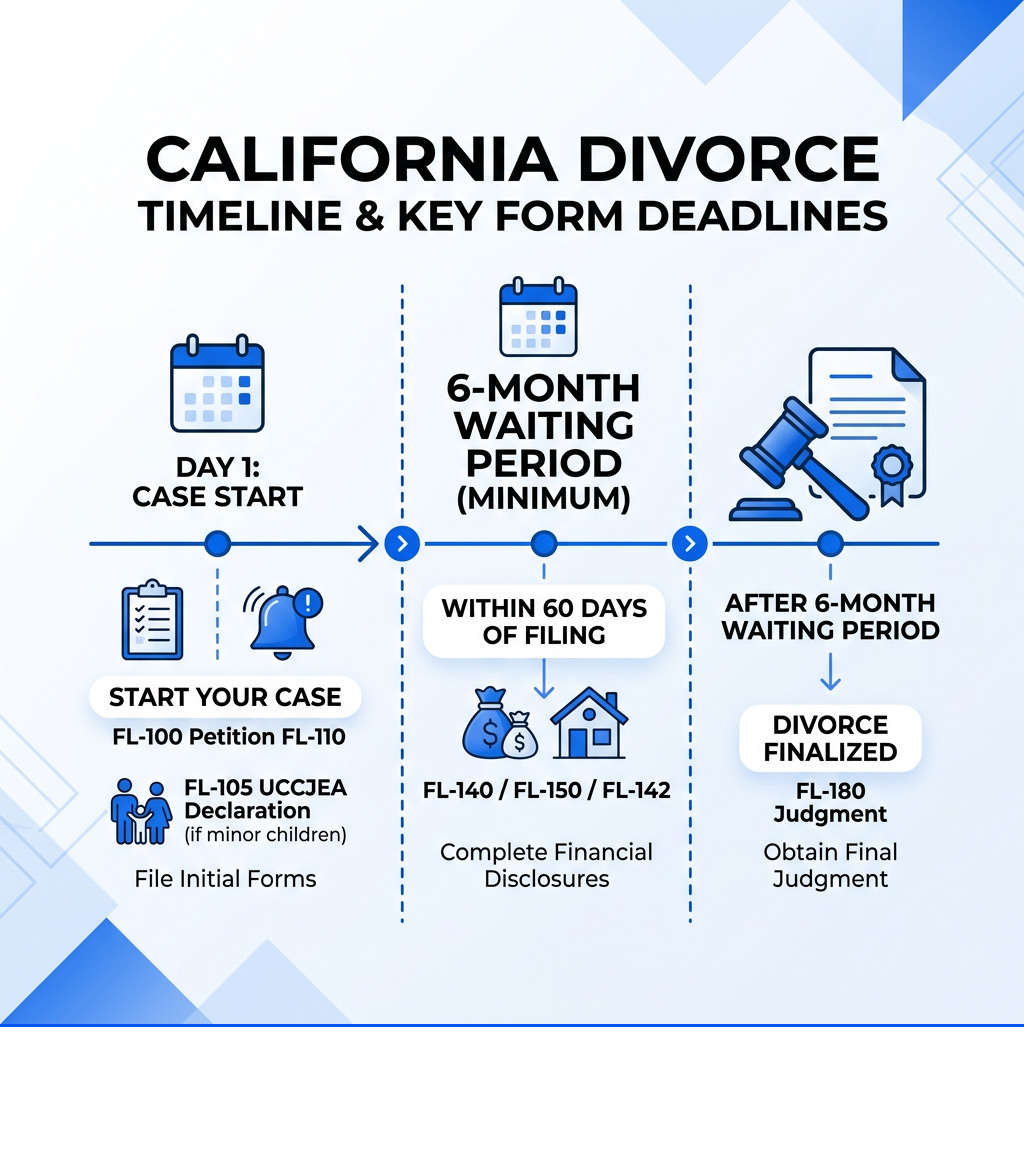
California divorce forms are the official Judicial Council documents required to legally end a marriage or domestic partnership in the state. If you need a quick overview, here are the core forms and key deadlines:
Essential California Divorce Forms at a Glance:
| Form | Purpose | Deadline |
|---|---|---|
| FL-100 | Petition — starts the case | Day 1 |
| FL-110 | Summons — notifies your spouse | Day 1 |
| FL-105 | UCCJEA Declaration — required if minor children | Day 1 |
| FL-115 | Proof of Service — confirms spouse was served | After service |
| FL-140 / FL-150 / FL-142 | Financial disclosures | Within 60 days of filing |
| FL-180 | Judgment — finalizes the divorce | After 6-month waiting period |
The minimum time to finalize a California divorce is six months and one day from the date your spouse was served, filed a response, or filed an Appearance (FL-130) — whichever comes first.
Filing fees run $435 to $450, though fee waivers are available if you can’t afford them.
Divorce is never easy — and when children, shared assets, or conflict are involved, the paperwork can feel like the last thing you want to deal with. But understanding which forms to file, in what order, and by what deadline is critical to protecting your rights.
California uses a structured, form-driven process for divorce. Miss a deadline or file the wrong document, and your case can stall — or worse, result in orders that don’t reflect what you actually want.
This guide walks you through every major form you’ll encounter, from opening your case to receiving your final judgment. Whether your divorce is straightforward or complex, knowing the paperwork is the first step.
At Pinkham & Associates, APLC, we offer free consultations to help you understand where you stand and what forms apply to your specific situation.
Starting Your Case: Essential California Divorce Forms
When someone decides to end a marriage in California, they don’t just “tell” the court; they have to provide a specific set of data points. This process begins with a few heavy-hitting California Divorce Forms. Before the ink touches the paper, the person filing (the “Petitioner”) must ensure they meet the residency requirements. In California, at least one spouse must have lived in the state for at least six months and in the county where they are filing (such as Orange County) for at least three months.
The very first document required is the FL-100 Petition. This form is essentially a “wish list” for the court. It asks for basic information: names, the date of marriage, the date of separation, and what the Petitioner wants the court to decide regarding child custody, support, and property division. You can access the Official FL-100 Form Download through the state’s judicial website.
Accompanying the Petition is the FL-110 Summons. While the Petition says “here is what I want,” the Summons says “you are being sued for divorce, and here are the rules you must follow now.” The Summons contains standard restraining orders that prevent either spouse from moving children out of state or selling off marital assets without permission once the case starts.
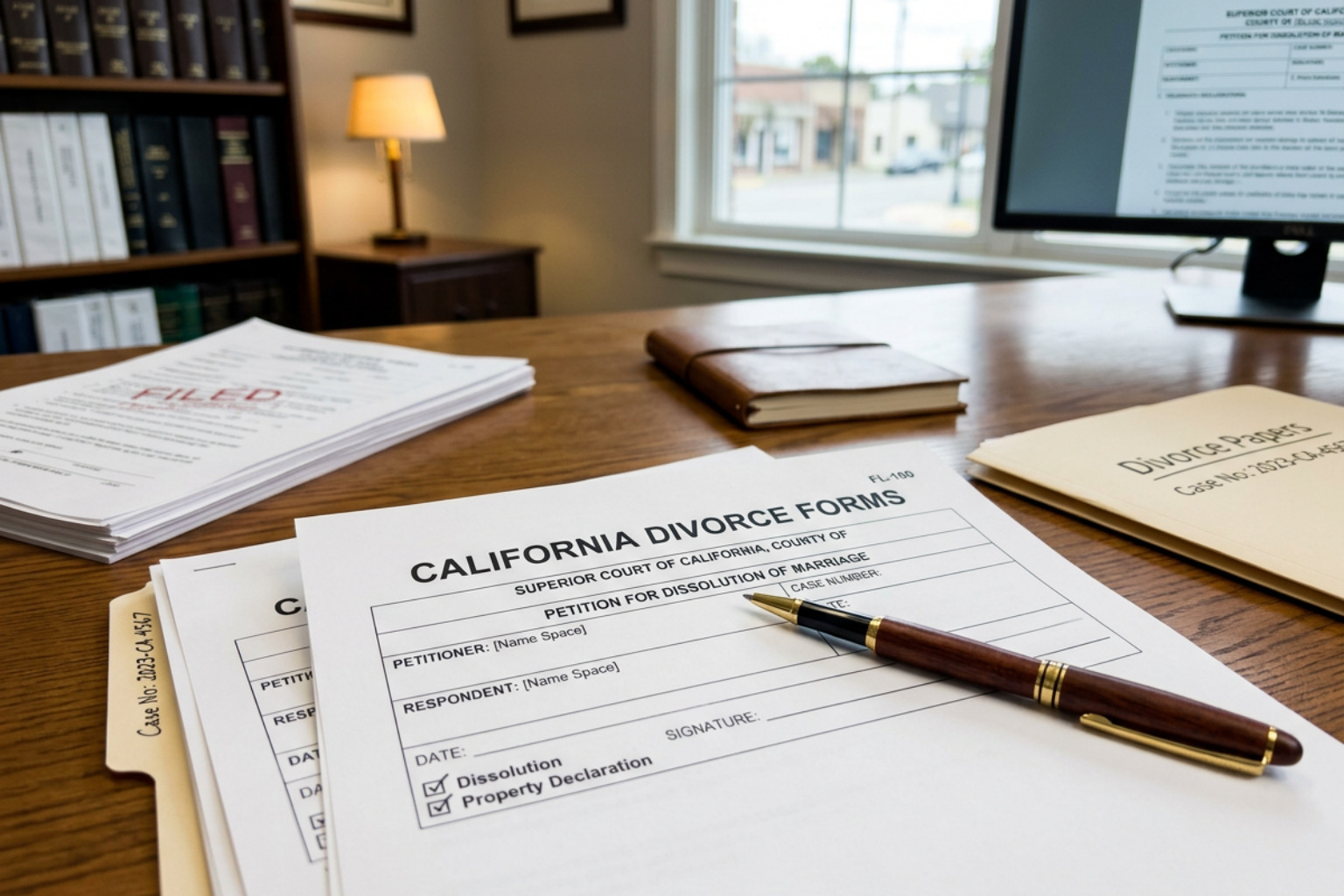
Filing these forms with the court clerk typically costs between $435 and $450. For those facing financial hardship, the court provides fee waiver forms (FW-001 and FW-003) to ensure that the legal system remains accessible to everyone, regardless of their bank balance.
Requirements for Minor Children
If the couple has minor children, the paperwork load increases slightly to protect the children’s interests. The most important additional document is the FL-105 UCCJEA Declaration. UCCJEA stands for the Uniform Child Custody Jurisdiction and Enforcement Act.
This form tells the judge where the children have lived for the last five years. Its purpose is to ensure that California has the legal authority (jurisdiction) to make custody orders. If the children have recently moved from another state, this form helps the court determine which state’s laws should apply. Detailed UCCJEA Information is available to help parents understand why this history is so vital to their custody case.
Serving the Respondent Properly
Once the forms are filed, they must be “served” on the other spouse (the “Respondent”). In California, the Petitioner cannot be the one to hand over the papers. Service must be performed by a third party over the age of 18—this can be a friend, a relative, or a professional process server.
After the papers are delivered, the server must fill out the FL-115 Proof of Service. This is the only way the court knows the Respondent actually received the documents. If the spouse is cooperative, they might sign the FL-117 Notice and Acknowledgment, which confirms receipt via mail and saves the Petitioner the hassle of hiring a professional server. Once served, the Respondent has a 30-day window to file a response. If they miss this window, the Petitioner may be able to finish the divorce through a “default,” essentially moving forward without the other person’s input.
Financial Disclosures and Property Division
California is a community property state, which means the court generally views everything earned or acquired during the marriage as belonging to both spouses equally. To ensure a fair split, the law requires a full and honest exchange of financial information. This is not optional; even if both parties agree on everything, they must still complete their disclosures.
The “Preliminary Declaration of Disclosure” consists of several California Divorce Forms that must be served on the other spouse within 60 days of filing the Petition. This package includes the FL-140 Declaration of Disclosure, which acts as a cover sheet. Crucially, the FL-140 is served on the spouse but is not filed with the court to keep private financial details out of the public record. Instead, the Petitioner files the FL-141 Declaration of Service to prove to the judge that the exchange happened. For a deeper look at these rules, see the Financial Disclosure Requirements.
Mandatory Financial California Divorce Forms
To complete the disclosure process, two specific forms do the heavy lifting:
- FL-150 Income and Expense Declaration: This form requires details on monthly income, taxes, and living expenses. It must be accompanied by pay stubs from the last two months.
- FL-142 Schedule of Assets and Debts: This is a comprehensive list of everything you own and everything you owe. It covers houses, cars, bank accounts, retirement plans, and even credit card debt.
In some cases, parties may use the FL-160 Property Declaration instead of the FL-142. The key is to distinguish between community property (acquired during marriage) and separate property (owned before marriage or received as a gift/inheritance). Pinkham & Associates, APLC often assists clients in Orange County—including Irvine and Newport Beach—in identifying these distinctions to prevent separate assets from being unfairly divided.
Requesting Temporary Orders
Divorces often take months, but bills and childcare needs don’t wait. If a spouse needs immediate help with child support, spousal support, or a custody schedule, they can file an FL-300 Request for Order. This form asks the judge to make temporary decisions that stay in place until the divorce is final.
In true emergencies—such as cases involving domestic violence or a parent threatening to skip the state with the children—one can file for FL-305 Temporary Emergency Orders. These “Ex Parte” orders can sometimes be granted within 24 to 48 hours. For those navigating this for the first time, the Request for Order Information sheet provides a helpful roadmap of the process.
Choosing Between Summary and Standard Dissolution
Not every divorce requires a mountain of paperwork. California offers a “short-cut” known as Summary Dissolution for couples who meet very specific criteria.
| Feature | Summary Dissolution | Standard Dissolution |
|---|---|---|
| Marriage Duration | Less than 5 years | Any length |
| Children | None (and not pregnant) | Any number |
| Real Estate | None (except a lease) | Any owned property |
| Community Assets | Less than $57,000 | No limit |
| Community Debts | Less than $7,000 | No limit |
| Spousal Support | Both waive it forever | Can be requested |
If a couple fits these narrow requirements, they can file a Joint Petition for Summary Dissolution. This process is faster and involves fewer California Divorce Forms, but it requires both spouses to be in total agreement.
Special Rules for Same-Sex California Divorce Forms
California has unique protections for same-sex couples and registered domestic partners. If a couple registered a domestic partnership in California, they can often file for divorce here even if they no longer live in the state, provided no other state has jurisdiction.
However, there is a catch: while California can end the legal relationship, it might not have the power to make orders about property or children if neither person currently lives in California. For same-sex couples married in California but living in a state that doesn’t recognize their marriage, they can often file their paperwork in the California county where they were married. The Legal Steps for Separation guide provides further details on these jurisdictional nuances.
Handling Uncontested and Default Cases
If the Respondent is served but chooses not to file a response within 30 days, the Petitioner can file an FL-165 Request to Enter Default. This essentially asks the court to move forward and grant the divorce based on the Petitioner’s requests.
In an “uncontested” divorce, both parties agree on all terms. They might use the FL-130 Appearance and Stipulations form to show the court they are working together. In these cases, the spouses usually draft a written agreement (a Marital Settlement Agreement) that outlines exactly how they want to handle their assets and children. This agreement is then attached to the final judgment forms.
Finalizing the Judgment and Next Steps
The final stage of the process is turning the “wish list” into a court order. The divorce is not official just because the six-month waiting period has passed; the court must sign a FL-180 Judgment. This is the document that officially restores both parties to the status of “single persons.”
Once the judge signs the Judgment, the court clerk will issue the FL-190 Notice of Entry of Judgment. This is the “receipt” that proves the divorce is done. If a spouse wants to return to their former or maiden name, they must ensure that request is checked on the FL-180. To avoid having the court reject your final papers for a typo or missing attachment, it is wise to use the official Judgment Checklist.
Final California Divorce Forms for Child Support
When children are involved, the final judgment must include specific orders for their support. The court requires the FL-191 Child Support Case Registry, which provides the state with the information needed to track support payments. If support is to be paid through a wage garnishment, the FL-195 Order/Notice to Withhold Income must be completed and sent to the paying spouse’s employer. These forms ensure that support orders are actually enforced and that children receive the financial stability they need.
Frequently Asked Questions about California Divorce Forms
How much are the court filing fees for divorce forms?
The standard filing fee for a Petition or a Response in California is currently between $435 and $450, depending on the county. In Orange County locations like Tustin or Costa Mesa, these fees are standard. If you cannot afford the fee, you can file a Request to Waive Court Fees (Form FW-001).
Can I waive the final financial disclosure exchange?
Yes, but only if you both agree. While the preliminary disclosure is mandatory, couples can skip the final disclosure by filing the FL-144 Stipulation and Waiver. This is common in uncontested cases where both parties feel they already have a full understanding of each other’s finances.
Where can I find free help with my divorce paperwork?
Most California Superior Courts, including the one in Orange County, offer a Family Law Facilitator or a Self-Help Center. These centers provide free information and can help you review your California Divorce Forms to ensure they are filled out correctly. You can find more information through the California Self-Help Centers portal.
Conclusion
Navigating the landscape of California Divorce Forms can feel like learning a second language. From the initial FL-100 Petition to the final FL-180 Judgment, each document serves a specific purpose in ensuring your transition to a new chapter is legally sound. While the forms are standardized, the strategies behind how you fill them out are not.
At Pinkham & Associates, APLC, we bring over 25 years of exclusive focus to family law. Whether you are in Yorba Linda, Placentia, or anywhere in Orange County, our team provides personalized strategies and fearless advocacy to protect your assets and your children. We understand that behind every form is a person looking for a fair resolution and a fresh start.
If you are overwhelmed by the paperwork or simply want to ensure your rights are fully protected, we are here to help. We offer free consultations to discuss your case and help you navigate the complexities of the California court system.
For more information or to begin your journey toward a resolution, visit our page for more info about divorce services.