



What You Need to Know About Alimony in Divorce (Before Anything Else)
Alimony in divorce is a court-ordered payment from one spouse to the other after — or sometimes during — a separation or divorce. Its purpose is simple: to reduce the financial gap when one spouse earns significantly less than the other.
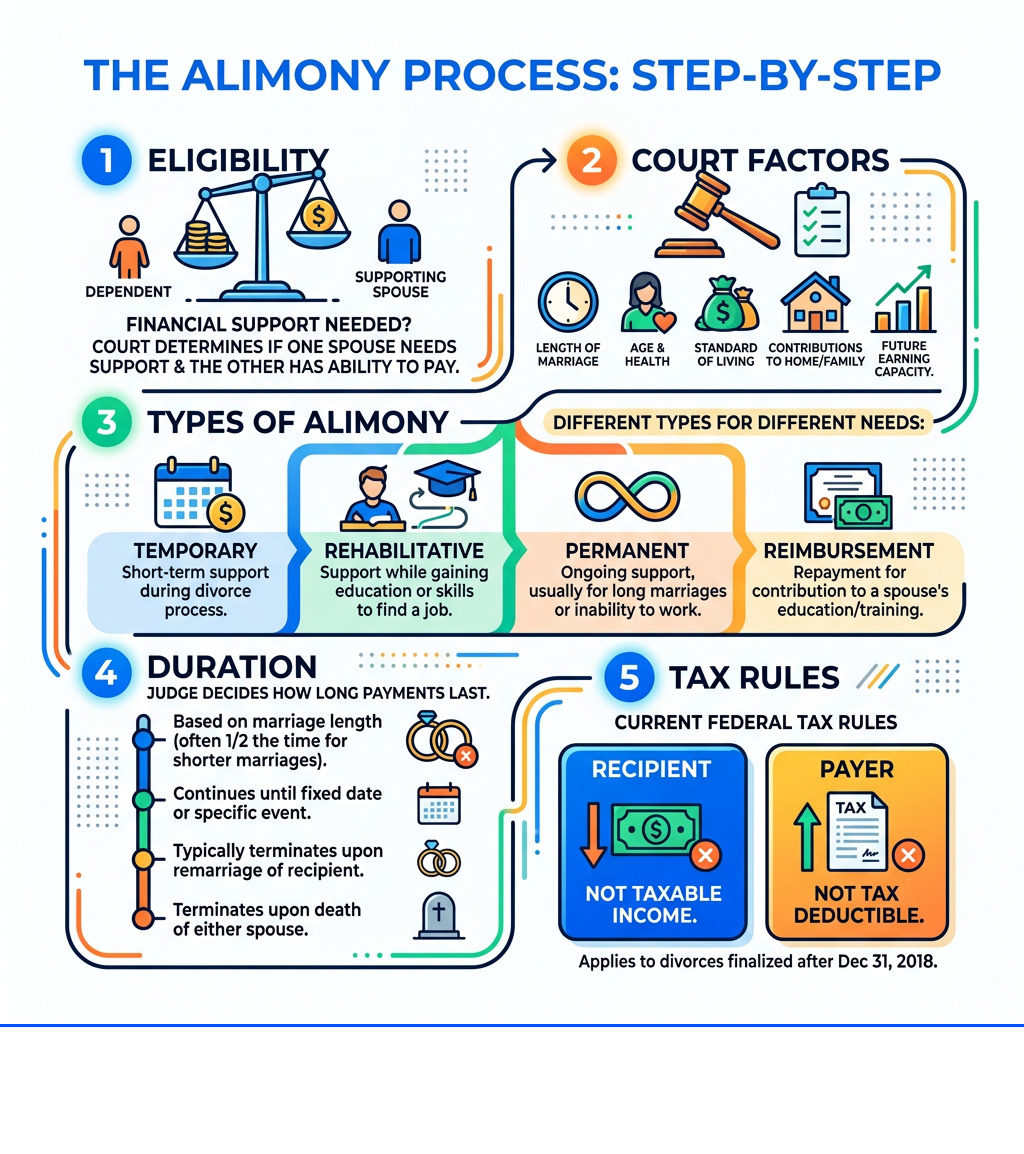
Here’s a quick overview of how it works:
- Who pays it: The higher-earning spouse
- Who receives it: The lower-earning or financially dependent spouse
- Why it’s awarded: To help maintain a reasonable standard of living after the marriage ends
- Is it automatic? No — a judge must decide it’s warranted based on your specific situation
- How long does it last? It depends on the length of your marriage and your state’s laws
- Is it taxable? For divorces finalized after December 31, 2018, alimony is not taxable income for the recipient and not deductible for the payer
Divorce is already one of the most stressful life events you can face. Add a spousal support dispute into the mix, and the financial pressure can feel overwhelming — especially if you’re also dealing with child custody, shared assets, and trying to hold everything together for your kids.
The rules around alimony aren’t always straightforward. Every state handles it differently. Courts use wide discretion. And the outcome can have a major impact on your financial future for years to come.
That’s why understanding the basics before you walk into a courtroom matters.
What is Alimony in Divorce and How Does it Work?

At its core, alimony in divorce—often legally referred to as spousal support or spousal maintenance—is a financial bridge. It is designed to prevent a spouse from falling into financial ruin after a marriage ends, particularly if they sacrificed their own career growth to support the family or the other spouse’s education.
According to legal definitions of alimony, it is a court-ordered requirement for one person to provide financial support to their ex-partner. It is important to note that alimony is not meant to be a “punishment” for the spouse who earns more; rather, it is a tool to ensure both parties can move forward with some level of financial stability.
The process often begins with a request for temporary alimony, also known as pendente lite support. This is support paid while the divorce is still pending in court. Because divorces in places like Orange County can take months or even years to finalize, temporary support ensures the lower-earning spouse can pay rent and buy groceries while the legal details are ironed out.
Different Types of Alimony in Divorce
Not all alimony is created equal. Depending on the length of the marriage and the needs of the spouses, a judge may order one of several types:
- Temporary Support (Pendente Lite): As mentioned, this is paid only while the divorce is in progress.
- Rehabilitative Alimony: This is the most common type. It is intended to give the receiving spouse time to “rehabilitate” their earning power by going back to school or gaining job skills.
- Permanent Alimony: Contrary to the name, “permanent” usually means “long-term.” It is typically reserved for very long marriages where one spouse is unlikely to ever become fully self-supporting due to age or health.
- Reimbursement Alimony: This is awarded if one spouse worked to put the other through professional school (like law or medical school) with the expectation of sharing in the future high income.
- Lump-Sum Alimony: Instead of monthly payments, the payer gives one large payment or a piece of property. This is often non-modifiable once finalized.
Is Alimony Mandatory in Every Case?
Absolutely not. There is no law that says every divorce must include spousal support. In fact, if both spouses earn roughly the same amount of money, it is highly unlikely a judge will order any support at all.
Whether alimony is awarded comes down to judicial discretion. The court looks at two primary “pillars”: the actual financial need of one spouse and the other spouse’s ability to pay. If you are navigating these waters in Southern California, seeking legal services for spousal support is vital to ensure your needs are accurately presented to the court.
Who Qualifies for Spousal Support and How Courts Decide
In California, specifically under the guidelines of Family Code 4320, the court must consider a specific set of factors before making a final order. Qualification isn’t just about who made less money; it’s about the “Marital Standard of Living” (MSOL).
The MSOL serves as a guidepost. The court looks at the lifestyle the couple enjoyed during the last few years of the marriage—the house they lived in, the cars they drove, and their typical spending habits. While it is rarely possible for both people to maintain that exact same lifestyle in two separate households, the court tries to get as close as is “just and equitable.”
To understand how courts decide alimony, you have to look at the “whole person.” A judge will evaluate:
- The age and health of both parties.
- The “earning capacity” of each person (what they could earn based on their skills and the job market).
- Any history of domestic violence.
- The tax consequences to each party.
Factors Influencing the Amount of Alimony in Divorce
The actual dollar amount is rarely a random guess. It is a calculation of spousal maintenance that weighs several heavy factors:
- Income Disparity: A massive gap between a CEO’s salary and a part-time retail worker’s wages will likely result in a higher award.
- Career Sacrifices: If one spouse stayed home for 15 years to raise children, their “marketability” in the workforce has decreased. The court views this as a contribution to the marriage that deserves compensation.
- Domestic Duties: Taking care of the home and children is considered a valuable contribution that allowed the other spouse to focus on their career.
- Child Custody: If the lower-earning spouse has primary custody of the children, their ability to work full-time might be limited, which can influence the support amount.
Gender Neutrality and Same-Sex Divorces
Gone are the days when alimony was only paid by men to women. Today, the law is strictly gender-neutral. If a wife is the high-earner, she may be ordered to pay support to her husband. In fact, many men are now receiving transitional or ongoing alimony as the “stay-at-home” parent role becomes more common among fathers.
Similarly, same-sex divorce considerations follow the exact same rules. The court focuses on the financial roles each partner played during the marriage, regardless of gender or sexual orientation.
Understanding the Duration of Alimony in Divorce
One of the most common questions we hear is: “How long do I have to pay this?” or “How long will I receive this?” The answer almost always depends on the length of the marriage.
In many jurisdictions, including California, a “short-term” marriage is generally one that lasts less than 10 years. For these marriages, the rule of thumb is that support lasts for half the length of the marriage. So, if you were married for six years, you might expect support to last for three.
The 10-Year Rule and Long-Term Marriages
Once a marriage hits the 10-year mark, it is legally considered a “marriage of long duration.” This is a significant threshold. In long-term marriages, the court does not necessarily set a termination date for support. It may continue indefinitely until the recipient remarries, either party dies, or there is a significant “change in circumstances” (like retirement).
While California is known for this 10-year guideline, other states have different benchmarks. For example, in Delaware, the 50% rule applies to any marriage under 20 years, but once you hit 20 years, there is no limit on duration.
State-Specific Duration Limits
State laws on alimony vary wildly, and it’s helpful to see how California compares to other regions:
- Texas: Known for being very strict. Alimony is generally limited to three years unless there are extenuating circumstances, and the marriage must have lasted at least 10 years.
- Kansas: Judges typically cannot order alimony for longer than 121 months (about 10 years).
- Florida: Recent reforms have capped durational alimony at 50% of a short marriage, 60% of a moderate marriage, and 75% of a long marriage.
Tax Implications and Modifying Alimony in Divorce
The landscape of alimony in divorce shifted dramatically on January 1, 2019. Before this date, the person paying alimony could deduct the payments from their taxes, and the person receiving it had to report it as taxable income.
Under the Tax Cuts and Jobs Act, for any divorce finalized after December 31, 2018, this is no longer the case. Alimony is now “tax-neutral” at the federal level.
- Payers: You cannot deduct the support payments.
- Recipients: You do not pay income tax on the support you receive.
This change often makes negotiations harder, as the “tax break” that used to incentivize higher-earning spouses to pay more is gone.
When Can Alimony Be Modified or Terminated?
Life doesn’t stand still after a divorce decree is signed. Jobs are lost, people retire, and ex-spouses find new love. Most alimony orders are “modifiable” unless the couple specifically agreed in writing that they are not.
You can seek to modify your support without the drama if there is a “material change in circumstances.” Common circumstances that end alimony include:
- Remarriage: In most cases, if the person receiving support gets remarried, alimony ends automatically.
- Cohabitation: If the recipient is living with a new romantic partner and sharing expenses, a judge may reduce or end the support because the recipient’s “need” has decreased.
- Retirement: When the payer reaches a reasonable retirement age, they can often petition to stop or lower payments since their income has naturally dropped.
The Role of Prenuptial Agreements
A prenuptial or postnuptial agreement can completely change the alimony game. Many couples use these documents to waive spousal support entirely or set a specific “formula” (e.g., $1,000 for every year of marriage).
However, these agreements aren’t bulletproof. To be enforceable, there must have been full financial disclosure, and both parties usually need to have been represented by independent lawyers. If an agreement would leave one spouse so destitute they require public assistance, a court might throw the alimony waiver out. If you are looking at changing or ending periodic payments based on a prenup, expert legal review is a must.
Enforcement and What to Do if You Can’t Pay
Court orders are not suggestions. If a judge orders you to pay alimony, you must pay it. If you find yourself in a position where you cannot afford spousal support, do not simply stop paying. That is the quickest way to end up in legal hot water.
Instead, you must immediately file a motion with the court to modify the order based on your new financial reality. Until the judge signs a new order, the old one remains in effect, and the “arrears” (unpaid debt) will continue to grow with interest.
Consequences of Non-Payment
If a spouse stops paying, the recipient can seek to enforce the alimony order through several aggressive legal channels:
- Contempt of Court: This can result in fines or even jail time.
- Wage Garnishment: The court can order an employer to take the alimony directly out of the payer’s paycheck.
- Lien on Property: A lien can be placed on a house or car, preventing it from being sold until the debt is paid.
- License Suspension: In some cases, professional or driver’s licenses can be suspended for non-payment.
It is a stressful situation, similar to when parents say I can’t afford child support. The key is proactive legal action rather than avoidance.
Frequently Asked Questions about Alimony
Can men receive alimony in a divorce?
Yes, absolutely. Alimony is based on financial need and the ability to pay, not gender. As more women become the primary breadwinners in households, more men are rightfully seeking and receiving spousal support to maintain their standard of living post-divorce.
Does adultery affect alimony awards?
In California, which is a “no-fault” divorce state, adultery generally does not affect the amount of alimony awarded. The court is focused on finances, not hurt feelings. However, if the cheating spouse spent significant “community” money (marital funds) on their lover—such as buying them a car or paying for expensive trips—the court may take that into account during asset division or support calculations.
How does child support impact alimony calculations?
Child support and alimony are related but separate. Usually, a court will calculate child support first. Because child support takes a chunk of the payer’s income, it reduces the “ability to pay” for alimony. Judges want to ensure that children are provided for first before addressing the needs of the ex-spouse.
Conclusion
Navigating alimony in divorce is one of the most complex parts of ending a marriage. Whether you are the one worried about how you will pay your bills or the one concerned about your future financial obligations, you don’t have to face this alone.
At Pinkham & Associates, APLC, we bring over 25 years of exclusive focus to family law. We understand the nuances of the California Family Code and how to build a personalized strategy that protects your interests. From our offices in Orange County, we provide fearless advocacy for clients in Irvine, Tustin, Newport Beach, and throughout the region.
We offer free consultations to help you understand your rights and your next steps. Don’t leave your financial future to chance—contact our spousal support experts today to ensure you have the advocacy you deserve.