


How Long Does Divorce Actually Take in California?
How long is the divorce process in California depends on your situation — but here’s the short answer:
| Divorce Type | Typical Timeline |
|---|---|
| Summary dissolution (simple cases) | 6 months |
| Uncontested divorce | 6-8 months |
| Moderately contested divorce | 12-18 months |
| Complex or high-conflict divorce | 2-5 years |
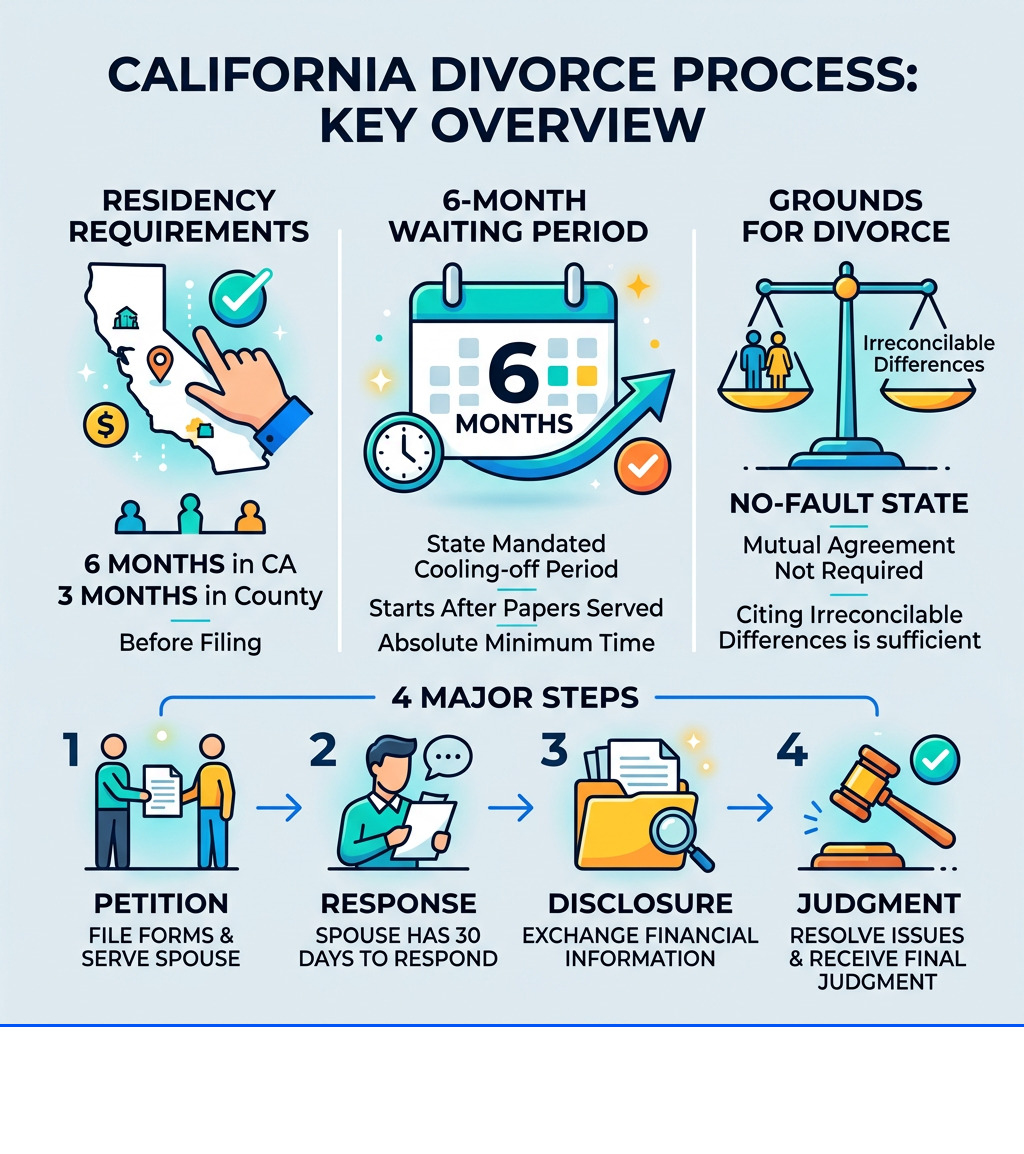
The absolute minimum is 6 months and one day. California law requires a mandatory waiting period before any divorce can be finalized — no exceptions, even if both spouses agree on everything.
That waiting period starts the day your spouse is served with divorce papers — not the day you file.
Most divorces take longer than 6 months. Disputes over children, property, or support can stretch the process to a year or more. Court backlogs in busy Southern California counties like Orange County add even more time.
A few other things to know upfront:
- You must meet residency requirements before filing: 6 months in California, 3 months in your county
- California is a no-fault state — you only need to cite “irreconcilable differences”
- The same process applies to domestic partnerships
- Legal separation follows similar steps but has no 6-month waiting period
Whether you’re just starting to consider divorce or you’ve already been served, knowing what to expect makes a real difference. The sections below break down every stage — and what can slow things down.
The Mandatory 6-Month Waiting Period in California
If you were hoping for a “quickie” divorce like you see in the movies, California might dampen those spirits just a bit. Per California Family Code § 2339, the state mandates a “cooling-off” period of exactly six months.

This clock doesn’t start the moment you decide to end the marriage or even the moment you walk into the courthouse to file the initial paperwork. Instead, the countdown begins on the date of service (when your spouse is legally handed the papers) or the date the respondent makes an official appearance in the case.
Why Does the Waiting Period Exist?
The legislature designed this period to prevent impulsive decisions. It gives couples one last window to consider reconciliation before the marital status is permanently terminated. Even if you and your spouse reach a full agreement on day 30, a judge cannot sign the final decree ending your marriage until that six-month mark has passed.
Marital Status vs. Property Issues
It is important to distinguish between “being divorced” (terminating the marital status) and “resolving the divorce” (dividing assets and settling custody). You can actually finish all your paperwork and have a judge approve your settlement before the six months are up. However, the judgment will simply state that your marriage officially ends on a future date—the day the waiting period expires.
The Legal Separation Exception
If you need immediate court orders regarding property or support but don’t want to wait, you might consider legal separation. In the legal-separation-vs-divorce-in-orange-county-explained/ guide, it is noted that legal separation follows nearly identical procedural steps but does not have a mandatory six-month waiting period. However, legal separation does not end the marriage; you remain legally wed and cannot remarry until you eventually convert the case to a dissolution and satisfy the waiting period.
How Long is the Divorce Process in California for Uncontested vs. Contested Cases?
The “six-month rule” is the floor, not the ceiling. For most residents in Irvine, Tustin, or Newport Beach, the reality of how long is the divorce process in California is dictated by the level of conflict between the parties.
| Case Complexity | Estimated Duration |
|---|---|
| True Uncontested | 6 – 8 Months |
| Simple Contested | 12 – 15 Months |
| Complex Contested | 18 – 24+ Months |
| High-Conflict/Trial | 2 – 5 Years |
Uncontested Divorces (The “Smooth” Path)
An uncontested divorce occurs when both parties agree on every single issue, including child custody, spousal support, and the division of community property. In these cases, the process usually wraps up shortly after the six-month waiting period expires, typically within 6 to 8 months. While it is the fastest route, many people still ask, do-i-need-a-lawyer-for-an-uncontested-divorce/? Even when you agree, an attorney ensures the paperwork is drafted correctly to avoid court rejections that could add months of administrative delays.
Contested Divorces (The “Bumpy” Path)
When spouses disagree on even one major issue, the case becomes “contested.” According to Martindale-Nolo research, contested divorces in California take an average of 18 months to finalize. If your case involves high-net-worth assets or intense custody battles, the timeline can easily stretch beyond two years.
Choosing between these paths is a major decision. For a deeper look at which route fits your situation, see our breakdown on uncontested-vs-contested-divorce-which-is-right-for-you/.
Orange County Court Realities
If you are filing in Orange County, your case will likely be handled at the Lamoreaux Justice Center in Orange. Local court backlogs play a significant role in your timeline. Currently, even after you submit your final judgment paperwork, it can take the court 6 to 7 months just to process the file-stamped judgment due to the sheer volume of cases.
How Long is the Divorce Process in California for Summary Dissolution?
For some, there is an even faster “short-track” option. Under Family Code § 2400, certain couples can file for a summary dissolution. This is an administrative way to end a marriage that skips many of the traditional court steps.
To qualify, you must:
- Have been married for less than 5 years.
- Have no children together (and the wife is not pregnant).
- Not own any real estate.
- Have limited community property and debts (caps apply).
- Both waive the right to spousal support.
While the six-month waiting period still applies, the paperwork is significantly simpler. You can find more details on the costs and requirements in our article on summary-dissolution-california-fee/.
Key Factors That Extend the California Divorce Timeline
Why do some divorces take 6 months while others take 6 years? It usually comes down to three “timeline killers”: kids, money, and stubbornness.
Child Custody Disputes
Nothing slows down a case faster than a disagreement over children. In Orange County, if parents cannot agree on a parenting plan, they must attend mandatory mediation through Family Court Services (FCS). Because these appointments are often booked weeks in advance, and reports can take additional weeks to finalize, a custody dispute typically adds a minimum of 3 to 6 months to the process. High-conflict cases requiring private custody evaluations can add a year or more.
Financial Disclosures and Discovery
California law requires a full and honest exchange of financial information. This involves the Preliminary and Final Declaration of Disclosure. If one spouse is slow to produce bank statements, tax returns, or business records, the other spouse may have to file motions to compel production, adding months of litigation. To avoid these pitfalls, check out our guide on six-mistakes-to-avoid-in-your-california-divorce/.
Community Property Complexity
In a community property state like California, assets acquired during the marriage are generally split 50/50. However, determining what is “community” vs. “separate” property can be complex. High-asset divorces involving business valuations, stock options, or forensic accountants to trace commingled funds will naturally take much longer than a case involving a simple W-2 income and a rented apartment.
To keep things moving, many couples find success by following tips-for-a-low-conflict-divorce-in-california/, which emphasizes cooperation and early disclosure to avoid the “trial trap.”
Navigating the California Judicial Council forms can feel like learning a second language. Here is the typical procedural roadmap for a standard dissolution.
- Filing the Petition (FL-100) and Summons (FL-110): This officially starts the case. You’ll pay a filing fee (usually $435-$450) unless you qualify for a fee waiver. You can find these at the official Judicial Branch of California website.
- Service of Process: A third party (not you!) must serve the papers to your spouse.
- Proof of Service (FL-115): This form is filed with the court to prove the spouse was served. This is the date the 6-month clock starts.
- The Response (FL-120): The respondent has 30 days to file a response.
- Financial Disclosures: Both parties must complete a Declaration of Disclosure, Schedule of Assets and Debts (FL-142), and Income and Expense Declaration (FL-150).
- Discovery Phase: This is the “information gathering” stage where attorneys exchange documents and take depositions.
- Settlement or Trial: Most cases end in a Marital Settlement Agreement (MSA). If not, the case goes to trial.
- Judgment (FL-180): The final document signed by the judge.
If you are feeling overwhelmed by the paperwork, it helps to know orange-county-divorce-law-what-to-expect-in-your-first-meeting/ so you can arrive prepared. You can also browse the See All Forms index to get familiar with the requirements.
How Long is the Divorce Process in California if a Spouse Doesn’t Respond?
What happens if you serve your spouse and they simply ignore the papers? You aren’t stuck in marital limbo forever. After the 30-day deadline passes, you can file a Request to Enter Default (FL-165).
Under California Code of Civil Procedure § 585, this allows the petitioner to proceed without the other party’s participation. While this might seem faster, courts scrutinize default judgments heavily, especially when children or significant assets are involved. For a full explanation of this scenario, read about what-happens-if-my-spouse-refuses-to-sign-divorce-papers-in-california/.
Frequently Asked Questions about California Divorce Timelines
Can the 6-month waiting period be waived?
No. There is no “emergency” or “fast-track” that allows a judge to waive the six-month waiting period for a divorce. It is a statutory requirement under Family Code § 2339. However, you can obtain temporary orders for custody or support within weeks of filing while you wait for the six months to pass.
Does the timeline differ for domestic partnerships?
The process and the six-month waiting period are identical for registered domestic partnerships. The only exception is for non-registered partnerships, which may not be subject to the same formal dissolution requirements.
How do court backlogs in Orange County affect my case?
Orange County courts, specifically the Lamoreaux Justice Center, handle thousands of cases. A “simple” hearing might be set 60 to 90 days out. If your case requires a multi-day trial, you may have to wait a year or more for an available date on the judge’s calendar.
Conclusion
Understanding how long is the divorce process in California is the first step toward regaining control of your life. While the law mandates a six-month wait, the choices you make—from how you communicate with your spouse to the attorney you hire—will determine if your case takes seven months or seven years.
At Pinkham & Associates, APLC, the team brings over 25 years of exclusive family law focus to residents across Orange County, including Irvine, Tustin, Yorba Linda, and Newport Beach. They provide the personalized strategies and fearless advocacy needed to navigate complex custody and asset division issues efficiently.
If you are ready to start your six-month countdown or need help resolving a contested case, contact Pinkham & Associates, APLC for a free consultation. For more information, visit our More info about divorce services page.