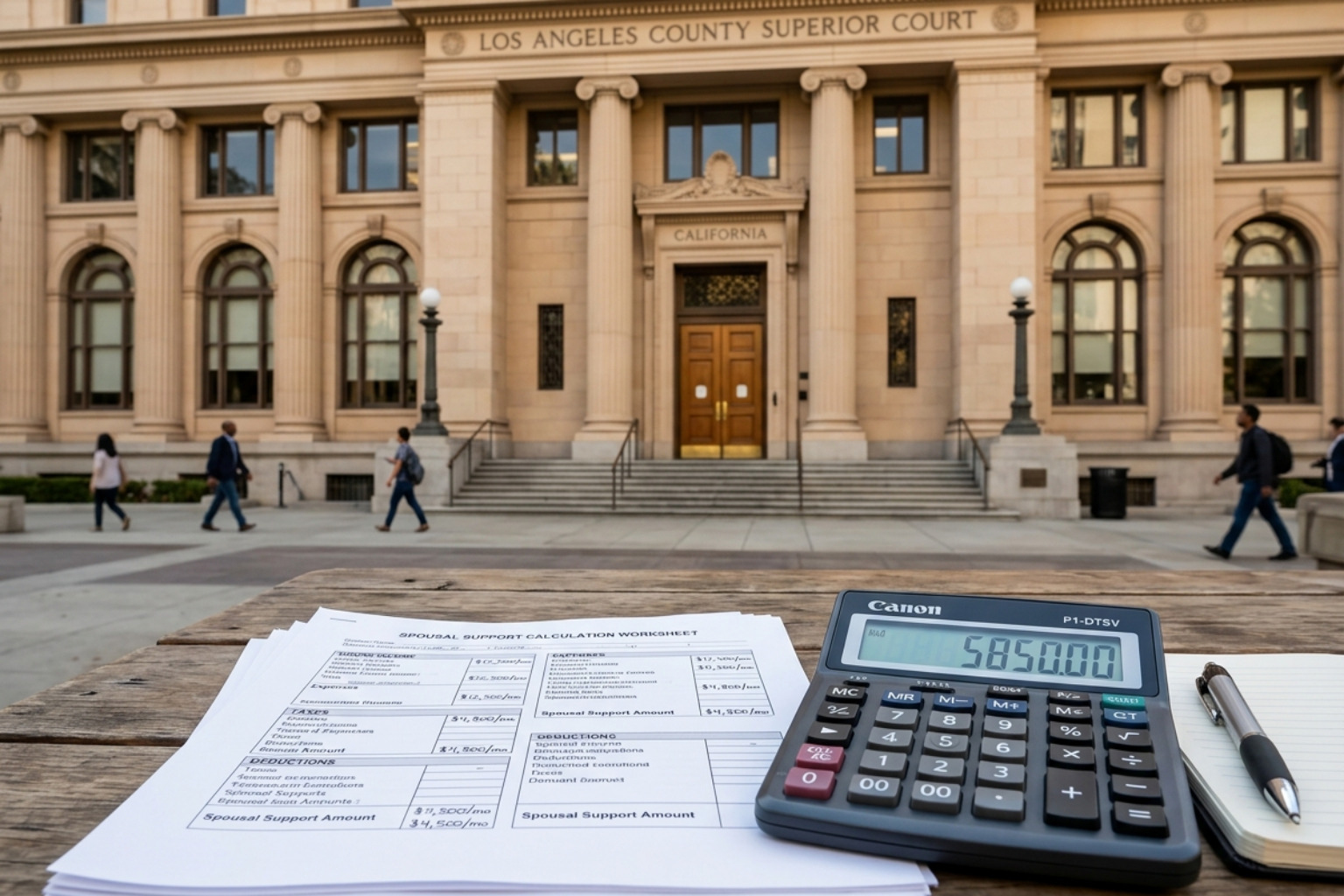



What a California Spousal Support Calculator Actually Tells You
A California spousal support calculator gives you a quick estimate of alimony payments based on both spouses’ incomes, tax status, and county-specific formulas. Here’s what most people need to know right away:
Quick answer — how temporary spousal support is estimated in California:
| County | Formula |
|---|---|
| Los Angeles | 40% of higher earner’s net income − 50% of lower earner’s net income |
| Santa Clara | 40% of payor’s net monthly income − 50% of recipient’s net monthly income |
| Alameda | 33% of higher earner’s net income − 33% of lower earner’s net income |
Key facts at a glance:
- Temporary support (during divorce) uses county guideline formulas
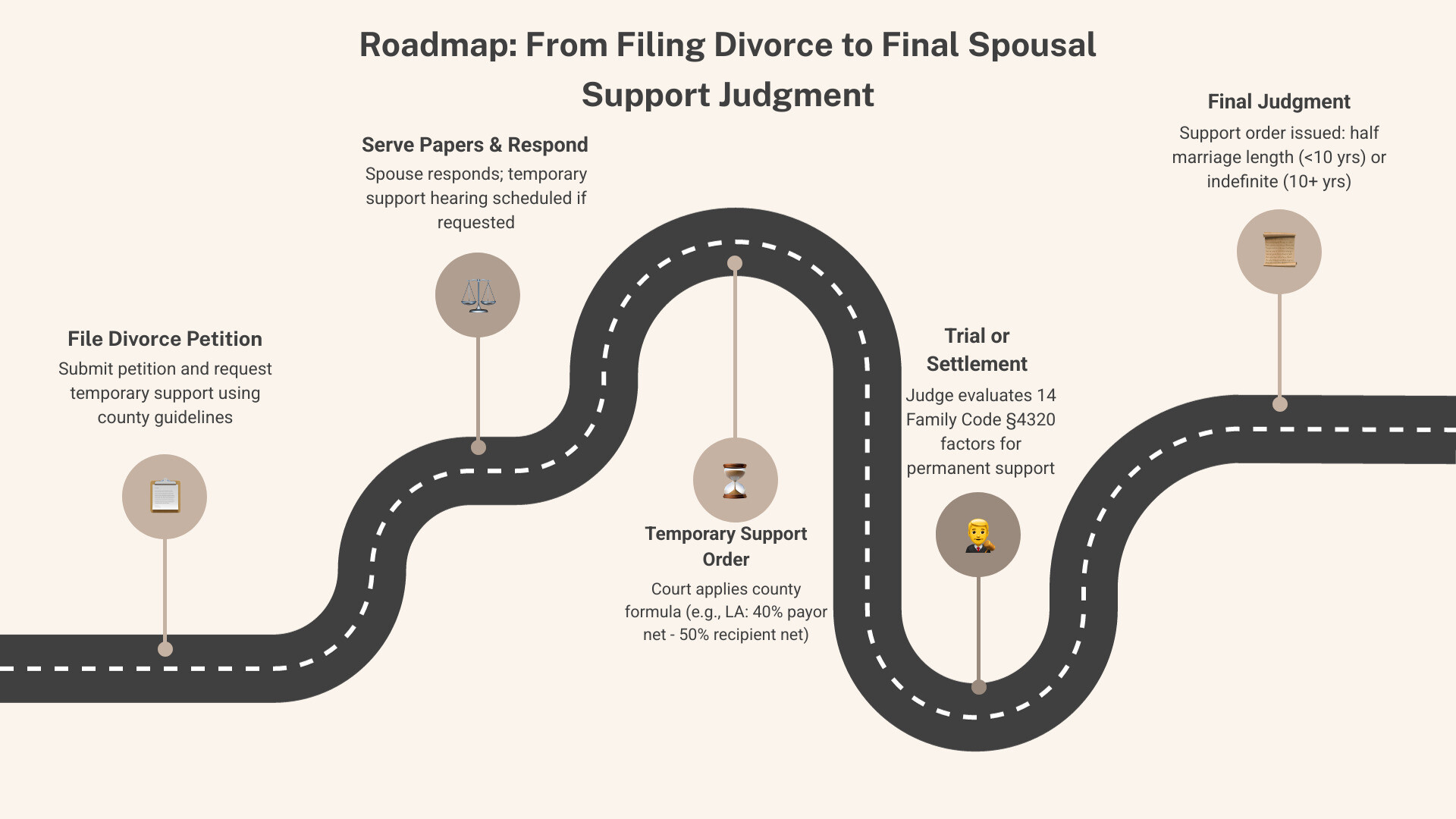
- Permanent support (after divorce) is decided by a judge using 14 factors under Family Code §4320 — no fixed formula applies
- Marriages under 10 years: support typically lasts half the length of the marriage
- Marriages 10+ years: support may be indefinite
- As of January 1, 2026, spousal support is non-deductible for the payor and non-taxable for the recipient under California’s SB 711
Divorce is already one of the most stressful experiences a family can go through. Adding financial uncertainty on top of custody battles and asset disputes can feel overwhelming.
That’s exactly why so many people in Southern California turn to online spousal support calculators first — they want a number, fast, before talking to anyone.
The problem? Online calculators only tell part of the story. They can estimate temporary support using county formulas, but they can’t account for judicial discretion, your specific county’s local rules, recent case law, or the 14 legal factors a judge weighs for permanent support.
This guide walks you through how these calculators work, where they fall short, and what you actually need to know to understand your spousal support situation in California.
California spousal support calculator further reading:
Understanding the California Spousal Support Calculator Framework
When people search for a california spousal support calculator, they are often looking for a single magic number. However, California law distinguishes between support paid while the divorce is pending and support ordered at the end of the case.
In the legal world, spousal support is the court-ordered payment from one spouse (or registered domestic partner) to help cover the other’s monthly expenses. While the term “alimony” is common in other states, California officially uses the term “spousal support.”

Temporary vs. Permanent Support
There are two primary phases of support in a California divorce:
- Temporary Support (Pendente Lite): This is support ordered while the divorce case is still active. Its purpose is to maintain the “status quo” and ensure the lower-earning spouse can cover their basic living expenses until the divorce is finalized. Courts almost always use a mathematical formula (a guideline) to set this amount. You can find more info about temporary alimony to see how it functions during the early stages of a split.
- Permanent (Post-Judgment) Support: Despite the name, “permanent” support rarely lasts forever. This is the support ordered as part of the final divorce judgment. Unlike temporary support, California law prohibits judges from using a simple calculator for the final order. Instead, they must weigh various life factors to determine a “just and equitable” amount.
For those looking for a quick estimate of what a court might do initially, a tool like the State of California Alimony Calculator can provide a baseline for temporary support.
Limitations of an Online California Spousal Support Calculator
While a california spousal support calculator is a great starting point, it comes with significant “fine print.” These tools are designed to mimic “guideline” software used by courts, but they cannot predict the human element of a judge’s decision.
Local court rules in Southern California—specifically in Orange County or Los Angeles—may influence how certain income types are treated. Furthermore, calculators often struggle with complex income scenarios, such as fluctuating bonuses, RSU (Restricted Stock Unit) vesting, or self-employment income. The Official Guideline Support Calculators certified by the Judicial Council are the only ones used by the courts themselves to ensure compliance with the latest statutes.
How to Calculate Temporary Support Using County Guidelines
Temporary support is designed to be predictable. Because the court wants to prevent financial hardship immediately after a separation, most counties have adopted specific formulas.
The Santa Clara and Los Angeles Formulas
If you are filing for divorce in Orange County or Los Angeles, the court will likely look at a “net disposable income” calculation.
- The Los Angeles/Santa Clara Guideline: This is the most common formula. It generally takes 40% of the higher earner’s net monthly income and subtracts 50% of the lower earner’s net monthly income.
- The Alameda Guideline: Some northern counties use a slightly different ratio, often taking 33% of the higher earner’s net and subtracting 33% of the lower earner’s net.
“Net income” isn’t just what is on a paycheck. It is the gross income minus specific allowable deductions like taxes, mandatory retirement contributions, and health insurance premiums.
Certified Software and Judicial Council Standards
To keep things uniform, the California Judicial Council certifies specific software programs for court use. As of April 2026, there are six certified calculators, including XSpouse and Family Law Software.
It is important to note that the industry standard “DissoMaster” has faced changes in recent years, and newer versions must be recertified annually to reflect current tax laws. For child-related support, the Guideline Calculator | CA Child Support Services is the official state resource, though it is primarily focused on child support rather than spousal maintenance.
Once a divorce reaches its final judgment, the california spousal support calculator gets put away. Judges are legally required to consider the “Marital Standard of Living” and 14 specific factors listed under Family Code Section 4320.
These factors include:
- The earning capacity of each party.
- The ability of the supporting spouse to pay.
- The needs of each party based on the standard of living established during the marriage.
- The duration of the marriage.
- The age and health of the parties.
- Documented history of domestic violence.
For a deep dive into these requirements, you can review detailed insights on Family Code 4320.
Marriage Duration and the 10-Year Rule
In California, the length of the marriage is the primary driver for how long support will last.
- Short-Term Marriage (Under 10 Years): There is a rebuttable presumption that support should last for half the length of the marriage. For example, if a couple was married for 6 years, support would typically last for 3 years.
- Long-Term Marriage (10+ Years): A marriage of 10 years or more is considered a “marriage of long duration.” In these cases, the court usually does not set a specific termination date for support. Instead, the court “retains jurisdiction,” meaning support continues until a spouse remarries, dies, or a “material change in circumstances” occurs.
Self-Sufficiency and the Gavron Warning
California law expects supported spouses to eventually become self-supporting. A judge may issue what is known as a “Gavron Warning.” This is a formal notice that the supported spouse is expected to make reasonable efforts to find employment or acquire marketable skills.
If a spouse ignores this warning and fails to seek a vocational examination or training, the court may eventually reduce or terminate their support.
Essential Inputs for a California Spousal Support Calculator
To get an accurate estimate from any california spousal support calculator, you need the right data. Most of this information comes from the FL-150 Income and Expense Declaration, which is a mandatory document in California divorces.
Required inputs typically include:
- Gross Monthly Income: All sources of income, including wages, commissions, and recurring monetary gifts.
- Tax Filing Status: Whether you file as Single, Head of Household, or Married Filing Separately.
- Children: The number of minor children and the percentage of “timeshare” each parent has.
- Health Insurance: The monthly premiums paid for health, dental, and vision insurance.
For help filling out these complex forms, refer to this guide to the FL-150 Income and Expense Declaration.
Interaction with Child Support Calculations
If you have children, child support is calculated first. Because child support is a priority under California law, the amount paid for the children reduces the “net disposable income” available for spousal support. A california spousal support calculator must account for this “offset” to be accurate.
Low-Income Adjustments and 2026 Thresholds
California provides protections for low-income payors. As of January 1, 2026, the Low-Income Adjustment (LIA) threshold is $2,929 monthly net disposable income. This figure is based on the updated minimum wage of $16.90 per hour. If a payor’s income falls below this level, the calculator automatically reduces the support amount to ensure the payor can still meet their own basic needs.
Tax Implications and the 2026 SB 711 Update
The tax treatment of spousal support has undergone a massive shift. Historically, alimony was tax-deductible for the person paying it and taxable income for the person receiving it.
Pre-2019 vs. Post-2026 Agreements
Under the federal Tax Cuts and Jobs Act of 2017, support for divorces finalized after December 31, 2018, became non-deductible at the federal level. However, California state tax law remained different—until now.
Effective January 1, 2026, SB 711 has fully conformed California state law to federal law. This means for all new agreements:
- Payor: Cannot deduct spousal support on state or federal taxes.
- Recipient: Does not report spousal support as taxable income.
This creates a “tax-neutral” transfer of post-tax dollars, which simplifies the math but often results in lower monthly “sticker prices” on support orders since the recipient isn’t losing a portion to the IRS.
Modifying and Terminating Your Support Order
A spousal support order is not necessarily set in stone. If there is a “material change in circumstances,” either party can request a modification.
Common reasons for modification include:
- Job Loss or Retirement: If the payor loses their job or reaches a reasonable retirement age, they may seek to lower payments.
- Remarriage: Spousal support automatically terminates if the recipient remarries.
- Cohabitation: Under Family Code §4323, if the recipient is living with a non-marital partner, there is a “rebuttable presumption” of a decreased need for support.
If you are struggling with payments, it is vital to act quickly. You can learn how to modify support without the drama to avoid falling into arrears.
Factors Affecting Modification
Not all changes lead to a reduction. For example, if a payor is convicted of domestic violence against the recipient, the court may terminate their right to receive support entirely under Family Code §4324. Conversely, if you are asking yourself, what if I cannot afford spousal support, you must file a formal motion with the court immediately; you cannot simply stop paying.
Frequently Asked Questions about California Spousal Support
How long does spousal support last for a marriage over 10 years?
In a marriage of 10+ years, the court usually retains jurisdiction indefinitely. This doesn’t mean you will pay forever, but it means the “door is open” for the court to make orders until the recipient remarries, dies, or a judge terminates the order based on the recipient’s self-sufficiency.
Does cohabitation automatically terminate alimony in California?
No. Unlike remarriage, cohabitation does not automatically end support. However, it does create a legal presumption that the recipient has a lower financial need, which the payor can use as grounds to request a reduction in court.
How does a domestic violence conviction affect support awards?
California has strict rules regarding domestic violence. Under Family Code §4320(i), a judge must consider documented abuse. Furthermore, there is a legal prohibition against awarding spousal support to a spouse convicted of a violent felony or certain domestic violence offenses against the other spouse.
Conclusion
Navigating a california spousal support calculator is only the first step in planning your financial future after divorce. While these tools provide a helpful “ballpark” figure for temporary support, the complexities of long-term support require a much more nuanced approach.
At Pinkham & Associates, APLC, we bring over 25 years of exclusive focus to family law matters in Orange County. Whether you are in Irvine, Costa Mesa, or Newport Beach, our firm provides the fearless advocacy and personalized strategies needed to ensure a fair outcome. We understand that behind every calculation is a real person trying to rebuild their life.
If you are ready to move past estimates and secure your financial future, learn more about our spousal support services or contact us for a free consultation. Our team is here to help you navigate the roadmap from filing to final judgment with confidence.