



What Is Legal Separation in the State of California?
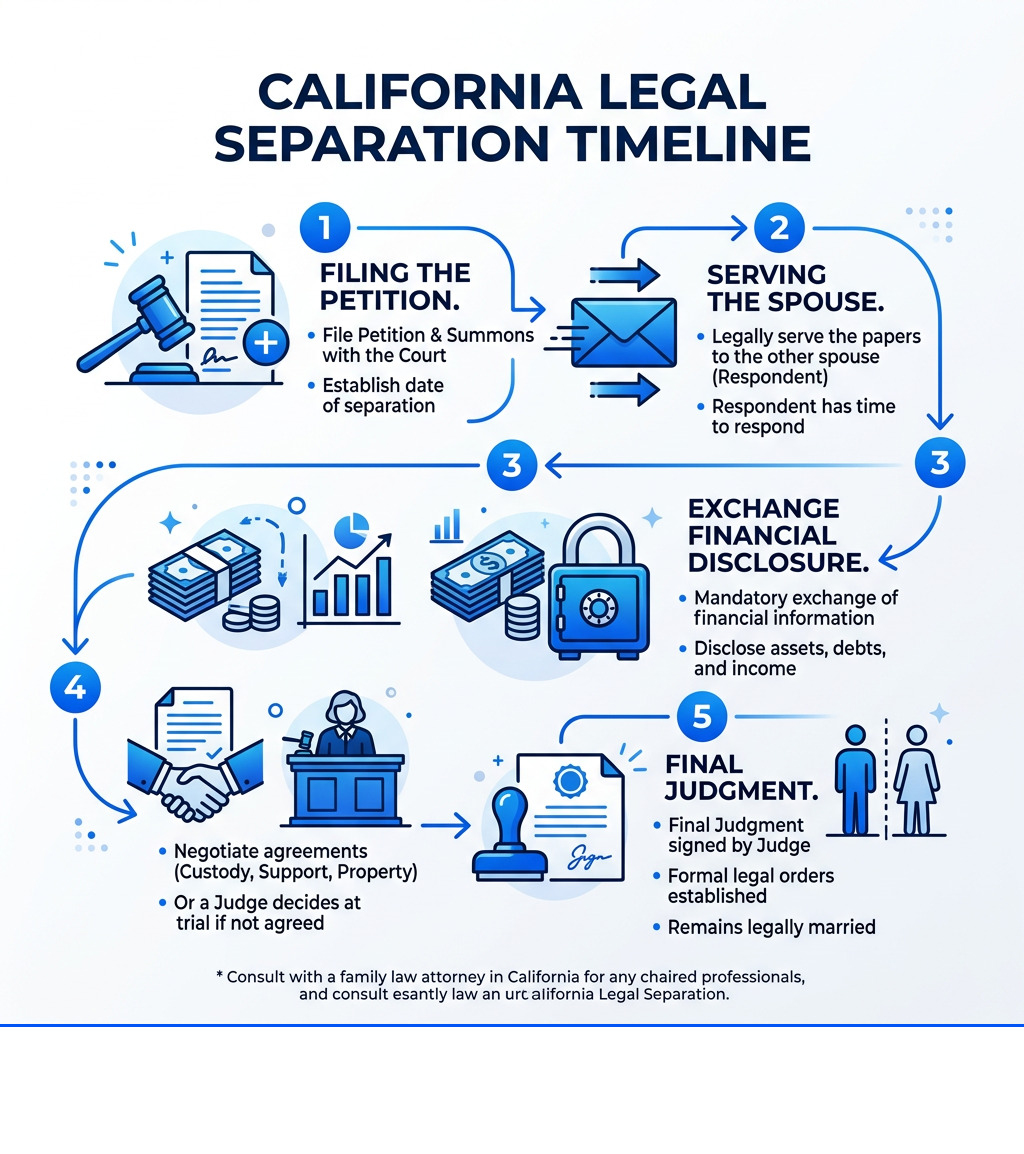
Legal separation in the state of California is a court-recognized process that lets married couples live apart, divide property, and set support arrangements — while remaining legally married.
Here’s what that means in plain terms:
- You stay married. Neither spouse can remarry or enter a new domestic partnership.
- The court still has authority. A judge can order property division, child custody, child support, and spousal support — just like in a divorce.
- No residency requirement. Unlike divorce, you can file for legal separation in California even if you just moved to the state.
- No waiting period. There is no six-month waiting period, unlike divorce which requires at least six months from the date the respondent is served before it can be finalized.
- It can be converted to divorce later. If you decide you want a full divorce, you can amend your case.
This is why many Southern California couples — especially those with children, shared health insurance, or religious beliefs that discourage divorce — choose legal separation as either a permanent arrangement or a first step toward divorce.
It’s not simply “moving out.” Legal separation is a formal legal process with real, enforceable court orders. Getting it wrong can affect your finances, your kids, and your future. That’s why understanding how it works matters — and why speaking with an experienced family law attorney (Pinkham & Associates, APLC offers consultations) is a smart first move.
Understanding Legal Separation in the State of California
When couples in Orange County find themselves at a crossroads, the first question is often: “Do we have to get a divorce?” In California, the answer is no. You can opt for a legal separation, which provides the structure of a divorce decree without actually ending the marriage.
Think of it as a “divorce-lite” in terms of paperwork, but with the same heavy-hitting legal protections. You still go through the process of dividing who gets the house in Tustin or the debts accrued in Newport Beach, but on paper, you remain “married.”
| Feature | Legal Separation | Divorce (Dissolution) |
|---|---|---|
| Marital Status | Remain Married | Single / Terminated |
| Right to Remarry | No | Yes |
| Residency Requirement | None (Immediate) | 6 months in CA / 3 months in County |
| Waiting Period | None | Minimum 6 months and 1 day |
| Court Orders | Custody, Support, Property | Custody, Support, Property |
Marital Status and the Remarriage Prohibition
The most significant hurdle for many is the “remarriage prohibition.” Because a judgment of legal separation does not terminate the marriage, neither party is free to marry someone else. If you meet someone new and want to tie the knot in Costa Mesa, you must first convert your separation into a full dissolution of marriage.
No Waiting Period
One of the “perks” of legal separation in the state of california is speed. A divorce has a mandatory six-month “cooling-off” period from the time the respondent is served. Legal separation has no such requirement. If both parties agree on all terms, a judgment can theoretically be entered much faster. For more details on these distinctions, you can explore legal separation vs divorce in Orange County explained or review the legal separation basics from California Courts.
Key Benefits of Legal Separation in the State of California
Why would someone choose to stay legally tethered to a spouse they no longer live with? The reasons are usually practical or deeply personal.
- Health Insurance: This is the “big one.” Many employer-sponsored health plans will terminate a spouse’s coverage upon divorce. By staying legally married, one spouse may be able to remain on the other’s policy. However, it is vital to check the specific plan’s summary description, as some insurers treat legal separation the same as divorce.
- Tax Benefits: Legally separated couples may still be able to file joint tax returns, which often results in a lower tax liability than filing as single or head of household.
- Social Security: If a marriage lasts at least 10 years, a lower-earning spouse may be eligible for derivative Social Security benefits based on the other spouse’s earnings. Legal separation allows the clock to keep ticking toward that 10-year mark.
- Religious Beliefs: For those whose faith prohibits or strongly discourages divorce, legal separation offers a way to live independently while remaining in good standing with their religious community.
- Military Benefits: For military families in Southern California, legal separation can preserve certain benefits, such as commissary privileges or health care through TRICARE, that would be lost in a dissolution.
Residency Requirements and Jurisdictional Rules
If you just moved to Irvine or Yorba Linda and realize the marriage is over, you usually can’t file for divorce right away. California requires you to live in the state for six months and the county for three months before filing for dissolution.
Legal separation in the state of California has no such requirement. You can file the day you move here. This makes it a popular “placeholder” for newcomers who want to get court orders for child support or custody immediately, with the intent to convert the case to a divorce once the residency clock runs out. For those needing professional guidance on these rules, More about legal separation in California is available.
Why Couples Choose Separation Over Divorce
Beyond the technicalities, there is the human element. Sometimes, a couple isn’t ready to say “it’s over” forever.
Trial Separation and Reconciliation Potential
A legal separation can act as a “controlled” trial period. It allows couples to experience the reality of living apart and managing separate finances while keeping the door to reconciliation slightly ajar. If you reconcile after a divorce, you have to get remarried. If you reconcile after a legal separation, you can simply ask the court to dismiss the case (if not finalized) or live together again (though you should consult a lawyer about how this affects your judgment).
Financial Protection and Next-of-Kin Rights
In a legal separation, you can still be each other’s “next-of-kin” for medical emergencies or inheritance purposes unless you specifically waive those rights in your agreement. It provides a safety net that divorce removes entirely. For those looking for a less adversarial path, more info about uncontested options can help clarify the best approach.
Living Together While Legally Separated
Can you be “separated” while sharing a roof in a high-cost area like Newport Beach? Thanks to a change in the California Family Code (specifically Section 70), the answer is a resounding yes.
The law used to require couples to live in separate residences to be considered “separated.” Now, the “date of separation” is defined by two factors:
- One spouse expresses a clear intent to end the marriage.
- Their conduct is consistent with that intent.
This means you can live in separate bedrooms, stop acting as a couple socially, and separate your finances while still living in the same house for financial reasons or to co-parent. The “date of separation” is crucial because it marks the moment you stop building “community property” and start earning “separate property.”
The Step-by-Step Process to File for Legal Separation
The procedural path for legal separation in the state of california is almost identical to divorce. You use the same stack of forms; you just check a different box.
- File the Petition: You start with the Petition for Dissolution of Marriage (form FL-100). On this form, you will check the box for “Legal Separation.” You can find more info about form FL-100 here.
- File the Summons: The Summons (form FL-110) contains standard restraining orders that prevent either spouse from moving children out of state or making major changes to insurance or bank accounts without permission.
- Pay the Fee: As of the latest updates, the filing fee in California is approximately $435. If you cannot afford this, you can apply for a fee waiver.
Service of Process and Financial Disclosures
Once you file, you must “serve” your spouse. You cannot do this yourself; it must be done by someone over 18 who is not a party to the case. After they are served, you file a Proof of Service (form FL-115).
Then comes the “fun” part: Financial Disclosures. California law requires total transparency. You must fill out:
- Declaration of Disclosure (form FL-140)
- Income and Expense Declaration (form FL-150)
- Schedule of Assets and Debts.
You must serve these on your spouse within 60 days of filing. There are two rounds: Preliminary and Final. The Final disclosure can sometimes be waived if both parties agree, but the Preliminary is mandatory.
Converting to Divorce: Legal Separation in the State of California
If you start as a legal separation but decide mid-stream that you actually want a divorce, don’t panic. You don’t have to start over. You can file an “Amended Petition.”
This is common when a spouse files for separation because they haven’t lived in Orange County long enough to meet residency requirements. Once the three-month county/six-month state residency is met, they simply amend the FL-100 to ask for a “Dissolution.” If the other party has already responded, you might need their consent or a court order to amend. For professional assistance with this transition, check out our Orange County divorce attorney page.
Financial and Family Impacts: Property, Support, and Children
California is a community property state. This means that generally, anything earned or acquired during the marriage (and before the date of separation) belongs 50/50 to both spouses.
- Property Division: This includes houses in Placentia, 401(k)s earned while working in Irvine, and even the family minivan.
- Debt Division: Unfortunately, “community” also applies to debts. Credit card balances or car loans taken out during the marriage are usually shared responsibilities.
- Separate Property: Anything you owned before the marriage or received as a gift or inheritance during the marriage is usually yours alone.
If you need the court to make decisions quickly regarding who stays in the house or who pays the bills while the case is pending, you can file a Request for Order. You can find more info about temporary orders to see how this works.
Child Custody and Support Guidelines
The court’s primary concern is always the “best interests of the child.” In a legal separation, you will need to establish:
- Legal Custody: Who makes major decisions about health, education, and welfare?
- Physical Custody: Where does the child live?
- Visitation (Parenting Time): A specific schedule for holidays, weekends, and school breaks.
If children are involved, you must file the Declaration Under Uniform Child Custody Jurisdiction and Enforcement Act (form FL-105).
Child support is not optional. California uses a complex mathematical formula (the “guideline”) based on both parents’ incomes and the percentage of time each parent spends with the children.
Spousal Support and Alimony Factors
Unlike child support, spousal support is not a guarantee. The court looks at several factors under Family Code Section 4320, including:
- The length of the marriage.
- The standard of living established during the marriage.
- The earning capacity of each spouse.
- Whether one spouse stayed home to care for children or supported the other’s education.
In “long-term” marriages (usually 10 years or more), the court retains jurisdiction over support indefinitely unless the parties agree otherwise. If you’re wondering whether you need professional help to navigate these negotiations, more info about hiring a lawyer can provide clarity.
Frequently Asked Questions about Legal Separation in the State of California
Can I remarry while legally separated in California?
No. You are still legally married. To remarry, you must obtain a final judgment of Dissolution of Marriage (divorce).
How much does it cost to file for legal separation?
The court filing fee is $435 for the Petitioner and $435 for the Respondent (as of current standards). These costs do not include attorney fees. Pinkham & Associates, APLC offers consultations to help you understand the potential total investment for your specific case.
What happens if we reconcile after a judgment is entered?
If a final judgment of legal separation has been entered, you are still married, so you don’t need to do anything to “stay” married. However, the court orders regarding property division and support remain in effect. If you want to undo those orders, you would likely need to file a motion to set aside the judgment or a new agreement, which is legally complex.
Conclusion
Navigating legal separation in the state of California requires more than just a desire to live apart; it requires a strategic understanding of the law to protect your assets and your children. Whether you are in Irvine, Costa Mesa, or Tustin, the team at Pinkham & Associates, APLC provides the fearless advocacy and personalized strategies built over 25 years of exclusive family law focus.
Don’t leave your financial future or your relationship with your children to chance. Start your legal separation today by reaching out for a consultation. We are here to help you move forward with confidence.