

What Is an Application for Divorce and Where Do You Get One Online?
The application for divorce you need depends on where you live.
In California, start at the Divorce Forms | California Courts | Self Help Guide to download official, free forms. The core filing document is Form FL-100, and it must be paired with supporting forms depending on your situation.
Official divorce forms are free. Never pay a third-party company for forms you can get directly from the court.
Divorce is already hard. The paperwork shouldn’t make it harder.
If you’re a parent in Southern California dealing with custody disputes, asset division, or a difficult spouse — the forms are just the starting point. Knowing which forms to file, when, and how to fill them out correctly can make or break your case.
This guide walks you through every key form and step in the California divorce process, from the initial petition to the final decree. Whether you’re just starting out or trying to understand what your spouse has already filed, you’ll find clear, practical answers here.
Pinkham & Associates, APLC offers free consultations if you’d like expert guidance before you file.
Eligibility and Legal Grounds for Filing
Before a person rushes to download an application for divorce, they must ensure they actually meet the criteria to file in their specific location. In California, residency is the first hurdle. To file for divorce in a California court, at least one spouse must have lived in the state for the last six months. Furthermore, they must have resided in the specific county where they plan to file—such as Orange County—for the last three months.
If a couple has lived in Irvine or Costa Mesa for years, they easily meet these California residency rules. However, if they just moved to Newport Beach from another state last month, they might need to wait a bit or file for legal separation first.
No-Fault Divorce and Legal Grounds
California is a “no-fault” divorce state. This means the court doesn’t care who cheated, who forgot the anniversary, or who left the cap off the toothpaste. The most common legal ground listed on an application for divorce is “irreconcilable differences.” This essentially tells the court that the marriage is irretrievably broken and there is no hope of fixing it.
While some jurisdictions use terms like “insupportable,” California keeps it simple. There is no requirement for a specific duration of marriage before filing, though the process itself will take at least six months to finalize due to mandatory waiting periods.
For those involved in specific jurisdictional contexts, such as Native American individuals, the process might involve an Application for Dissolution of Marriage under tribal law or federal regulations, which often carries its own unique residency and separation requirements.
Essential Forms in an Application for Divorce
The “divorce packet” is rarely just one piece of paper. It is a collection of documents that tell the court who the parties are, what they own, and what they want.
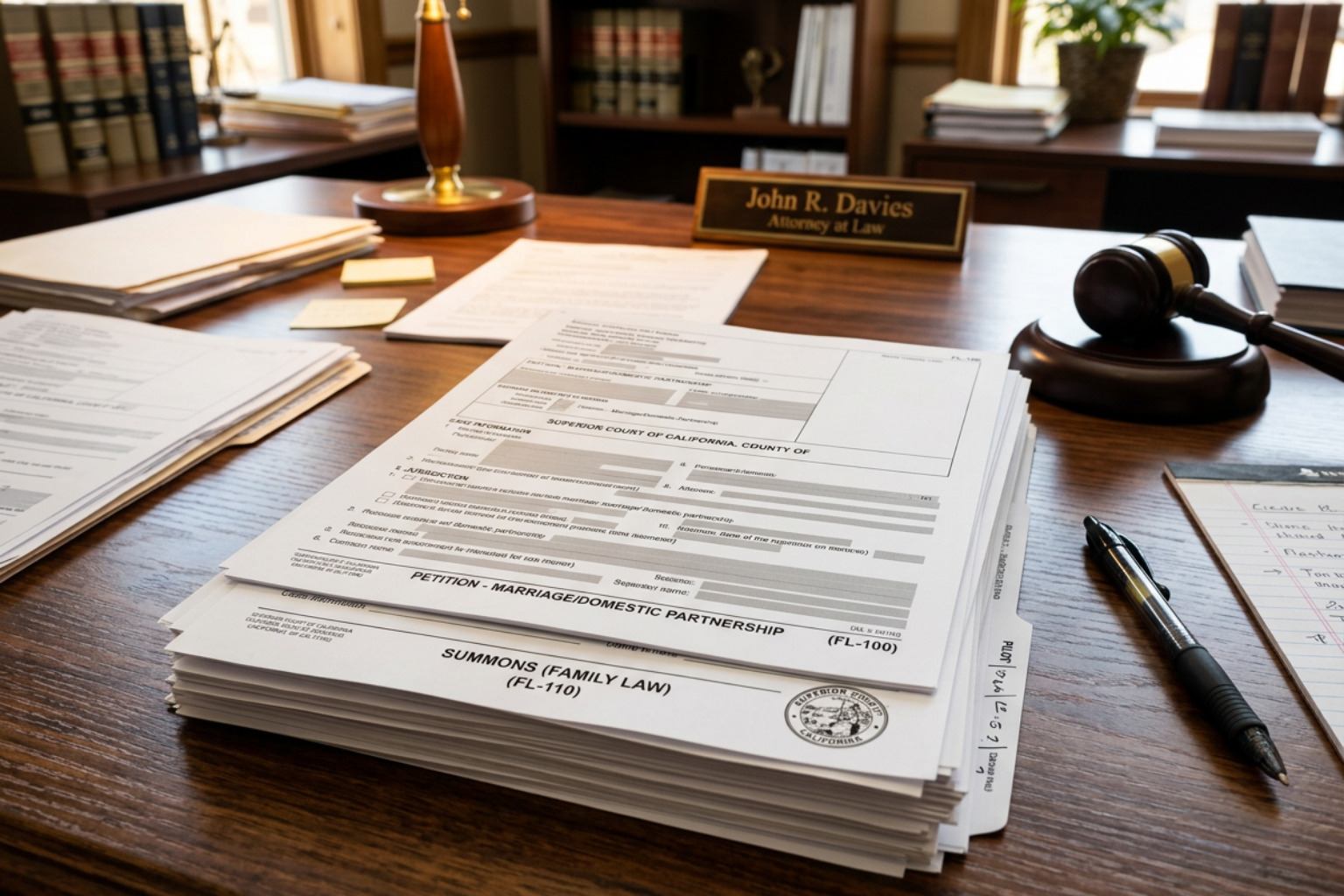
The primary document is the FL-100 Petition—Marriage/Domestic Partnership. This is the foundation of the case. It identifies the parties and asks the court for specific orders regarding children, property, and support.
Other critical “starter” forms include:
- Form FL-110 Summons: This contains the “Automatic Temporary Restraining Orders” (ATROs) that prevent either spouse from moving children out of state or selling off assets once the case begins.
- Form FL-105 UCCJEA: This is mandatory if there are minor children involved. It tracks where the children have lived for the last five years to ensure the court has the authority to make custody orders.
Starting the Process with an Application for Divorce
When the Petitioner (the person starting the case) fills out the application for divorce, they must provide exhaustive details. This includes full legal names, the date of marriage, and the date of separation. The separation date is particularly important in California because it marks the end of the “community” for property division purposes.
Once filed, the documents must be officially delivered to the Respondent. This is known as “service of process.” To prove to the court that the other spouse knows about the divorce, the Petitioner must file a FL-115 Proof of Service. If the spouse is cooperative, they might sign a FL-117 Notice and Acknowledgment of Receipt, which saves everyone the hassle of a formal process server.
Downloading Your Application for Divorce and Supporting Documents
For residents in Yorba Linda or Placentia, the best place to find these forms is the Divorce Forms | California Courts | Self Help Guide.
As the case progresses, other forms become necessary:
- FL-130 Appearance and Stipulation: Used when both parties agree on how the case should proceed.
- FL-140 Declaration of Disclosure: A “cover sheet” for the financial documents that must be exchanged.
- FL-141 Declaration Regarding Service: Tells the court that the financial disclosures were actually sent to the other side.
Handling Financial Disclosures and Property Division
California is a community property state. This means that, generally, everything acquired during the marriage is owned 50/50. However, determining what is “community” and what is “separate” requires meticulous record-keeping.
| Property Type | Definition | Typical Treatment |
|---|---|---|
| Community Property | Assets/debts acquired from date of marriage to date of separation. | Divided 50/50. |
| Separate Property | Assets owned before marriage, or acquired by gift or inheritance. | Stays with the original owner. |
| Mixed Assets | A separate property house paid for with community income. | Requires complex “Moore-Marsden” calculations. |
To sort this out, the court requires a FL-150 Income and Expense Declaration and a FL-160 Property Declaration. For a more granular look at every bank account and credit card, parties often use the FL-142 Schedule of Assets and Debts.
The Marital Standard of Living (MSOL)
In high-asset areas like Newport Beach or Tustin, the Marital Standard of Living (MSOL) is a major factor in spousal support. The court looks at the lifestyle established during the marriage—typically over the three years prior to separation—to determine a fair support amount. This includes analyzing net income and average monthly expenditures. If a couple spent $14,000 a month on their lifestyle, the court uses that as a guidepost (though not a strict ceiling) for support.
Retirement and Debts
Dividing a 401(k) or pension isn’t as simple as withdrawing cash. It often requires a Qualified Domestic Relations Order (QDRO). This is a separate legal document that instructs a plan administrator on how to split the funds without triggering massive tax penalties. Similarly, debts are divided, but it is important to remember that creditors aren’t bound by a divorce decree. If a spouse is ordered to pay a joint credit card but fails to do so, the bank can still come after the other party.
Addressing Child Custody and Support Requirements
When children are involved, the application for divorce becomes significantly more complex. California courts make all decisions based on the “best interests of the child.” This includes evaluating health, safety, and the child’s emotional ties to each parent.
New Protections: Piqui’s Law and AB 2024
Recent changes in California law have strengthened protections for children. Piqui’s Law (SB 331) prohibits judges from ordering children into unregulated “reunification programs” that have been criticized for ignoring abuse allegations. It also mandates specific training for judges to better recognize domestic violence and child abuse.
Additionally, AB 2024 has streamlined how courts handle Domestic Violence Restraining Orders (DVROs) in custody cases. Court clerks are now required to accept ex parte DVRO requests more efficiently, ensuring that safety protocols are in place before custody is even discussed.
Key Custody Forms
- FL-311 Custody and Visitation: An optional but highly recommended form to detail a specific parenting plan.
- FL-342 Child Support Information: Used to calculate support based on the state’s guideline formula.
- FL-312 Child Abduction Prevention: If there is a risk that one parent might take the child out of the country without permission, this form allows the court to implement travel restrictions.
Filing Fees, Service of Process, and Finalizing the Decree
Filing an application for divorce isn’t free. In California, the standard filing fee is currently around $435 to $450, depending on the county.
What if You Can’t Afford the Fee?
For those facing financial hardship, the court offers fee waivers. An individual can submit a “Poverty Affidavit” or a Request to Waive Court Fees (Form FW-001). If they receive public benefits like Medi-Cal or food stamps, or if their income falls below a certain threshold, the judge will typically grant the waiver.
The Waiting Period
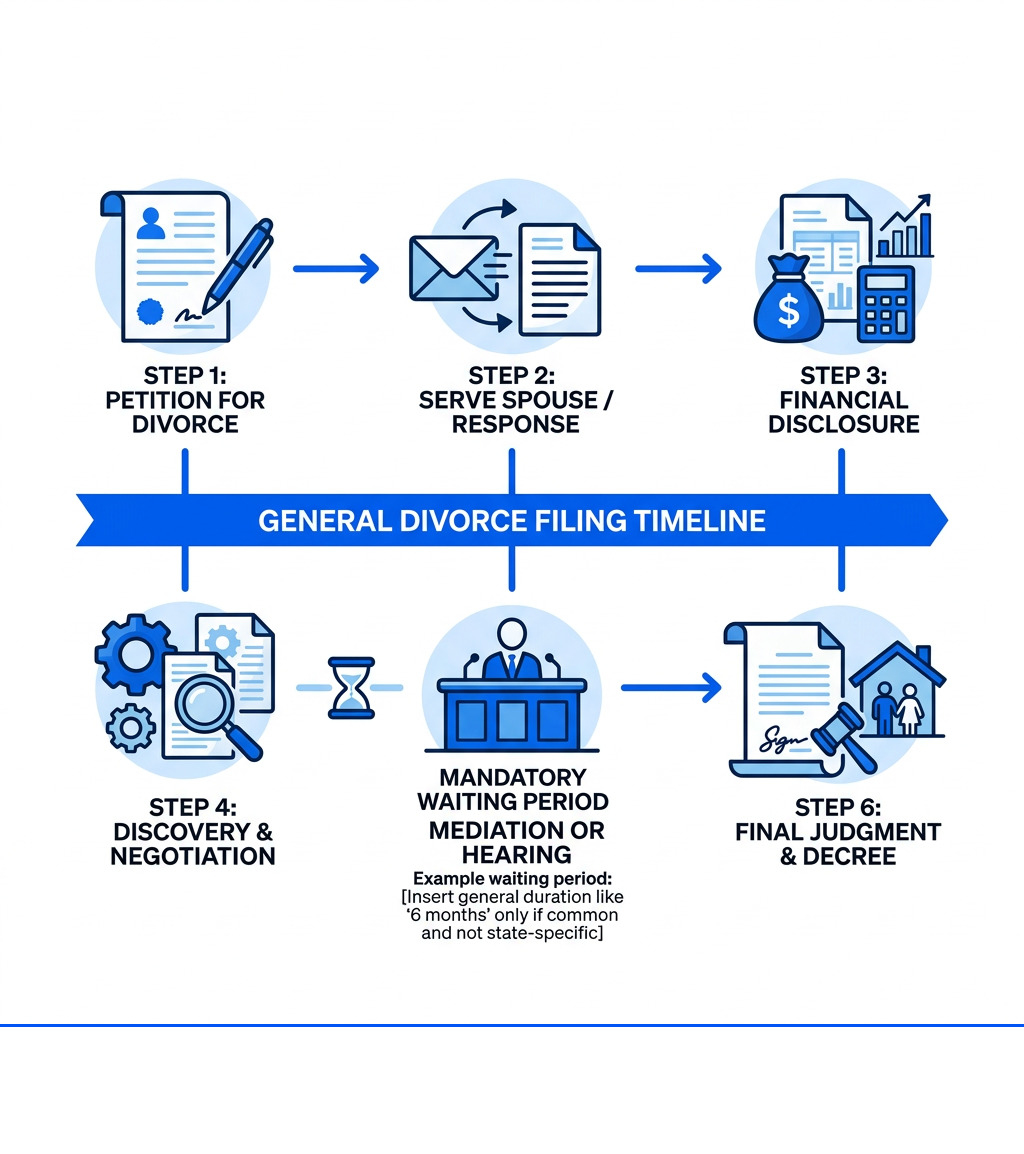
One of the most common questions in Orange County is: “How fast can I get this over with?” The answer is at least six months and one day. This mandatory waiting period begins the moment the Respondent is officially served with the papers. Even if a couple agrees on everything on day one, they cannot be legally single until that six-month clock runs out.
Finalizing the Judgment
The end of the road involves the FL-180 Judgment. This is the document the judge signs to make the divorce official. It must be accompanied by the FL-190 Notice of Entry of Judgment, which is the clerk’s way of saying, “It’s done.”
To ensure nothing is missed, many litigants use the FL-182 Judgment Checklist. Missing one signature or failing to attach a required form can lead to the court rejecting the entire packet, forcing the parties to start the finalization process over again.
Frequently Asked Questions about Divorce Paperwork
What if I can’t afford the filing fee for an application for divorce?
If an individual cannot afford the court fees, they should file a Request to Waive Court Fees (Form FW-001). The court will review their income and expenses to determine if they qualify for a waiver. This covers the initial filing fee and potentially other costs like service of process.
How long is the mandatory waiting period before a divorce is final?
In California, there is a mandatory six-month waiting period. This period starts from the date the Respondent is served with the application for divorce or the date they file a response. A person is not legally divorced until the court issues a final judgment after this period has passed.
Can I change my name back to my maiden name during the process?
Yes. The FL-100 Petition includes a section where a person can request to have their former legal name restored. This is the easiest and most cost-effective time to do it, as it is included in the final divorce decree.
Conclusion
Navigating a divorce in Orange County requires more than just a printer and an application for divorce. It requires a strategic understanding of California’s complex family laws, from the nuances of community property to the latest safety protections for children.
At Pinkham & Associates, APLC, the team provides fearless advocacy and personalized strategies for clients in Irvine, Newport Beach, Costa Mesa, and throughout Orange County. With over 25 years of exclusive focus on family law, they understand that behind every form is a person’s future.
Whether a person is dealing with a high-conflict custody battle or a complex asset division, having expert legal advocacy is essential. For more information on navigating the paperwork or to get professional help, visit the divorce document filing resource page.
Contact Pinkham & Associates, APLC today for a free consultation and ensure your rights are protected throughout the divorce process.