


What You Need to Know About Filing a Legal Separation in California
Filing a legal separation in California lets married couples live apart and divide their finances, property, and parenting responsibilities — without ending the marriage.
Here’s a quick overview of how the process works:
- Complete your forms — Fill out Petition (FL-100), Summons (FL-110), and if you have children, the UCCJEA form (FL-105). Check the “legal separation” box instead of “divorce.”
- File with your local court — Pay the $435–$450 filing fee, or apply for a fee waiver if needed.
- Serve your spouse — Have someone over 18 (not you) deliver the papers to your spouse.
- Exchange financial disclosures — Both spouses share full financial information using forms FL-140, FL-150, and FL-142.
- Reach an agreement or go to court — Settle issues like custody, support, and property through negotiation, mediation, or a judge’s decision.
- Get your judgment — Submit the final Judgment (FL-180) for court approval. Unlike divorce, there is no six-month waiting period.
Unlike divorce, a legal separation does not end your marriage. You stay legally married, which means you cannot remarry. But the court can still make binding orders on property division, child custody, child support, and spousal support.
People often choose legal separation over divorce for reasons like keeping a spouse on a health insurance plan, honoring religious beliefs, or simply needing more time before making a permanent decision.
One important note: California requires no strict residency waiting period to file for legal separation — unlike divorce, which requires you to have lived in California for at least six months and in your county for at least three months.

Filing a legal separation in california vocabulary:
Understanding Legal Separation vs. Divorce in California
When a marriage hits a rocky patch, most people immediately think of the “D-word.” However, California law provides a distinct alternative that many couples in Orange County find more suitable for their specific needs. While both processes involve the court and result in legally binding orders, the destination is different.
The Big Difference: Marital Status
The most significant distinction is that filing a legal separation in California does not end your marriage. In a divorce (dissolution), the court restores your status to that of a “single person.” In a legal separation, you remain legally married. This means you cannot remarry or enter into a new domestic partnership. If you meet someone new and want to tie the knot, you will eventually need to convert that separation into a divorce.
Why Choose Separation Over Divorce?
Couples often opt for legal separation vs divorce in orange county explained for several strategic or personal reasons:
- Health Insurance Retention: Many insurance policies terminate coverage for a spouse once a divorce is finalized. By staying legally married, one spouse may be able to remain on the other’s employer-provided health plan.
- Tax Benefits: Staying married may allow a couple to continue filing joint tax returns, which can sometimes result in significant savings.
- Religious Beliefs: For those whose religion prohibits or discourages divorce, a legal separation provides a way to live apart and settle financial matters while technically upholding their religious vows.
- Social Security: If a marriage lasts at least 10 years, a divorced spouse may be entitled to derivative Social Security benefits. Some couples choose legal separation to “clock in” those 10 years before eventually divorcing.
| Feature | Legal Separation | Divorce (Dissolution) |
|---|---|---|
| Ends Marriage? | No | Yes |
| Can Remarry? | No | Yes |
| Residency Requirement | None (just live in CA) | 6 months in CA, 3 months in county |
| Waiting Period | None | 6 months minimum |
| Property Division | Yes | Yes |
| Child Custody/Support | Yes | Yes |
For a deeper dive into these options, you can check out the Legal separation overview provided by the California Courts.
Requirements for Filing a Legal Separation in California
California is a “no-fault” state. This means you don’t have to prove your spouse did something wrong (like cheating or being “cruel”) to get a legal separation. You simply need to state that there are irreconcilable differences that have caused an irremediable breakdown of the marriage. In short: if you say the marriage isn’t working, the court takes your word for it.
The “Date of Separation”
One of the most critical concepts in filing a legal separation in California is the “date of separation.” Under California Family Code §70, this is the date when one spouse expresses their intent to end the marriage and acts in a way that is consistent with that intent.
Interestingly, you don’t necessarily have to move out to be considered “separated.” In high-cost areas like Newport Beach or Irvine, many couples continue to live under the same roof for financial reasons or to co-parent effectively while being legally separated. As long as you are living separate lives (separate finances, no longer acting as a “couple”), the court can recognize this date. This date is vital because it usually marks the point where “community property” earnings stop and “separate property” earnings begin.
Mental Capacity and Residency
While the bar for california separation laws is relatively low, the person filing must have the mental capacity to understand the proceedings. Courts have ruled that this threshold is lower than what is required to sign a complex business contract; even someone with mild dementia may be permitted to file if they can coherently express their desire to separate.
As mentioned in the guide to staying married while living apart, legal separation has a major advantage for newcomers to the state: there is no 6-month residency requirement. If you just moved to Yorba Linda last week, you can file for legal separation immediately, whereas you would have to wait months to file for a divorce.
Step-by-Step Process for Filing a Legal Separation in California

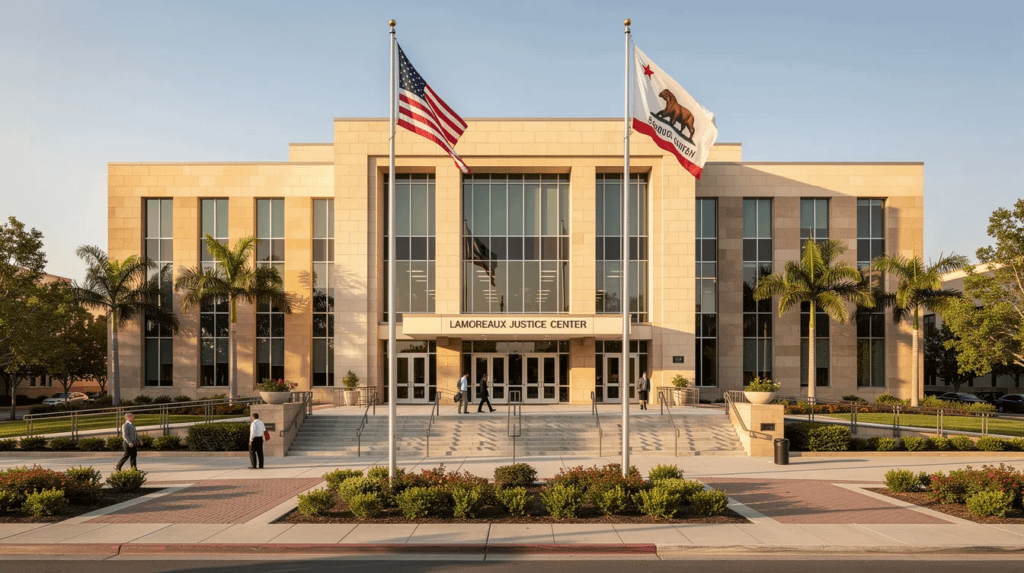
Ready to start? The process is procedural, and getting the paperwork right the first time can save you months of headaches at the Lamoreaux Justice Center in Orange County.
Step 1: Fill Out the Initial Forms
You will need a standard packet of forms to open your case. You can find these on the California Courts self-help guide.
- FL-100 (Petition): This is the main document. You’ll list your marriage date, separation date, and what you want the court to do regarding children and property. Crucial: Check the box for “Legal Separation.”
- FL-110 (Summons): This tells your spouse they are being sued and explains the “Standard Family Law Restraining Orders” (ATROs). These orders prevent either of you from moving children out of state or hiding money once the case starts.
- FL-105 (UCCJEA): If you have children under 18, this form is mandatory. It tracks where the children have lived for the last five years.
Step 2: Filing and Fees
Once your forms are ready, you file them with the court clerk. In Orange County, this is typically done at the Lamoreaux Justice Center. The filing fee is generally between $435 and $450. If you cannot afford this, you can file form FW-001 to request a fee waiver. For more details on these documents, see our california-divorce-forms-complete-guide.
Serving Papers and Financial Disclosures
After filing, you must “serve” your spouse. You cannot do this yourself. You must have an adult (a friend, relative, or professional process server) hand-deliver the papers. They then fill out FL-115 (Proof of Service), which you file with the court.
Your spouse has 30 days to file a “Response” (FL-120). If they don’t, you may be able to proceed by “default,” meaning you get what you asked for in your petition (within reason).
Financial Disclosures: No Secrets Allowed
California law requires a full and honest exchange of financial information. This is not optional. You must complete:
- FL-140 (Declaration of Disclosure)
- FL-150 (Income and Expense Declaration)
- FL-142 (Schedule of Assets and Debts)
These forms ensure that both parties know exactly what is in the “community pot.” If you hide a secret bank account in Costa Mesa, the court can penalize you heavily later. You can find these in our family-law-forms section.
Finalizing the Judgment and Orders
The goal of filing a legal separation in California is to reach a final Judgment (FL-180). This document acts as your new “rulebook” for life. It will detail:
- Child Custody and Visitation: Where the kids live and when they see each parent.
- Child Support: Calculated based on state guidelines.
- Spousal Support (Alimony): Whether one spouse pays the other to maintain their standard of living.
- Property Division: How you split the house in Tustin, the 401(k), and the credit card debt.
The best part? Once the judge signs the Judgment, it is final immediately. There is no six-month waiting period like there is for a divorce. To see the full path, view our legal-separation-in-california-the-ultimate-process-roadmap.
Advanced Considerations: Joint Petitions and Conversions
The legal landscape in California is always evolving to make things less adversarial.
The New Joint Petition (Coming 2026)
Starting January 1, 2026, California will introduce a “Joint Petition” process (FL-700). This allows both spouses to file together as “Petitioner 1” and “Petitioner 2.” It’s designed for couples who are already in total agreement and want to avoid the “petitioner vs. respondent” dynamic. However, you cannot request temporary court orders with this method; it’s strictly for those who have their entire agreement ready to go. You can read more about this on the Joint petition guide.
Amending to Divorce
What if you file for legal separation but realize halfway through that you actually want a divorce? You can amend your petition. If you didn’t meet the residency requirements for divorce when you first filed, you can file for separation first, wait until you hit the 6-month mark in California, and then file an amended FL-100 to change the case to a dissolution. This is a common strategy for people who have just moved to the area.
If you’ve never done this before, our guide on how-to-file-divorce-documents-even-if-youve-never-tried-it-before can help demystify the paperwork.
If you and your spouse agree on everything, your case is “uncontested.” You can write up your agreement, have a judge sign it, and you’re done.
If you disagree on things like who gets the house in Newport Beach or how much child support is fair, your case is “contested.” In these situations, you might end up in a trial at the Lamoreaux Justice Center. However, most contested cases are settled through mediation. Mediation is often faster, cheaper, and much less stressful than a public court battle. Our team at Pinkham & Associates, APLC specializes in these legal-services/legal-separation/ to help you find a middle ground.
Frequently Asked Questions about Filing a Legal Separation in California
Can I remarry after a legal separation?
No. This is the most common point of confusion. A legal separation settles your financial and parenting issues, but it leaves your marital status intact. To the eyes of the law, you are still “married.” To remarry, you must obtain a divorce to restore your status to “single.”
How much does it cost to file for legal separation?
The court filing fee is typically $435–$450. This doesn’t include costs for a process server or attorney fees. If you are on a limited income, you can ask the court to waive these fees. For a breakdown of the official steps and costs, refer to FL-107-INFO Legal Steps for a Divorce or Legal Separation.
Can I live in the same house while legally separated?
Yes. Under Family Code §70, the “date of separation” is defined by your intent and actions, not just your physical address. Given the high cost of living in Orange County, many couples continue cohabiting for financial reasons while being legally separated. Just ensure you are clearly living separate lives to satisfy the court’s requirements.
Conclusion
Filing a legal separation in California is a powerful tool for couples who need the structure of a court order without the finality of a divorce. Whether you are staying married for health insurance, religious reasons, or simply to keep your options open, understanding the process is the first step toward a stable future.
At Pinkham & Associates, APLC, we have spent over 25 years providing fearless advocacy and personalized strategies for families throughout Orange County. Whether you are in Irvine, Placentia, or Costa Mesa, we understand the local court systems and the nuances of California family law.
If you’re considering a legal separation, don’t navigate these complex waters alone. We offer free consultations to help you understand your rights and build a roadmap for your next chapter.
Contact Pinkham & Associates, APLC today to schedule your free consultation and get the expert guidance you deserve.