



What You Need to Know About Filing for Full Custody
Filing for full custody means asking a court to give one parent both the legal right to make decisions for a child and the primary (or exclusive) physical care of that child.
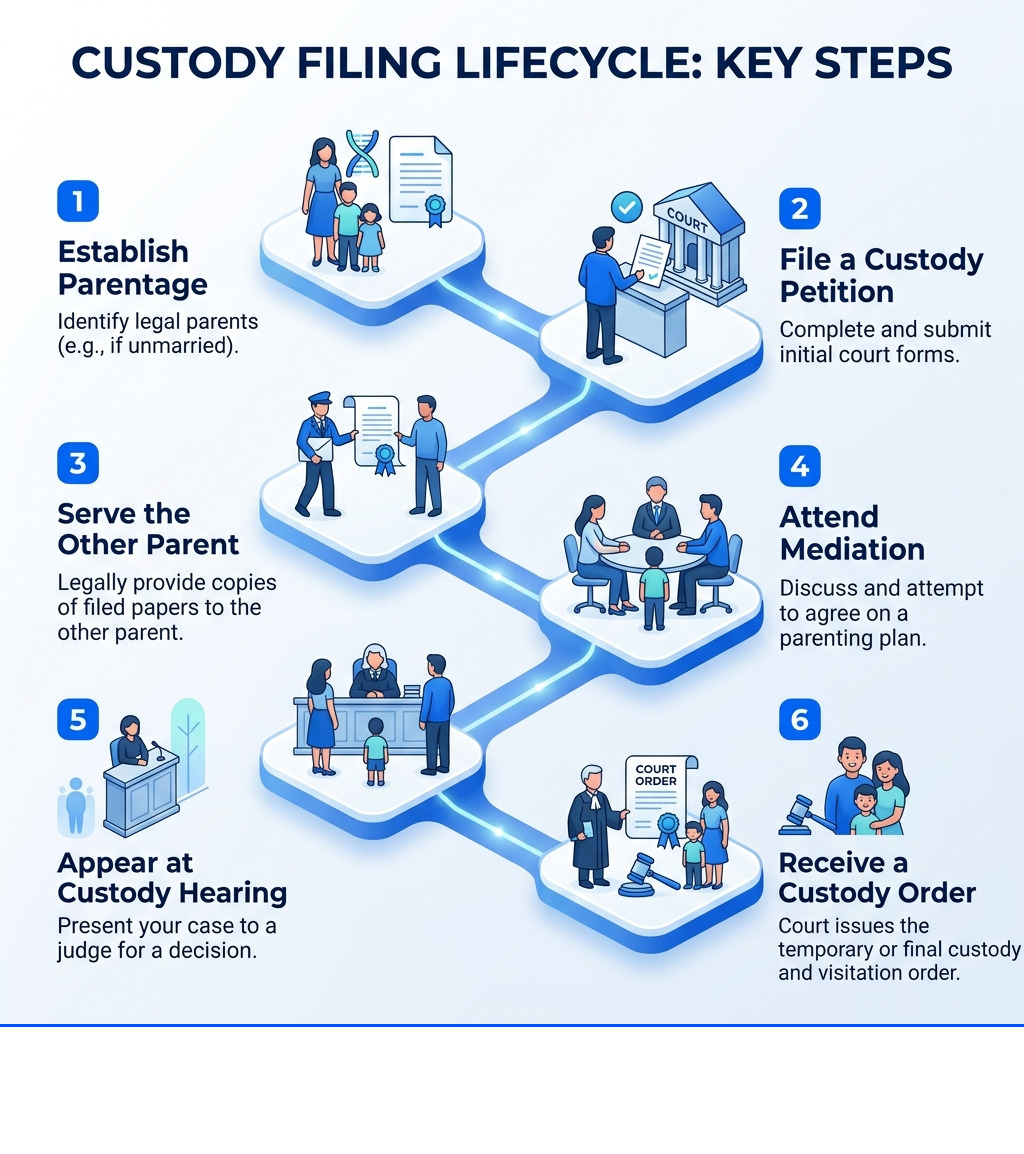
Here are the key steps at a glance:
- Establish parentage (if unmarried)
- File a custody petition with your county’s Superior Court
- Pay the filing fee (or apply for a fee waiver)
- Serve the other parent with copies of your filed documents
- Attend mediation (required in most California counties)
- Appear at your custody hearing and present your case
- Receive a temporary or final custody order from the judge
Full custody is not automatically granted just because one parent asks for it. Courts in California — and across the U.S. — base every custody decision on the best interests of the child. That means you’ll need to show evidence that full custody is the safest, most stable option for your child.
This is a high-stakes process. Mistakes in paperwork, missed deadlines, or the wrong words in court can hurt your case. Especially in contested cases, having an experienced family law attorney in your corner makes a real difference.
If you’re in Southern California and want to understand your options before you file, Pinkham & Associates, APLC offers free consultations to help you figure out the right path forward.
Understanding Full Custody vs. Joint Custody
When people talk about filing for full custody, they are usually referring to what California law calls “sole custody.” However, custody isn’t just one big bucket; it is divided into two distinct parts: legal and physical. Understanding the difference is the first step in building a successful case.
In California, the courts generally start with the presumption that joint custody—where both parents share rights and responsibilities—is in the child’s best interest. To win a case for Child Custody that is “full” or “sole,” the petitioner must prove that a joint arrangement would be detrimental to the child.
| Custody Type | What it Means | Decision Maker |
|---|---|---|
| Sole Legal Custody | One parent makes all major life decisions. | One Parent |
| Joint Legal Custody | Both parents must consult and agree on major decisions. | Both Parents |
| Sole Physical Custody | The child lives primarily with one parent. | One Parent (Primary) |
| Joint Physical Custody | The child spends significant time living with both parents. | Both Parents |
It is important to note that a parent can have sole physical custody but share joint legal custody. This is actually quite common in Orange County courts. For a deeper dive into the nuances of these rules, you can review California Child Custody Laws 2025 What You Need to Know.
Legal Custody vs. Physical Custody
Legal custody is about the “big picture” of a child’s life. If a parent is granted sole legal custody, they do not need the other parent’s consent to make decisions regarding:
- Healthcare: Choosing doctors, dentists, and mental health professionals.
- Education: Selecting schools, tutors, or special education programs.
- Religion: Deciding which religious activities or institutions the child attends.
- Extracurriculars: Signing up for sports, camps, or travel.
Physical custody, on the other hand, deals with the child’s daily residence. When a parent has sole physical custody, the child lives with them full-time. The other parent may still have “parenting time” or Child Custody and Timeshare rights, but the child’s “home base” is with the custodial parent.
The Role of Visitation for Non-Custodial Parents
A common misconception is that filing for full custody means the other parent disappears from the child’s life forever. In reality, California judges believe it is almost always better for a child to have frequent and continuing contact with both parents.
Even if one parent is awarded sole physical and legal custody, the court will typically grant the other parent Visitation rights. These can range from:
- Unsupervised Visitation: Scheduled weekends or evenings.
- Supervised Visitation: Visits that must occur in the presence of a professional monitor or a trusted family friend.
- No Visitation: Only ordered in extreme cases of abuse, neglect, or severe substance abuse where the child’s safety is at immediate risk.
While this guide focuses on California, other states like New York follow similar logic regarding the high bar for denying visitation entirely, as noted in this resource on How Do I Get Full Custody Of My Child In New York? – Family Law – United States.
Eligibility and Legal Requirements
Before you head to the courthouse, you must ensure you meet the legal requirements to file. The most critical standard used by every judge in California is The Best Interests of a Child Test. This isn’t just a catchy phrase; it’s a legal framework that looks at the child’s health, safety, and welfare above all else.
Another major hurdle is jurisdiction. Under the “Home State Rule,” a child must typically have lived in California for at least six consecutive months before a California court can make a custody order. If the child recently moved from another state, you might have to file in that state instead.
Establishing Parentage for Unmarried Parents
If the parents were never married, the process of filing for full custody usually begins with Paternity or parentage establishment. Without a legal determination of who the parents are, the court cannot issue custody or support orders.
Parentage can be established by:
- Voluntary Declaration of Parentage: Both parents sign a form (usually at the hospital) acknowledging they are the legal parents.
- Court Order: Filing a Petition for custody and support | California Courts | Self Help Guide to have the court legally recognize the father. This may involve DNA testing if parentage is disputed.
Who Can File Beyond Biological Parents?
While custody cases usually involve biological parents, other individuals can sometimes seek custody under “extraordinary circumstances.” This might include:
- Grandparents: If both parents are unfit or if the child has lived with the grandparent for a long period.
- Legal Guardians: Individuals appointed by the court to care for a child.
- De Facto Parents: Someone who has acted as the child’s parent on a day-to-day basis for a significant amount of time.
Judges take Some Factors Considered by the Court When Making Custody Orders very seriously when non-parents are involved, as the constitutional rights of biological parents are quite strong.
Step-by-Step Process: Filing for Full Custody in California
If you live in Orange County, your case will likely be handled at the Child Custody | Superior Court of California | County of Orange location known as the Lamoreaux Justice Center in the city of Orange.
The filing fee for a new custody case is generally between $435 and $450. If you cannot afford this, you can file a Request to Waive Court Fees. Once your papers are filed, you aren’t done—you must legally “serve” the other parent to give them notice of the proceedings. For those feeling overwhelmed by the paperwork, consulting an Irvine Child Custody Lawyer can ensure everything is filed correctly the first time.
Required Forms for Filing for Full Custody
The “paperwork” part of filing for full custody is often the most frustrating. In California, you will need several specific forms:
- Form FL-300 (Request for Order): This tells the judge exactly what you want (sole custody) and why.
- Form FL-260 or FL-100: These are the petitions that start the case. FL-100 is for divorce, while FL-260 is for “Petition for Custody and Support” for unmarried parents.
- UCCJEA Affidavit (Form FL-105): This form tells the court where the child has lived for the last five years to ensure California has the right to hear the case.
While these are California forms, the general process of filing a petition is a standard procedural step across many jurisdictions, including New York, as seen in Filing for Custody | NY CourtHelp.
Serving the Other Parent and Response Timelines
“Service of Process” is the legal term for delivering the court papers to the other parent. You cannot do this yourself. You must hire a professional process server, use the County Sheriff, or have a friend over 18 (who is not involved in the case) deliver the papers.
Once served, the other parent has 30 days to file a response. If they fail to respond, you may be able to seek a “default judgment,” where the judge grants your requests because the other parent didn’t show up to contest them.
Common Mistakes to Avoid When Filing for Full Custody
When emotions run high, it’s easy to make mistakes that haunt your case later. Avoid these pitfalls:
- Vindictive Language: Calling the other parent a “monster” or “loser” in court documents makes you look high-conflict, not like a concerned parent.
- Falsifying Evidence: Judges have a “BS detector” developed over decades. If you lie, you lose all credibility.
- Violating Temporary Orders: If the judge gives you a temporary schedule, follow it perfectly.
- Social Media Posts: Never post about your case, the other parent, or your “partying” lifestyle on Instagram or Facebook. Everything you post is potential evidence.
Proving Parental Fitness and Gathering Evidence

To win full custody, you must show the court that you are a fit parent and that the other parent lacks the capacity to provide a safe, stable environment. This is where What Judges Consider in Custody Decisions becomes your roadmap.
Evidence isn’t just your word against theirs. You need objective proof, such as:
- School Records: Attendance, grades, and teacher comments.
- Medical Reports: Proof of the child’s health or the other parent’s untreated health issues.
- Witness Testimony: Statements from neighbors, coaches, or family members who have seen the parenting dynamic first-hand.
- Communication Logs: Using apps like TalkingParents or OurFamilyWizard to show harassment or a refusal to co-parent.
In highly contested situations, you may need Expert Legal Help for Contentious Custody Battles to help subpoena records or depose witnesses.
Documenting Unfitness and Safety Concerns
If you are filing for full custody because the other parent is “unfit,” you must define what that means legally. In California, unfitness usually involves:
- Substance Abuse: Recent drug or alcohol abuse that affects parenting.
- Domestic Violence: A history of abuse toward the child or the other parent.
- Neglect: Failing to provide food, shelter, or medical care.
- Criminal History: Especially crimes involving violence or children.
For mothers in California, there is a specific guide on How Do You Get Full Custody of a Child as a Mother in California that outlines how to present this evidence effectively.
The Role of Custody Evaluators and Mediation
In Orange County, mediation is mandatory before you see a judge. A court-appointed mediator will try to help you and the other parent reach an agreement. If you can’t agree, the court may order a “730 Evaluation.”
A custody evaluator (usually a psychologist) will perform home studies, interview the child, and review all evidence before making a recommendation to the judge. During this time, the judge may also consider the child’s preference, though as discussed in Can a Child Pick Which Parent to Live With in Orange County, a child’s wish is rarely the only factor.
Emergency Orders and Modifying Existing Custody
Sometimes, you can’t wait months for a hearing. If a child is in immediate danger of physical harm or being abducted, you can file for an “Ex-Parte” or emergency order.
Requesting Emergency Full Custody
An emergency petition asks the judge to make a decision within 24 to 48 hours. Valid reasons for an emergency order include:
- A credible threat of child abduction to another country or state.
- Recent physical or sexual abuse.
- Severe neglect (e.g., a parent being incarcerated or hospitalized with no one to care for the child).
If you find yourself in a situation where you previously lost custody and now need to act because of an emergency, you should review How to Get Child Custody Back for strategic advice.
Modifying a Final Custody Order
Custody orders are never truly “final.” They can be changed until the child turns 18. However, to change an existing order to full custody, you must prove there has been a “significant change in circumstances.” This could be a parent’s relocation, a new substance abuse problem, or the child’s declining health. Understanding What Happens at a First Custody Hearing in Orange County can help you prepare for the modification process.
Frequently Asked Questions about Filing for Custody
How long does the process typically take?
In California, getting a temporary order can take 4 to 8 weeks. However, a fully contested trial for permanent sole custody can take anywhere from six months to over a year, depending on the court’s backlog and whether evaluations are required.
Do I need a lawyer to file for full custody?
While you are allowed to represent yourself, filing for full custody is incredibly complex. If the other parent has an attorney, you are at a significant disadvantage. A lawyer knows the rules of evidence and how to present a case that aligns with the “best interests” standard. For tips on selection, see The Ultimate Guide to Finding Custody Attorneys Who Actually Get It.
How does child support factor into full custody?
Child support is almost always a part of the conversation. Generally, the parent with sole physical custody will receive child support from the non-custodial parent. The amount is calculated using a state-wide formula that considers both parents’ incomes and the amount of time the child spends with each.
Conclusion
Filing for full custody is one of the most significant legal steps a parent can take. It requires a clear strategy, meticulous documentation, and a deep understanding of California’s “best interest” laws. Whether you are dealing with a high-conflict divorce or a safety emergency, you don’t have to navigate this path alone.
Pinkham & Associates, APLC has spent over 25 years providing fearless advocacy and personalized strategies for families in Orange County, Irvine, Tustin, and throughout Southern California. We understand that your children are your world, and we treat every case with the urgency and care it deserves. We have Orange County child custody attorneys ready to help.
If you are ready to take the next step, contact us today. Pinkham & Associates, APLC offers free consultations to help you protect your parental rights and your child’s future. More info about child custody services is available on our website to help you start your journey toward a stable family life.