

What Are the Contested Divorce Steps? A Quick Answer First
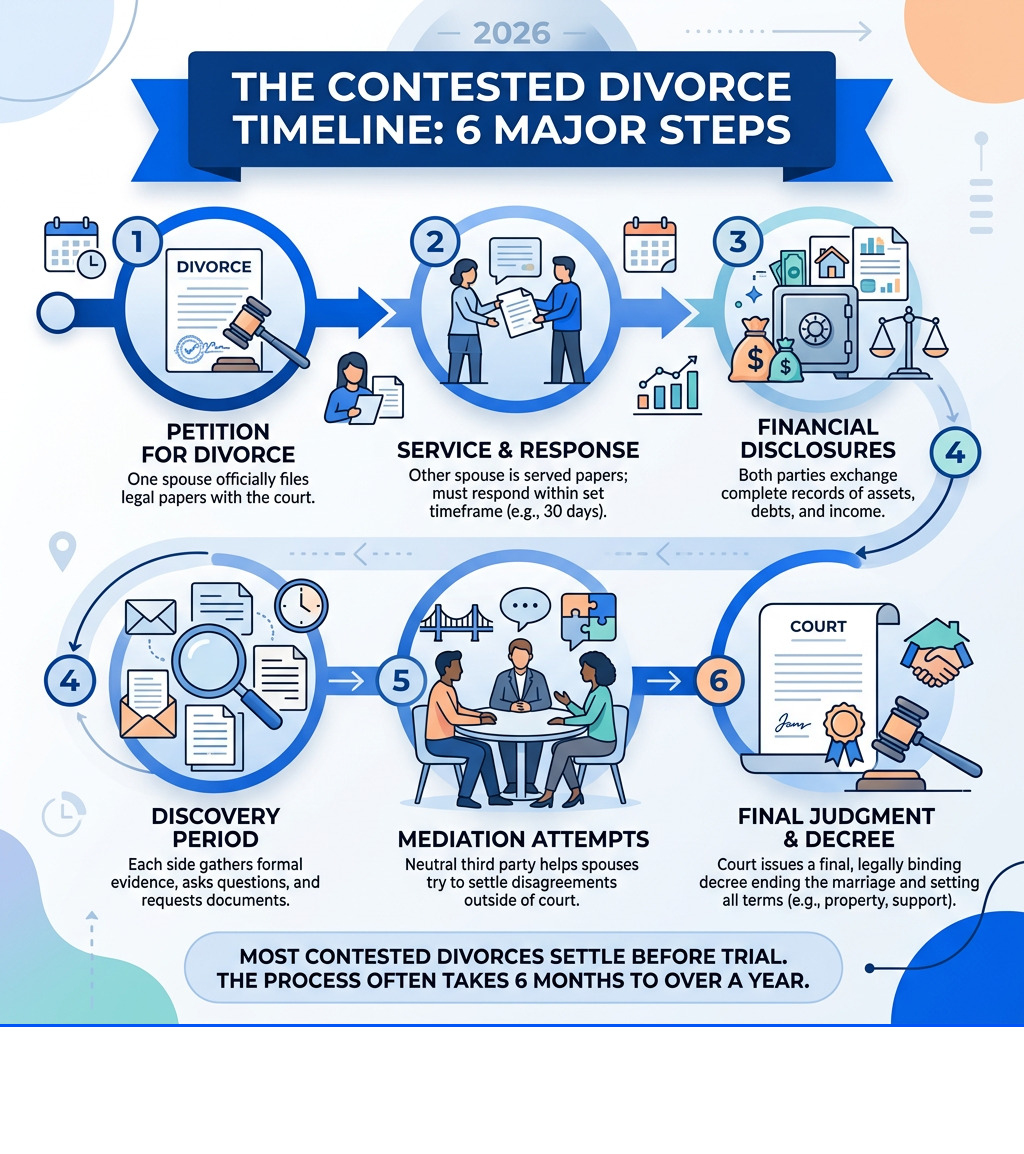
If you’re facing a contested divorce, here are the core steps you’ll go through:
- Filing – One spouse files a petition for divorce with the court
- Service – The other spouse is formally served with divorce papers and has 30 days to respond
- Financial Disclosures – Both spouses exchange mandatory financial documents
- Discovery – Each side gathers evidence through interrogatories, depositions, and document requests
- Temporary Orders – A judge may set interim rules on custody, support, and use of assets
- Mediation – Spouses attempt to reach a settlement with a neutral third party
- Trial – If no settlement is reached, a judge hears evidence and makes final rulings
- Final Judgment – The court issues a decree that legally ends the marriage
Most cases settle before ever reaching trial — but the process can still take anywhere from 6 months to well over a year.
Going through a contested divorce is one of the hardest things a person can face. It’s not just a legal process — it’s an emotional marathon, especially when children, a family home, or years of shared finances are on the line.
Unlike a simple split where both spouses agree on everything, a contested divorce means at least one major issue is unresolved. That could be who the kids live with, how the house gets divided, or whether one spouse receives spousal support. When those disagreements can’t be worked out privately, the court steps in — and the process gets longer, more expensive, and significantly more stressful.
The good news? Understanding what’s coming makes it far less overwhelming. This guide walks you through every stage of the process clearly, so you know what to expect and how to protect yourself and your family at each step.
And if you have questions specific to your situation, Pinkham & Associates, APLC offers free consultations — so you don’t have to figure this out alone.
Contested vs. Uncontested: Which Path Are You On?
In family law, there are essentially two paths to ending a marriage. An uncontested divorce is the “easy” route—at least on paper. It occurs when both spouses agree on every single term of the split, from who gets the blender to who gets the house. They sign a marital settlement agreement, present it to the court, and the judge signs off.
A contested divorce is the opposite. It happens when spouses cannot agree on one or more important terms. This doesn’t necessarily mean you are at war; it simply means you need the court’s intervention to resolve disputes. Because the court must get involved, the contested divorce steps involve more paperwork, more time, and more formal legal procedures.
Deciding which path is right for you often depends on the level of conflict and the complexity of your assets. You can learn more about these differences in our guide on uncontested vs contested divorce which is right for you.
| Feature | Uncontested Divorce | Contested Divorce |
|---|---|---|
| Cost | Generally lower; fewer billable hours | Higher; involves discovery and hearings |
| Speed | Can be finished in months | Often takes 6–12+ months |
| Control | Spouses decide the outcome | A judge may make the final decision |
| Stress | Lower; collaborative | Higher; adversarial |
Common Disagreements in Contested Divorce Steps
What exactly makes a divorce “contested”? It isn’t always a screaming match. Sometimes, it’s a simple, calm disagreement over a complex financial asset. Common friction points include:
- Child Custody and Visitation: Deciding where the children will live and how much time they spend with each parent.
- Asset Division: California is a community property state, meaning marital assets are generally split 50/50. However, determining what is “separate property” versus “community property” is a frequent source of conflict.
- Spousal Maintenance (Alimony): Disagreement might be over any combination of: property, debts, spousal maintenance (alimony), child custody or parenting time, child support, or valuation of assets.
- Debt Allocation: Who is responsible for the credit card bills or the mortgage?
- Business Valuation: If one spouse owns a business, determining its worth can be a massive undertaking.
The First Contested Divorce Steps: Filing and Service
The legal journey officially begins with a Petition for Dissolution of Marriage. In Orange County, the spouse who starts the process is the “Petitioner,” and the other is the “Respondent.”
To file in California, at least one spouse must have lived in the state for six months and in the county where they are filing for three months. The petition outlines the basic facts of the marriage and what the Petitioner is asking for (custody, support, etc.). Navigating these initial forms can be tricky, so we’ve put together the no stress guide to california divorce forms to help you keep your sanity.
Once the papers are filed, they must be “served.” This is the formal process of delivering the Summons and Petition to the other spouse. In California, you cannot serve your own spouse; a neutral third party, such as a process server or a sheriff, must do it. Once served, the Respondent has a 30-day response window to file their own papers.
What Happens if a Spouse Refuses to Sign?
A common myth is that you can’t get divorced if your spouse “refuses to sign the papers.” This is false. If your spouse is served and simply ignores the documents, the case moves into what is called a true default.
If they refuse to cooperate, the court can eventually grant the divorce without their input. You can read more about what happens if my spouse refuses to sign divorce papers in california to understand the “proof of service” requirements and how to move forward when the other side is being difficult.

Discovery and Temporary Orders: Gathering the Facts
Once the initial paperwork is handled, the “Discovery” phase begins. This is often the longest part of the contested divorce steps. Discovery is the formal process of exchanging information. Neither spouse is allowed to hide assets or lie about income.
During this phase, both parties must provide mandatory financial disclosures. This includes tax returns, bank statements, pay stubs, and retirement account info. To get a deeper look into the other side’s finances or claims, your attorney may use:
- Interrogatories: Written questions that the other spouse must answer under oath.
- Depositions: Out-of-court testimony given under oath, usually recorded by a court reporter.
- Subpoenas: Legal orders for third parties (like banks or employers) to produce records.
- Document Production: Formal requests for physical or digital files.
If the other side is being uncooperative during this phase, your lawyer may need to prepare a motion to ask the judge to compel them to provide the information.
Securing Stability with Temporary Orders
Divorces don’t happen overnight, but bills still need to be paid and kids still need a schedule. This is where Temporary Orders (also known as pendente lite orders) come in.
A judge can issue temporary rulings to maintain the “status quo” while the divorce is pending. These orders cover:
- Child Support and Alimony: Ensuring the lower-earning spouse can survive during the litigation.
- Custody Schedules: Establishing who has the kids on which days.
- Attorney Fees: In some cases, the higher-earning spouse may be ordered to pay a portion of the other spouse’s legal fees to ensure a level playing field.
- Use of the Family Home: Deciding who stays in the house and who pays the mortgage.
Mediation: Can You Settle These Contested Divorce Steps Out of Court?
Just because a divorce starts as “contested” doesn’t mean it has to end in a courtroom battle. In fact, the vast majority of cases settle before trial. One of the most effective ways to reach an agreement is through mediation.
In mediation, a neutral third party helps both spouses communicate and find middle ground. The mediator doesn’t make decisions for you; instead, they facilitate a conversation to help you reach a voluntary settlement. Many people prefer this because it keeps the power in their hands rather than leaving it to a judge who doesn’t know their family.
At Pinkham & Associates, APLC, we offer mediation flat fee options for those looking for a predictable cost while trying to resolve their disputes amicably. Even if you only agree on some issues, mediation can significantly narrow the scope of a trial.
Converting a Contested Case to Uncontested
It is possible—and often encouraged—to convert a contested case into an uncontested one at any point. This usually happens through negotiation. Once an agreement is reached, the attorneys draft a stipulated judgment.
By settling, you achieve:
- Cost Reduction: You stop paying for trial prep and expert witnesses.
- Speed: You don’t have to wait for a court date on a crowded docket.
- Privacy: Settlement details are often more private than a public trial.
The Final Stage: Trial and Judgment
If mediation fails and no settlement is reached, the case proceeds to a divorce trial. This is the “Hollywood” version of divorce, but in reality, it is a formal and often grueling process.
When spouses cannot agree on important terms of a divorce—such as how to divide property, custody of children, or financial support—the case becomes a contested divorce. In a trial, the court must intervene to resolve these disputes.
During the trial:
- Evidence is Presented: Both sides submit documents, photos, and financial records.
- Witness Testimony: You, your spouse, and potentially experts (like child psychologists or forensic accountants) will testify.
- Cross-Examination: Each attorney has the chance to question the other side’s witnesses.
- Judge’s Ruling: After hearing all the evidence, the judge makes a final decision on all unresolved issues.
- Final Decree: The court issues a written judgment that legally ends the marriage and dictates the terms of the split.
Managing the Timeline and Costs of Your Case
One of the most frequent questions we hear is: “How long will this take?” While every case is unique, a contested divorce in California typically lasts between 6 and 12 months, though complex cases involving high-value assets or intense custody battles can go on for over a year.
Several factors affect the timeline:
- Court Backlogs: Orange County courts are busy, and getting a trial date can take time.
- Cooperation: If one spouse is slow to provide discovery, the process drags on.
- Complexity: Valuing a business or evaluating a child’s best interests takes time.
Costs also vary. You’ll be looking at filing fees, attorney fees, and potentially expert witness costs. Working with an experienced contested divorce lawyer in tustin or Orange County can actually save you money in the long run by preventing costly mistakes and focusing on efficient strategies.
Frequently Asked Questions about Contested Divorce
How long do the contested divorce steps typically take?
In California, there is a mandatory six-month waiting period from the date the Respondent is served before the divorce can be finalized. However, because of discovery, mediation, and court scheduling, most contested cases take 10 to 18 months.
Can I settle my case after the trial has already started?
Yes! You can settle at any time—even on the morning of the trial or during a lunch break in the middle of testimony. Judges generally prefer when couples reach their own agreements and will usually stop the trial to review and approve a settlement.
Do I need a lawyer for a contested divorce?
While you are legally allowed to represent yourself, it is highly risky in a contested case. The rules of evidence and procedure are complex. If your spouse has an attorney and you don’t, you may be at a significant disadvantage. If your case was uncontested, you might wonder do i need a lawyer for an uncontested divorce, but in a contested scenario, professional advocacy is essential to protect your rights.
Conclusion
The contested divorce steps are undoubtedly challenging, but they are a means to an end. By following the procedural roadmap—from the initial filing through discovery and potentially to trial—you are moving toward a new chapter of your life.
At Pinkham & Associates, APLC, we have spent over 25 years focusing exclusively on family law in Orange County. We provide the fearless advocacy and personalized strategy needed to navigate high-conflict situations without losing your mind. Whether you are in Irvine, Tustin, Newport Beach, or anywhere else in the region, we are here to help.
Don’t let the process overwhelm you. Take the first step toward clarity and peace of mind by contacting us for a free consultation.