


What Is the California Legal Separation Process?
The california legal separation process is a formal court procedure that lets married couples live apart, divide property, and set support and custody terms — all while staying legally married.
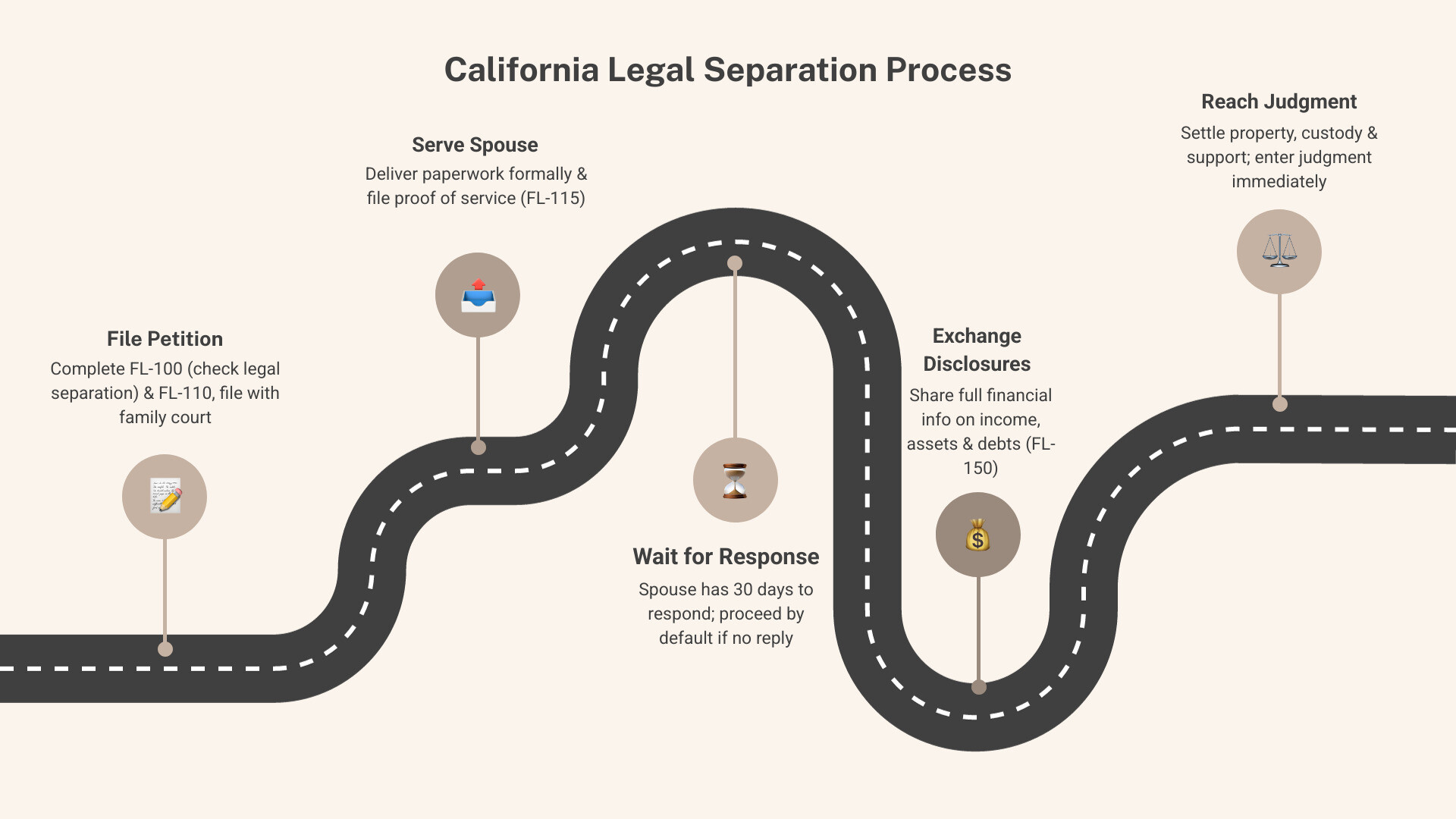
Here’s a quick overview of the core steps:
- File your petition — Complete form FL-100 (check the “legal separation” box) and form FL-110, then file with your county’s family court.
- Serve your spouse — Formally deliver the paperwork to your spouse and file proof of service (FL-115).
- Wait for a response — Your spouse has 30 days to respond. If they don’t, you can proceed by default.
- Exchange financial disclosures — Both spouses must share a full picture of income, assets, and debts.
- Reach a judgment — Settle all issues (property, custody, support) by agreement or through the court, then file the final judgment.
Unlike divorce, there is no 6-month waiting period for legal separation. A judgment can be entered as soon as both sides agree — or if no response is filed.
That said, the process isn’t always simple. Many Southern California parents face tough decisions about child custody, support, and asset division at the same time they’re dealing with real emotional strain. Divorce litigation alone can cost anywhere from $15,000 to well over $50,000 — which is why understanding all your options matters.
Legal separation gives couples a structured legal framework without permanently ending the marriage. Whether you’re considering it as a stepping stone to divorce, a way to protect your finances, or a solution that fits your personal beliefs, it’s worth knowing exactly how it works before you decide.
Pinkham & Associates, APLC offers free consultations to help you figure out the right path forward for your family.
Understanding Legal Separation vs. Divorce in California
When couples in Irvine or Newport Beach reach a crossroads, the first question is usually: “What is the difference between getting a divorce and a legal separation?” While both processes involve the court and address the same core issues—like who gets the house and where the kids sleep—the final result for your marital status is completely different.
In a divorce, your marriage is legally terminated. You return to the status of a “single person” and are free to remarry. In a legal separation, you remain legally married to your spouse. You cannot remarry, but you are no longer financially or legally tied to their future debts or actions.
Why Choose Legal Separation?
There are several strategic and personal reasons why residents in Tustin or Yorba Linda might choose the california legal separation process over a standard dissolution:
- Religious Beliefs: Some religions do not recognize or permit divorce. Legal separation allows couples to live independent lives and resolve financial matters without violating their faith.
- Health Insurance Retention: In many cases, a person can stay on their spouse’s employer-provided health insurance plan if they are legally separated but not divorced. Once a divorce is final, that coverage usually ends immediately.
- Social Security Benefits: Under federal law, if a marriage lasts at least 10 years, a person may be eligible for derivative Social Security benefits based on their spouse’s earnings. If a couple is close to that 10-year mark, they might choose legal separation to “clock in” those extra months or years.
- Tax Implications: Legally separated couples may still be able to file joint tax returns, which can offer significant savings depending on their income brackets.
- A “Trial Run”: For some, it is a way to test the waters of living apart. Interestingly, research shows that about 14% of couples who legally separate eventually reconcile.
For a deeper dive into these nuances, you can read more about Legal Separation vs Divorce in Orange County Explained.
Comparison Table: Divorce vs. Legal Separation
| Feature | Divorce (Dissolution) | Legal Separation |
|---|---|---|
| Marital Status | Terminated (Single) | Remains Married |
| Right to Remarry | Yes | No |
| Residency Requirement | 6 months in CA / 3 months in County | None (Immediate filing) |
| Waiting Period | Minimum 6 months | None |
| Property Division | Yes | Yes |
| Spousal/Child Support | Yes | Yes |
Eligibility and the California Legal Separation Process
California is a “no-fault” state. This means you don’t have to prove your spouse did something wrong (like cheating or being mean) to file for legal separation. You simply need to state that there are “irreconcilable differences” that have caused an irremediable breakdown of the marriage.
One of the biggest advantages of the california legal separation process is the lack of residency requirements. To file for a divorce in Orange County, at least one spouse must have lived in California for six months and in the county for three months. If you just moved to Placentia or Costa Mesa yesterday, you can’t file for divorce yet—but you can file for legal separation immediately. This is a common strategy for new residents who need immediate court orders for child support or custody.
To start the case, you must use the Petition for Dissolution of Marriage (form FL-100). Don’t let the name fool you; this same form is used for both divorce and separation. You simply check the box for “Legal Separation.” You will also need to file a Summons (form FL-110), which notifies your spouse that a court case has started and explains the automatic temporary restraining orders (ATROs) that prevent either of you from moving the kids or hiding money.
Step 1: Initiating the California Legal Separation Process
The first step is paperwork. Beyond the FL-100 and FL-110, if you have children, you must also file form FL-105, which tells the court where the children have lived for the last five years.
Once the forms are filled out, they must be filed with the Clerk of the Court. In Orange County, this usually involves paying a filing fee (currently around $435). If you cannot afford the fee, you can request a “fee waiver” from the court. For a detailed walkthrough of these requirements, check out The No-Stress Guide to California Divorce Forms.
Timeline and Waiting Periods in the California Legal Separation Process
Unlike a divorce, which has a mandatory “cooling-off” period of six months and one day before you can be officially single, legal separation has no waiting period. If you and your spouse agree on everything on day one, the judge can sign your judgment immediately.
However, the clock starts once the “Respondent” (the spouse who didn’t file) is served. They have 30 days to file a “Response” (form FL-120). If they don’t respond, the “Petitioner” can ask for a “default,” meaning the judge can grant the separation based on the Petitioner’s requests without the other spouse’s input.
Financial Disclosures and Property Division
California is a community property state. This means that generally, any assets or debts acquired during the marriage belong equally to both spouses. Conversely, “separate property” is anything you owned before the marriage or received as a gift or inheritance during the marriage.
In the california legal separation process, determining the “date of separation” is critical. This is the date when one spouse intended to end the marriage and their actions matched that intent (like moving out or announcing the split). Anything earned or bought after this date is typically considered separate property.
Mandatory Disclosures
You cannot finish a legal separation without “showing your cards.” Both spouses must exchange a “Declaration of Disclosure.” This includes:
- Schedule of Assets and Debts (FL-142): A list of everything you own and everything you owe.
- Income and Expense Declaration (form FL-150): A detailed look at what you earn and what you spend each month.
The court uses these forms to decide on spousal support (alimony). The judge looks at the “marital standard of living,” the length of the marriage, and each person’s ability to work. In Orange County, the goal is often to ensure that both parties can maintain a lifestyle similar to what they had during the marriage, at least for a period of time.
Managing Child Custody and Support Orders
For parents in Irvine or Yorba Linda, the kids are the top priority. In a legal separation, the court can make the exact same orders regarding children as it would in a divorce.
Custody Types
- Legal Custody: Who makes the big decisions? This covers school, doctor visits, and religious upbringing. Most parents share “joint legal custody.”
- Physical Custody: Where do the kids live? This can be “joint” (the kids spend significant time with both) or “sole” (the kids live with one parent and visit the other).
The court’s only standard is the “best interests of the child.” This means the judge doesn’t care about what’s “fair” to the parents; they care about what provides the child with health, safety, and frequent, continuing contact with both parents.
Child Support
California uses a strict statewide formula to calculate child support. It primarily looks at:
- How much money each parent makes.
- The percentage of time each parent spends with the child.
- Certain expenses like health insurance premiums or mandatory retirement contributions.
Because this is a math-based guideline, there is very little room for “negotiation” on the base amount, though parents can agree to share “add-on” costs like extracurricular activities or private school tuition in Placentia.
Finalizing the Case or Converting to Divorce
Once you have exchanged disclosures and reached an agreement on all issues—or had a judge decide them at a trial—you will submit a Judgment (form FL-180). This document outlines every detail of your new life: who gets the SUV, how the 401(k) is split, and the holiday visitation schedule.
Mediation and Settlements
Many couples find that the california legal separation process is much smoother when using mediation. Instead of fighting in a courtroom, a neutral mediator helps you find common ground. This is often faster and much less expensive than a trial. For more on how the court views these basics, see the Legal separation basics guide.
What if You Change Your Mind?
Life happens. Sometimes couples legally separate and then realize they want to be fully divorced.
- Before the Judgment is final: You can simply “amend” your petition. You file the same FL-100 form but check the “Dissolution” box this time. If you now meet the residency requirements, the case simply shifts tracks.
- After the Judgment is final: If you are already legally separated and decide you want a divorce, you must file a brand-new case for dissolution of marriage.
Interestingly, while some move toward divorce, others move back together. The U.S. Census Bureau suggests a 14% reconciliation rate for separated couples. If you reconcile, you can ask the court to dismiss your case or vacate the separation judgment.
Frequently Asked Questions about Legal Separation
Can I remarry while legally separated?
No. This is the most important thing to remember. In the eyes of the law, you are still married. If you try to marry someone else while legally separated, it is considered bigamy, and the new marriage will be void. You must finish a divorce (dissolution) to restore your “single status” before you can say “I do” again.
Does my spouse have to agree to a legal separation?
Yes and no. To get a judgment of legal separation, both spouses must usually agree. If you file for legal separation and your spouse files a “Response” asking for a divorce, the court will almost always grant the divorce instead. California law favors the “greater” remedy; if one person wants the marriage to be over, the court isn’t going to force them to stay legally married.
Can I change a legal separation to a divorce later?
Absolutely. As mentioned earlier, if the case is still open, you can amend your petition. If you filed for separation because you hadn’t lived in Orange County long enough, you can “upgrade” to a divorce petition once you hit that 3-month/6-month mark. You don’t even have to pay a new filing fee to amend the petition in most cases.
Conclusion
The california legal separation process is a powerful tool for couples who need the protection and structure of the law but aren’t ready—or aren’t able—to end their marriage entirely. Whether you are looking to preserve health insurance, honor your religious values, or simply take a “breather” while protecting your assets, legal separation offers a flexible path forward.
However, because the decisions you make now regarding property division, child custody, and support will affect you for years to come, you shouldn’t navigate this roadmap alone. At Pinkham & Associates, APLC, we bring over 25 years of exclusive focus to family law. We provide personalized strategies and fearless advocacy for families in Orange County, Irvine, Tustin, and the surrounding areas.
If you’re ready to explore your options with a team trusted by other lawyers for our high success rate, we are here to help.
More info about legal separation services
Contact Pinkham & Associates, APLC today to schedule your free consultation and take the first step toward your new chapter.