


When You Need a Domestic Partnership Dissolution Lawyer: What to Know First
A domestic partnership dissolution lawyer helps unmarried couples legally end their relationship — handling property division, financial support, parental rights, and more. Here’s a quick breakdown of when and why you need one:
Who needs a domestic partnership dissolution lawyer?
- Registered domestic partners ending their relationship in California or Florida
- Unmarried couples with shared property, debts, or children
- Same-sex couples navigating dissolution without the clear legal framework of traditional divorce
- Parents fighting for custody or parental rights without a formal marriage record
Key things to know upfront:
- California gives registered domestic partners nearly the same legal rights as married couples
- Florida has no statewide recognition — rights depend entirely on your city or county
- Without prior written agreements, dissolving a domestic partnership can be complicated and contentious
- A lawyer can protect your property, your children, and your financial future
Ending a domestic partnership isn’t as simple as just walking away. Unlike divorce, there’s no single, uniform legal process — especially in Florida, where recognition varies by local ordinance. The legal path forward depends heavily on where you live, whether you’re registered, and what agreements you have in place.
That complexity is exactly why getting the right legal help matters. Pinkham & Associates, APLC offers free consultations to help you understand your options before you take a single step.
Understanding Domestic Partnerships in Florida and California
Navigating the legal landscape of domestic partnerships can feel like walking through a maze where the walls keep moving. In the United States, the rules change drastically the moment you cross state lines. For residents in California and Florida, the differences are stark.
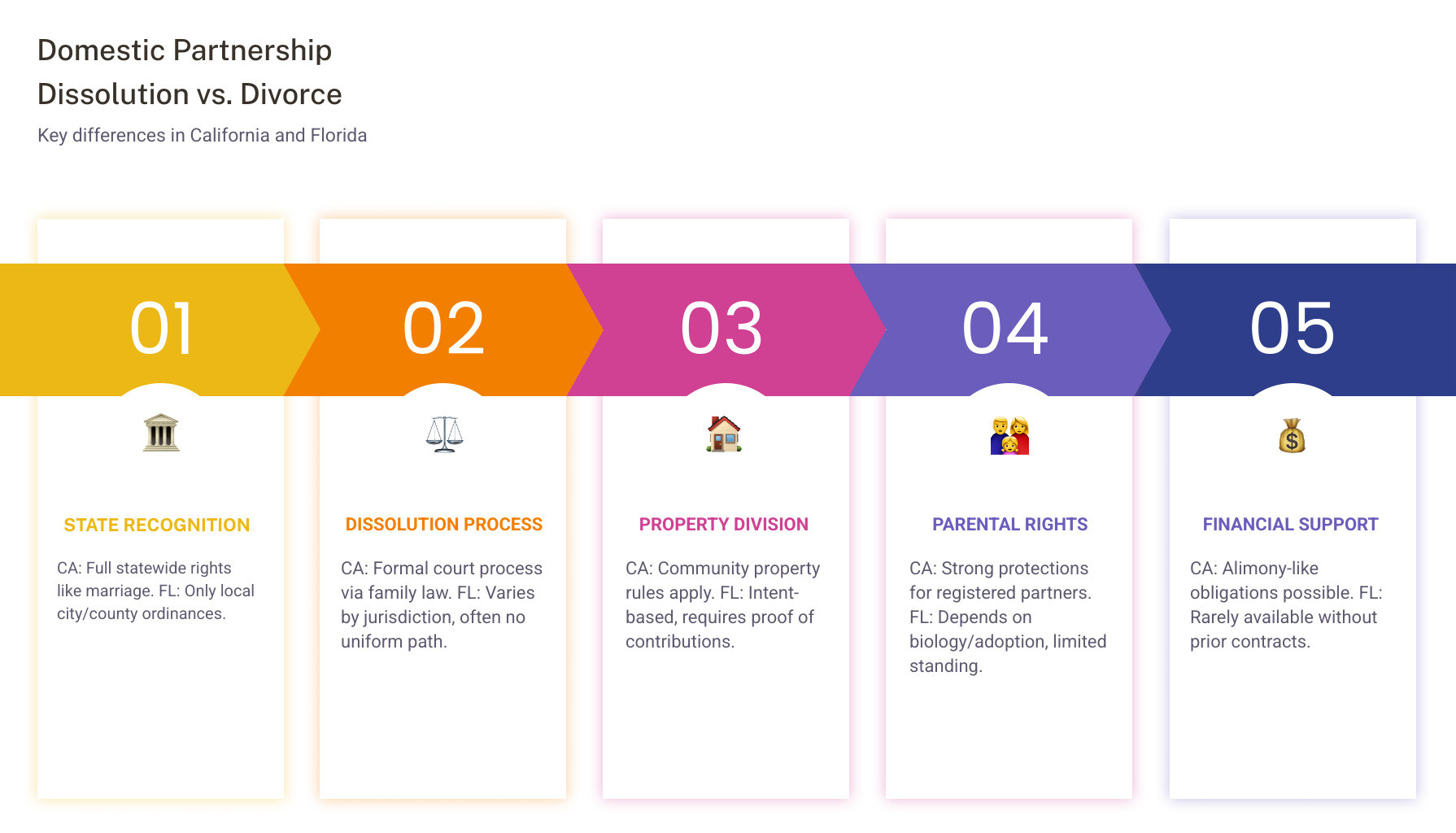
In California, the state provides a robust framework for registered domestic partners. Under California law, registered partners are granted nearly all the same rights, protections, and benefits—as well as the same responsibilities and obligations—as married spouses. This includes the right to use the family law courts for a formal dissolution.
Florida, however, takes a different approach. There is no statewide recognition of domestic partnerships in the Sunshine State. Instead, “rights” are a patchwork of local ordinances. Cities like Orlando have established their own rules, such as Sec. 57.81-,Sec.%2057.81.%20%2D%20Registration%20of%20Domestic%20Partnerships.,COMPARE%20VERSIONS,-(a)), which allows couples to establish domestic partnerships-,Sec.%2057.81.%20%2D%20Registration%20of%20Domestic%20Partnerships.,COMPARE%20VERSIONS,-(a)) at the municipal level. Other areas with registries include Orange County, Miami-Dade, and Broward County.
To register in these jurisdictions, couples typically must meet specific eligibility requirements:
- Both partners must be at least 18 years old.
- Neither can be married or in another domestic partnership.
- They cannot be related by blood in a way that would prohibit marriage.
- They must share a primary residence.
- They must sign a notarized affidavit agreeing to mutual support and responsibility for each other’s welfare.

Because there is no uniform state law in Florida, a domestic partnership dissolution lawyer must be an expert in local “home rule” powers. These local registries provide limited but vital rights, such as hospital visitation, the authority to make medical decisions if a partner is incapacitated, and next-of-kin status for funeral arrangements.
However, having “standing” in a local registry doesn’t automatically give you the right to ask a judge for alimony or a 50/50 split of a house. This is where a Same-Sex Divorce Attorney becomes essential. They understand which rights are enforceable by contract and which require specific litigation strategies to protect your interests when the partnership ends.
Why You Need a Domestic Partnership Dissolution Lawyer
When a marriage ends, the law provides a “safety net” of statutes that dictate how things should be split. When a domestic partnership ends—especially one that wasn’t registered or exists in a state with limited protections—that safety net disappears. You aren’t just going through a breakup; you are often entering into complex civil litigation.
If you and your partner disagree on who gets the house, how to split the savings, or who the children should live with, you are facing a Contested Divorce scenario without the benefit of standard divorce laws. A lawyer provides the advocacy needed to ensure you aren’t left with nothing simply because you didn’t have a marriage license.
When to Hire a Domestic Partnership Dissolution Lawyer for Property Disputes
Property division for unmarried couples is one of the most contentious areas of law. In a traditional marriage, assets acquired during the union are usually considered community property. In a domestic partnership, things get murky fast.
A domestic partnership dissolution lawyer can help with:
- Property Division: Determining what was intended to be shared versus what remains separate.
- Commingled Assets: Untangling bank accounts or investments where both partners’ money was mixed.
- Partition Actions: If you own a home together but aren’t married, you may need a partition action—a legal proceeding to force the sale of the property or a buyout—similar to how business partners split up.
- Business Valuation and Goodwill: This is particularly complex for high-net-worth individuals. In cases like Marriage of Slater, the courts looked at whether a partner’s interest in a medical practice was an asset to be divided or just a contractual right. Similarly, in Marriage of Baltins, the court dealt with the aftermath of one spouse using duress and misrepresentation to secure an unfair property split.
Choosing the Right Domestic Partnership Dissolution Lawyer for Your Case
Not all family lawyers are equipped to handle the nuances of domestic partnerships. You need someone who can balance the “business” side of a breakup with the emotional reality of family law. Whether you are aiming for an Uncontested vs Contested Divorce style of resolution, your attorney should prioritize negotiation and mediation to save you time and stress. However, if your partner is being unreasonable, you need a firm with the trial experience to fight for your fair share.
In California, registered domestic partners generally follow community property rules. This means everything earned or acquired during the partnership belongs equally to both people. In Florida, however, you may have to rely on “intent.” Did you intend for the house to be joint property? Can you prove you contributed to the mortgage even if your name isn’t on the deed?
The issue of Spousal Support (alimony) is another major hurdle. In California, registered partners can request support just like married couples. In Florida, there is no statutory right to alimony for domestic partners. Unless you have a written cohabitation agreement that promises support, a court might not have the power to award it.
Other financial challenges include:
- Retirement Assets: Dividing a 401(k) or pension often requires a Qualified Domestic Relations Order (QDRO). Doing this for a domestic partnership requires precision to avoid massive tax penalties.
- Federal Limitations: Domestic partners cannot file joint federal tax returns and do not qualify for Social Security survivor benefits, which makes the division of existing assets even more critical for your long-term security.
Protecting Your Financial Future
The best way to handle a dissolution is to prepare for it before it happens. At Pinkham & Associates, APLC, we often advise unmarried couples to create “safety nets” through:
- Cohabitation Agreements: These act like “pre-nups” for unmarried couples, clearly stating who owns what.
- Legal Separation Documents: Formally outlining the end of financial ties.
- Estate Planning: Since domestic partners don’t have automatic inheritance rights in many places, having a will and a Power of Attorney is the only way to ensure your partner is protected (or that an ex-partner is removed).
Child Custody and Parental Rights for Domestic Partners
Nothing is more important than your children. For domestic partners, Child Custody and Child Support can be legally perilous if one partner is not the biological parent.
In California, the law is clear: if you are a registered domestic partner, you are presumed to be a legal parent of any child born into that partnership. In Florida, the non-biological parent may have no automatic rights at all.
To protect the parent-child bond, a domestic partnership dissolution lawyer may recommend:
- Second-Parent Adoption: Formally establishing legal parenthood for the non-biological parent.
- Paternity Actions: Using the courts to establish legal fatherhood or motherhood.
- Parenting Plans: Creating a detailed schedule that serves the “best interests of the child,” regardless of the parents’ legal status.
Even if you aren’t the biological parent, if you have acted as a parent and formed a substantial bond, a skilled lawyer can argue for visitation rights to ensure the child’s life isn’t upended by the dissolution.
Frequently Asked Questions about Domestic Partnership Dissolution
Does Florida recognize domestic partnerships at the state level?
No. Florida does not have a statewide registry. Recognition is handled at the city or county level (like Orlando or Miami-Dade). These registries offer limited rights, such as hospital visitation and medical decision-making, but do not provide the full suite of protections that come with marriage.
How is property divided if we were never married?
In California, if you are registered, it follows community property rules. If you aren’t registered (or you’re in Florida), property division is based on “intent” and legal title. If both names are on a deed, it’s usually split 50/50. If only one name is on the deed, the other partner may need to file a partition action or prove they contributed to the asset’s value to get a share. You should find local legal experts to review your specific deeds and accounts.
Can I receive alimony after a domestic partnership ends?
In California, yes—registered partners have the same right to request spousal support as married couples. In Florida, alimony is generally not available for domestic partners unless there was a specific, written contract (like a cohabitation agreement) that stipulated support would be paid upon separation.
Conclusion
Ending a domestic partnership involves more than just moving out; it involves untangling a shared life that may not have the same legal “anchors” as a marriage. Whether you are dealing with the division of a family business, fighting for time with your children, or trying to secure your financial future, you shouldn’t do it alone.
Pinkham & Associates, APLC has spent over 25 years focusing exclusively on family law in Orange County, California. We provide the personalized strategies and fearless advocacy needed to navigate these “gray areas” of the law. We’ve helped countless individuals in Irvine, Tustin, Newport Beach, and beyond reach successful resolutions in even the most contested cases.
Don’t leave your future to chance. Contact a domestic partnership dissolution lawyer at Pinkham & Associates, APLC today for a free consultation. We are here to protect what matters most to you.