



When Your Financial Future Is on the Line: What You Need to Know About Property Division
Finding a property division attorney near me is one of the most important steps you can take when facing divorce — especially when your home, retirement savings, or business is at stake.
Here’s a quick overview of what you need to know:
- What it is: Property division is the legal process of splitting assets and debts between spouses during a divorce.
- How it works: Depending on your state, assets are divided either through community property rules (like in California) or equitable distribution (like in New York or Illinois).
- What’s at stake: Your home, bank accounts, retirement funds, business interests, and shared debts can all be affected.
- Why an attorney matters: A qualified local attorney protects your rights, uncovers hidden assets, and fights for a fair outcome — so you don’t leave money on the table.
- First step: Schedule a free consultation with a property division attorney in your area to understand your options.
Divorce is hard enough on its own. Add in the question of who gets what, and things can get overwhelming fast.
Whether you’re worried about keeping the family home, protecting a business you built, or making sure your retirement savings aren’t wiped out — property division law is complex. The rules vary by state. The stakes are high. And the decisions made now can follow you for decades.
The good news? You don’t have to figure it out alone.
A skilled property division attorney can guide you through every step — from identifying what counts as marital property to negotiating a fair split or fighting for your rights in court. At Pinkham & Associates, APLC, we offer free consultations so you can get clarity on your situation without any pressure.
This guide breaks down everything you need to know about property division — in plain language — so you can move forward with confidence.
Understanding Property Division and State Law Variations
When you start searching for a property division attorney near me, the first thing you’ll notice is that the rules change depending on where you live. In the United States, there are two primary systems for dividing assets: Community Property and Equitable Distribution.

In states like California, we follow Community Property laws. This means that, generally, any asset acquired or debt incurred during the marriage belongs to both spouses equally. When the marriage ends, the “community” is split 50/50. However, even in community property states, achieving that perfect split requires a deep understanding of 7 Vital Points to Divorce and Division of Assets.
Other states, such as New York and Illinois, use Equitable Distribution. In these jurisdictions, the goal isn’t necessarily a 50/50 split, but a “fair” one. Judges look at factors like the length of the marriage, the health and age of each person, and their future earning potential.
Distinguishing Marital vs. Separate Property
Before anything can be divided, a property division attorney near me must help you “characterize” your assets. This is a fancy way of saying we need to figure out what belongs to the marriage and what belongs only to you.
- Marital (Community) Property: Anything earned or bought from the date of marriage to the date of separation. This includes your income, the house you bought together, and even the credit card debt racked up during the marriage.
- Separate Property: Assets you owned before the wedding, or things you received as a gift or inheritance specifically addressed to you alone.
Things get tricky when assets are “commingled.” For example, if you had a savings account before marriage but deposited your marital paychecks into it, that separate property might have “transmuted” into community property. Understanding Transferring Property Between Spouses (Transmutation) is essential to ensure you don’t accidentally give away your pre-marital wealth. Similarly, specific rules apply to Gifts & Inherited Property Divided California Divorce cases.
Factors Influencing Court Decisions
In California, while the 50/50 rule is the starting point, the court has some discretion in how that “equal” division is achieved. They may look at the Community Property and Family Home to decide if one spouse should stay in the house while the other receives a larger share of the retirement accounts.
Courts also consider:
- The length of the marriage.
- Income disparities between spouses.
- Non-financial contributions (like being a stay-at-home parent).
- The tax consequences of selling certain assets.
Why You Need a Property Division Attorney Near Me
You might think, “We’re pretty civil; can’t we just split everything down the middle ourselves?” While that sounds great in theory, the reality of Property Division is rarely that simple.
A property division attorney near me acts as your financial bodyguard. They perform asset discovery, which is the process of making sure your spouse isn’t hiding a secret bank account or “forgetting” about a stock portfolio. They also ensure that assets are valued correctly. A house isn’t just worth what you paid for it; it’s worth what the market says today, minus the mortgage and potential selling costs.
For legal professionals, organizations like the About Law Society membership provide resources that keep attorneys sharp, but for you, the client, the most important resource is an attorney who knows the local Orange County courts inside and out.
Protecting Business Interests and High-Net-Worth Assets
If you own a business, divorce can feel like a professional heart attack. Is your spouse entitled to half the company? In California, the answer often depends on whether the business was started during the marriage or if community funds were used to grow it.
We use forensic accounting to peel back the layers of business finances. This helps determine the “goodwill” value of the business and ensures that your livelihood isn’t dismantled during the split. For those in Irvine or Newport Beach, High‑Asset Divorce in Orange County: How to Protect Wealth is a specialized field. You can learn more about the specific nuances in our guide on How Orange County Divides Business Interests in Divorce.
Retirement accounts are often the largest asset after the family home. However, you can’t just withdraw half the money and hand it over without facing massive tax penalties and fees.
To divide a 401k or a pension, you need a Qualified Domestic Relations Order (QDRO). This is a special legal document that tells the plan administrator how to split the funds. Without a property division attorney near me to draft this correctly, you could lose a significant portion of your future security to the IRS. For more details, see our insights on How Are Retirement Assets Divided Divorce.
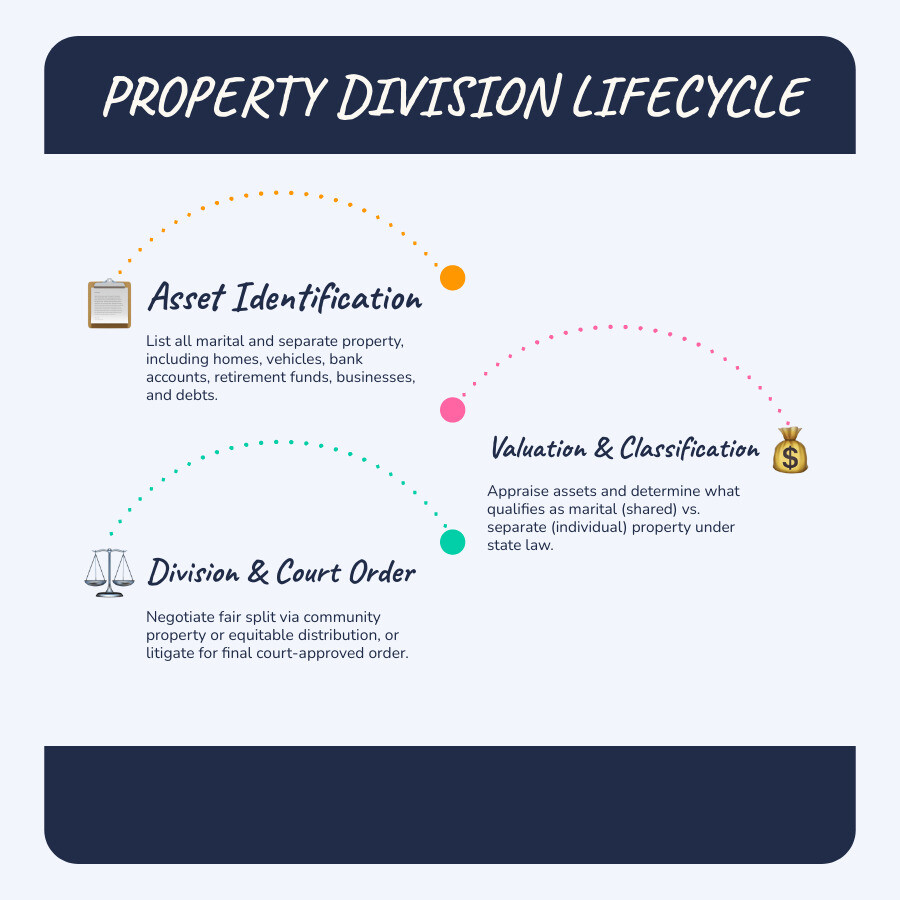
The Step-by-Step Property Division Process
Knowledge is power. Here is how the process generally unfolds when you work with a firm like Pinkham & Associates, APLC:
- Identification: We list every single thing you own and every penny you owe.
- Characterization: We label each item as “Community” or “Separate.”
- Valuation: We hire appraisers or experts to put a price tag on everything.
- Negotiation: We try to reach a fair deal with your spouse’s lawyer.
- Litigation: If they won’t be fair, we go to court and let a judge decide.
This process is explored in depth in The Ultimate Guide to Asset Protection in Complex Divorces.
Finding a Qualified Property Division Attorney Near Me
When searching for a property division attorney near me, look for someone with local experience. An attorney in Orange County will know the local judges and how they typically rule on asset disputes.
While some people may Check if your problem is covered by legal aid, most complex property cases require a private firm with the resources to hire experts and forensic accountants. You want a firm with a high success rate and a focus exclusively on family law.
What to Expect from a Property Division Attorney Near Me
Your first meeting should be a free consultation. During this time, the attorney will listen to your story, look at your rough financial picture, and give you an honest assessment of what to expect.
You’ll need to start “document gathering” — bank statements, tax returns, property deeds, and loan documents. This is the foundation of your case. For those with significant wealth, it’s vital to understand Understanding High Net Worth Divorces and How They Work before you walk into that first meeting.
Avoiding Common Pitfalls: Costs, Debts, and Mediation
One of the biggest mistakes people make is focusing only on the assets and forgetting about the debts. In California, community debt is split just like community assets. If your spouse went on a shopping spree right before the separation, you might be on the hook for half of that bill.
Another major pitfall? Hidden assets. If you suspect your spouse is stashing cash, you need to know What to Do if Your Spouse is Hiding Assets During Divorce. Taking proactive steps is the best way How to Protect Your Money During a Divorce.
Alternatives to Court: Mediation and Agreements
You don’t always have to “fight it out” in a courtroom. Mediation is a process where a neutral third party helps you and your spouse reach an agreement. It’s often faster, cheaper, and much less stressful.
If you are currently married or planning to be, California Prenuptial Agreements (or postnuptial agreements) are the ultimate way to avoid a property division nightmare in the future. These agreements allow you to decide now how things should be split, rather than leaving it to a judge later.
Frequently Asked Questions about Asset Division
How is the marital home typically divided?
The home is usually handled in one of three ways:
- Buyout: One spouse keeps the house and pays the other spouse their share of the equity.
- Sell and Split: The house is sold, the mortgage is paid off, and the remaining cash is split 50/50.
- Deferred Sale: If there are children, the court might allow one parent to stay in the house for a set period (like until the kids graduate) before selling it.
For a deeper dive, check out our page on Community Property and Family Home.
Can property division orders be modified after divorce?
In most cases, no. Unlike child support or alimony, which can change if someone loses a job, property division is usually final once the judge signs the decree. This is why getting it right the first time is so critical. There are very rare exceptions, such as if you discover your spouse committed fraud by hiding assets. We discuss these high-stakes scenarios in Property Division Issues in Orange County High Asset Divorces.
How are marital debts divided between spouses?
Just like assets, debts acquired during the marriage are generally split 50/50 in California. This includes mortgages, car loans, and credit card debt. However, there are Things That Can Put You at a Disadvantage in a California High Net Worth Divorce, such as “wasteful dissipation” of assets, where one spouse spends marital money on non-marital things (like an affair or gambling).
Conclusion
Navigating the “Great Divide” of property division requires more than just a calculator; it requires a strategic partner who understands the law and your personal goals. At Pinkham & Associates, APLC, we bring over 25 years of exclusive family law experience to the table. We serve clients throughout Orange County, California, including Irvine, Tustin, Placentia, Costa Mesa, Newport Beach, and Yorba Linda.
We pride ourselves on fearless advocacy and a personalized approach that protects your financial future. Whether you are dealing with a complex business valuation or simply want to ensure you keep your fair share of the family home, we are here to help.
Ready to take the first step? Don’t leave your future to chance. More info about family lawyer services is just a click away, or you can contact us today to schedule your free consultation. Let’s make sure your “fresh start” is a financially secure one.