



What You Need to Know About Legal Separation Laws in California
Legal separation laws in California allow married couples to live apart, divide property, and set support terms — without ending the marriage.
Here’s a quick snapshot of how it works:
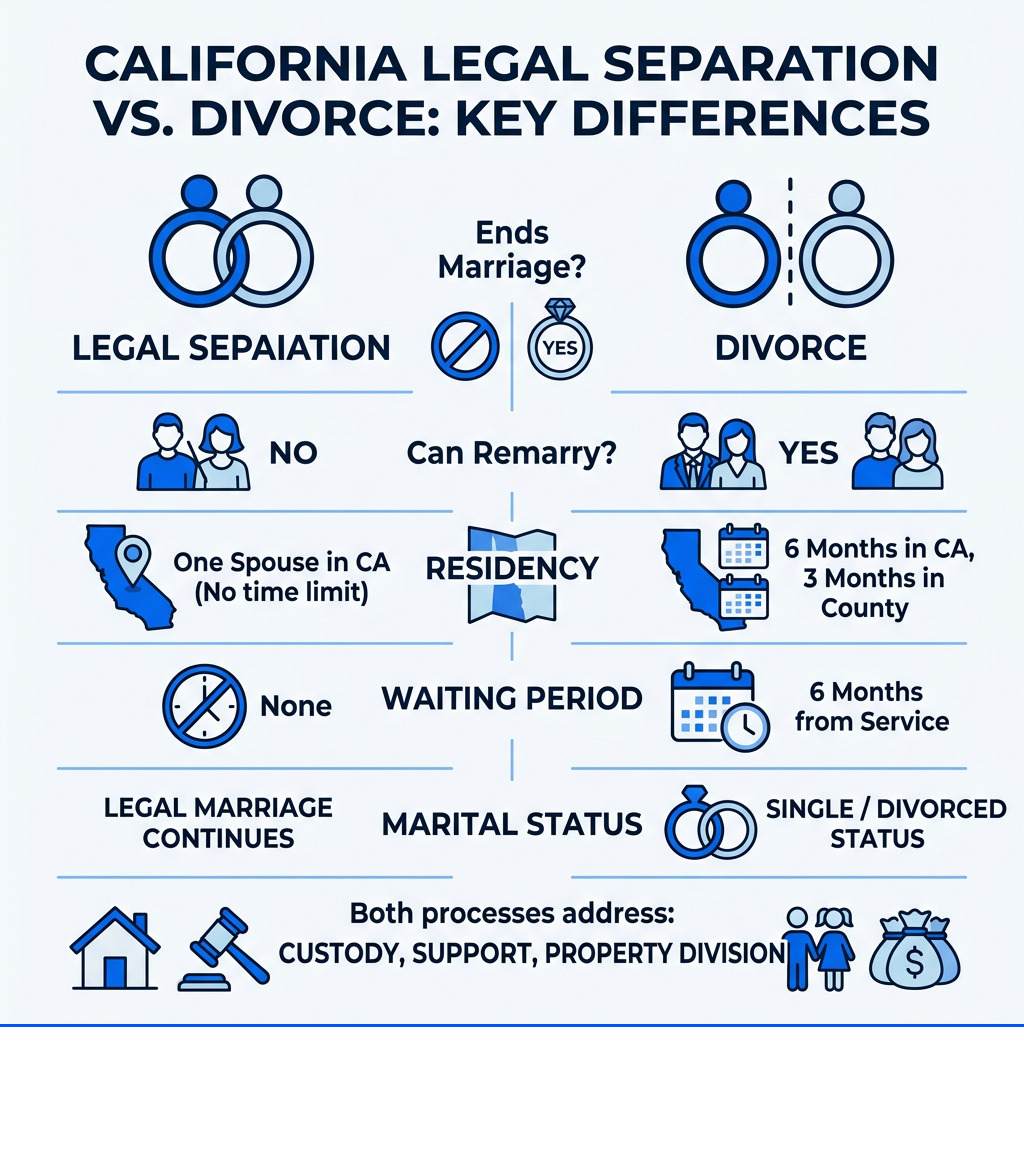
| Key Factor | Legal Separation | Divorce |
|---|---|---|
| Ends the marriage? | No | Yes |
| Can remarry? | No | Yes |
| Residency requirement? | One spouse in CA (no time limit) | 6 months in CA, 3 months in county |
| Waiting period? | None | 6 months from date of service |
| Addresses custody, support, property? | Yes | Yes |
| Can convert to divorce later? | Yes | N/A |
You stay legally married, but the court can still make binding orders about:
- Child custody and parenting time
- Child and spousal support
- Division of community property and debts
- Attorney fees
This matters a lot if you’re a parent in Southern California trying to protect your kids, your finances, and your future — without making an irreversible decision right now.
Legal separation isn’t just “moving out.” It’s a formal court process. And the rules around it can be surprisingly different from divorce.
Whether you’re unsure about permanently ending your marriage, need to keep a spouse on your health insurance, or simply don’t yet meet California’s divorce residency requirement — legal separation may be the right move for now.
At Pinkham & Associates, APLC, we offer free consultations to help you figure out which path fits your situation.
Understanding Legal Separation Laws in California
In the eyes of the law, a legal separation is a specific court-recognized status. While many people use the term “separated” to mean they are living in different houses, the California Court’s Self-Help Center basics clarify that a legal separation requires a court judgment. You remain legally married, which means you cannot marry someone else or enter into a new domestic partnership, but your financial and parental lives are formally disentangled.
California is a “no-fault” state. This means that under legal separation laws in California, you do not need to prove that your spouse did something wrong, like cheating or abandonment, to get a separation. You only need to cite “irreconcilable differences” — a legal way of saying the marriage has broken down and cannot be saved. In rare cases, “incurable insanity” is also a cited ground, but irreconcilable differences is the standard for the vast majority of cases in Orange County and beyond.
One of the most critical aspects of this legal status is the “date of separation.” According to the California Family Code, this is the date when at least one spouse expresses a clear intent to end the marriage and follows through with conduct that matches that intent. This date is a major milestone because it typically marks the end of “community property” accumulation. From that moment forward, your earnings and the debts you incur are generally considered your separate property, not shared marital assets.
Why Couples Choose Separation Over Divorce
If a legal separation involves almost the same amount of paperwork as a divorce, why would anyone choose it? For many residents in Irvine, Tustin, and Newport Beach, the reasons are deeply personal or strategically financial.
Religious and Personal Beliefs
For some, religious tenets forbid divorce. Legal separation allows these individuals to live independent lives, divide their assets, and settle custody matters through the court system while technically remaining married in accordance with their faith.
Health Insurance and Benefits
This is perhaps the most common practical reason for choosing separation. Most employer-sponsored health insurance plans terminate coverage for a spouse once a divorce is finalized. However, because a legally separated couple is still married, the non-employee spouse can often remain on the family health plan. This is a lifesaver for families dealing with chronic illness or high medical costs.
Social Security and Military Benefits
Remaining married can have long-term financial upside. For example, Social Security derivative benefits often require a marriage to have lasted at least 10 years. If a couple is at the nine-year mark, filing for legal separation allows them to reach that 10-year milestone while living apart. For military families, staying married preserves certain benefits and keeps the service member subject to the Uniform Code of Military Justice (UCMJ) provisions regarding adultery and family support.
The “Trial” Period
Sometimes, a couple isn’t 100% sure they want to end the marriage forever. Legal separation acts as a formal “time-out.” It provides the structure of a court order for support and custody, which can lower the stress of living apart. If the couple eventually reconciles, they don’t have to get remarried; they can simply ask the court to dismiss the case. You can find more info about legal separation services to see if this protective middle ground suits your needs.
The Step-by-Step Filing Process
The process for obtaining a legal separation is nearly identical to the divorce process. It begins with paperwork and ends with a judge’s signature.

- The Petition (Form FL-100): This is the starting line. You fill out this form to tell the court what you want regarding custody, support, and property. On this form, you will check the box for “Legal Separation” instead of “Dissolution of Marriage.”
- The Summons (Form FL-110): This form contains standard restraining orders that go into effect immediately. These orders prevent either spouse from hiding money, changing insurance beneficiaries, or taking the children out of state without permission.
- Filing and Fees: You must file these forms with the Superior Court. As of recent years, the filing fee is approximately $435, though fee waivers are available for those who qualify financially.
- Service of Process: You cannot just hand the papers to your spouse. A third party (someone over 18 who is not involved in the case) must serve the papers. Then, you must file a Proof of Service FL-115 to show the court the spouse was properly notified.
- The Response: The other spouse has 30 days to file a Response (Form FL-120). If they don’t, the petitioner can request a “default,” allowing the case to proceed without them.
- The Judgment (Form FL-180): Your separation is not official until the judge signs the Judgment. This document outlines every detail of your agreement or the court’s orders.
Residency Rules Under Legal Separation Laws in California
One of the biggest advantages of legal separation laws in California is the lack of a strict residency duration. To file for a divorce, at least one spouse must have lived in California for six months and in the specific county (like Orange County) for three months.
Legal separation has no such requirement. As long as one spouse lives in the state at the time of filing, you can start the process immediately. This is a common strategy for people who have just moved to Costa Mesa or Yorba Linda and need immediate court orders for child support or custody but don’t yet qualify for a divorce. For a deeper look, see how legal separation vs divorce in Orange County explained covers these residency shortcuts.
Financial Disclosures in Legal Separation Laws in California
Transparency is mandatory in California family law. Both parties must complete a “Declaration of Disclosure.” This isn’t just a suggestion; it’s a requirement to ensure that property division is fair.
- Declaration of Disclosure FL-140: This acts as a cover sheet for your financial package.
- Schedule of Assets and Debts (FL-142): You must list everything you own and everything you owe, from the house in Newport Beach to the credit card debt.
- Income and Expense Declaration (FL-150): This shows the court exactly what you earn and what it costs you to live, which is used to calculate child and spousal support.
Failure to be honest during this phase can result in heavy court sanctions later. While you can sometimes use a “Final Waiver” (Form FL-144) to skip the second round of disclosures, the preliminary exchange is almost always required.
Key Issues Resolved in a Separation Judgment
A legal separation judgment is a comprehensive document. It doesn’t just say you are separated; it acts as a manual for your new “single-ish” life.
Child Custody and Parenting Time
The court uses the “best interests of the child” standard. This includes deciding where the child will live (physical custody) and who makes major decisions about their education and health (legal custody). In Orange County, courts generally prefer that children have frequent and continuing contact with both parents unless there are safety concerns like domestic violence.
Child and Spousal Support
California uses a specific mathematical formula (often called “Guideline Support”) to determine child support. Spousal support, or alimony, is more flexible in a legal separation. The court considers the length of the marriage, the standard of living during the marriage, and each person’s ability to pay.
Community Property Division
California is a community property state. This means that, generally, everything acquired during the marriage is owned 50/50. This includes:
- Retirement accounts and 401(k)s
- Real estate equity
- Business interests
- Vehicles and furniture
The judgment will also confirm “separate property”—things you owned before the marriage or received as a gift or inheritance during the marriage. Navigating this can be complex, which is why many follow a legal separation process roadmap to ensure no assets are overlooked.
Frequently Asked Questions about California Separation
Can I convert a legal separation to a divorce later?
Yes. This is a very common path. If you file for legal separation because you don’t meet the residency requirements for divorce, you can “amend” your petition once you hit the six-month mark. If you already have a final judgment of legal separation and later decide you want to be fully divorced so you can remarry, you will generally need to file a new petition for dissolution of marriage. However, you can often incorporate the terms of your separation agreement into the new divorce judgment to save time.
Is there a waiting period for legal separation?
Unlike divorce, which has a mandatory six-month “cooling-off” period from the date the respondent is served, legal separation laws in California allow for an immediate judgment. If you and your spouse agree on all terms, you could technically be legally separated as soon as the court processes your paperwork. You don’t have to wait six months to have your property divided or your support orders finalized.
What happens if one spouse wants a divorce but the other wants a separation?
In California, the “right to divorce” usually wins. If one spouse files for a legal separation, but the other spouse files a Response asking for a “Dissolution of Marriage” (divorce), the court will almost always grant the divorce. The court cannot force someone to stay married if they want to be single. Legal separation generally requires the consent of both parties unless one party fails to show up to court entirely (a default).
Conclusion
Navigating the legal separation laws in California can feel like walking through a maze, especially when your family’s stability and your financial future are on the line. Whether you are choosing separation for religious reasons, to maintain health insurance, or as a stepping stone toward a new life, having the right guidance makes all the difference.
At Pinkham & Associates, APLC, we have spent over 25 years focusing exclusively on California family law. We understand the nuances of the courts in Santa Ana, the specific needs of families in Irvine, and the complexities of high-asset divisions in Newport Beach. We provide fearless advocacy and personalized strategies to ensure your rights are protected throughout the separation process.
If you’re ready to take the next step or just have more questions about your specific situation, we are here to help. Consult our legal separation experts today for a free consultation. Let us help you turn a “single-ish” situation into a solid plan for your future.