


Divorce Document Filing: What You Need to Know Before You Start
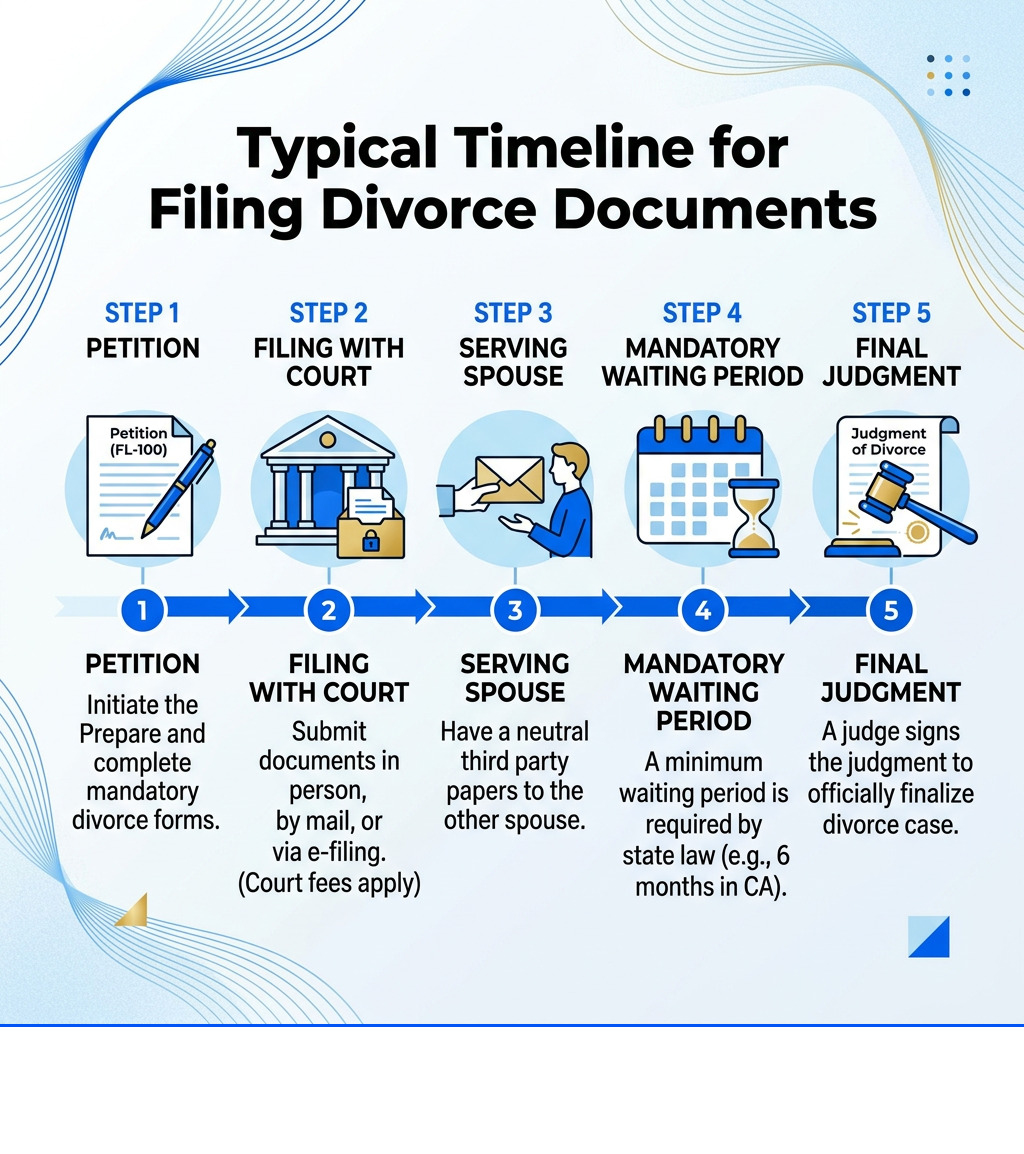
Divorce document filing is the process of submitting the legal paperwork that officially starts your divorce case with the court. Here’s a quick overview of how it works:
- Fill out your forms – Complete your Petition (FL-100), Summons (FL-110), and any required supporting documents
- File with the court – Submit your forms in person, by mail, or through e-filing (fees apply)
- Serve your spouse – Have a neutral third party deliver copies to your spouse
- Wait out the mandatory period – California requires a minimum 6-month waiting period
- Get your final judgment – A judge signs the Judgment of Divorce to finalize everything
Divorce is already one of the hardest things you’ll go through. The paperwork shouldn’t make it worse.
But for most people — especially parents dealing with custody, support, and asset questions all at once — the forms are genuinely confusing. The language is vague. The requirements vary. And one small mistake can send your case back to square one.
You’re not alone in feeling stuck. As one person described their experience online: “We know exactly what we want but I am having a very hard time translating it to the forms required to file for a divorce.”
That frustration is real, and it’s common.
This guide walks you through every stage of divorce document filing in plain language — from picking the right forms to serving your spouse to avoiding the errors that delay cases for months. Whether you’re filing on your own or working with an attorney, knowing the process puts you in control.
Note: Divorce involves more than paperwork. Property division, child custody, support orders, and financial disclosures all carry serious legal consequences. If your situation is complex, Pinkham & Associates, APLC offers free consultations to help you understand your options before you file.
Understanding the Basics of Divorce Document Filing

Before you pick up a pen or open a PDF, you need to know if you are even eligible to file in your local area. In California, residency requirements are strict. To file for divorce in a California court, at least one spouse must have lived in the state for the last six months and in the specific county where they plan to file for the last three months.
If you live in Orange County—whether in Irvine, Newport Beach, or Costa Mesa—you will likely be filing your documents at the Lamoreaux Justice Center in Orange.
California is a “no-fault” state. This means you don’t have to prove your spouse did something wrong to get a divorce. The most common ground is “irreconcilable differences,” which essentially means the marriage has broken down and cannot be saved.
One of the first decisions you’ll face is whether your case is contested or uncontested. An uncontested divorce happens when both parties agree on every single issue, including how to split the bank accounts and who gets the dog. If there is even one disagreement about a credit card debt or a Saturday afternoon visitation schedule, the case is technically contested. You can learn more about which path fits your situation by reading about Uncontested vs. Contested Divorce: Which is Right for You?.
Filing for Divorce with Children vs. Without Children
The Divorce Document Filing process changes significantly when children are involved. If you have minor children, the court requires additional forms to address child custody, visitation (parenting plans), and child support.
The court’s primary concern is the “best interests of the child.” You will need to submit a detailed parenting plan that outlines where the children will live and how holidays will be spent. In California, both parents are typically required to attend a mediation session or a parenting orientation to help reach an agreement on these issues. While some states like New York have specific DIY programs for uncontested divorces, California residents in Orange County must ensure their local forms meet the specific requirements of the California Family Code.
Step-by-Step Guide to Preparing Your Papers
Preparing your paperwork is the most time-consuming part of the process. You are essentially telling the court the story of your marriage, your assets, and your children through checkboxes and text boxes.
To help navigate this, we’ve put together The No-Stress Guide to California Divorce Forms to simplify the jargon. You can also find official forms and instructions through the California Courts self-help portal.
Step 1: Preparing Your Divorce Document Filing
The “Petitioner” is the person who starts the case. The “Respondent” is the other spouse. To get started, the Petitioner must fill out:
- FL-100: Petition: This is the core document. It asks for basic info about the marriage, children, and what you want the court to order regarding property and support.
- FL-110: Summons: This document contains “Standard Family Law Restraining Orders” (SFLROs). Once filed, these orders immediately prohibit both spouses from doing things like moving the children out of state or cashing out insurance policies without permission.
- Property Declarations: If you have significant assets or debts, you’ll need to list them on forms like the FL-160.
Step 2: Choosing Your Filing Method
Once your forms are ready, you have to get them to the court clerk. In Orange County, you have a few options:
- In-Person Filing: You take the original and at least two copies to the courthouse. The clerk stamps them, keeps the original, and gives the copies back to you.
- Mail-In Filing: You can mail your documents to the court. If you do this, you must include a self-addressed stamped envelope so the clerk can send your “conformed” (stamped) copies back to you.
- e-Filing: Many California courts now allow or even require electronic filing. While New York uses the NYSCEF system and New Jersey uses JEDS, California has its own approved e-filing service providers.
Costs, Fees, and Mandatory Financial Disclosures
Divorce Document Filing isn’t free. In California, the standard filing fee for a petition is between $435 and $450. If the Respondent decides to file a “Response,” they will also have to pay a similar fee. For those ending a very short marriage with few assets, the Summary Dissolution California Fee might be a consideration, though the base filing fee remains standard.
If you cannot afford the fee, you can ask for a “Fee Waiver.” You generally qualify if you receive public benefits (like Food Stamps or Medi-Cal), if your household income is below a certain level, or if the court determines you simply don’t have enough money to pay for basic necessities and court fees at the same time.
The Importance of Full Financial Disclosure
In California, you cannot just “agree” to a divorce without showing your cards. Both spouses have a “fiduciary duty” to each other, which is a high legal standard of honesty. You must complete a FL-150: Your Income and Expense Declaration and a Schedule of Assets and Debts.
The landmark Feldman case in California proved how serious this is—a husband was sanctioned $390,000 for failing to disclose financial information, even though the other spouse didn’t prove they lost money because of it. The court wants to see that you’ve been transparent.
Interestingly, a Service of Preliminary Disclosure is Not Required if Agreement Predates the Filing of Petition for Divorce in very specific circumstances, but for 99% of cases, you will be exchanging these disclosures shortly after filing.
After you file your papers, the clock doesn’t start ticking until you “serve” your spouse. You cannot just hand the papers to them yourself. You must have a neutral third party (someone over 18 who is not involved in the case) deliver the documents. This can be a friend, a relative, or a professional process server.
Once the papers are delivered, the server fills out a “Proof of Service” (FL-115), which you then file with the court. This tells the judge that your spouse is officially aware of the case. If you’re worried about how they will react, you might wonder What Happens If My Spouse Refuses to Sign Divorce Papers in California?. The short answer: the case can often proceed without their signature through a “default” process.
Waiting Periods and Final Judgments
California has a mandatory six-month “cooling off” period. This means you cannot be officially divorced until at least six months and one day after the date your spouse was served. Even if you agree on everything on day one, you are still legally married for those six months.
Once the waiting period is over and all your agreements are reached, you submit the FL-180: Judgment. This is the final document that a judge signs to end the marriage. Once the “Notice of Entry of Judgment” is mailed, you are officially single.
Common Pitfalls in Pro Se Litigation
Filing “pro se” (on your own) is possible, but it is risky. The court clerks are not allowed to give you legal advice; they can only tell you if a form is filled out correctly from a technical standpoint.
Common mistakes include:
- Vague Language: Saying “we will split the property fairly” isn’t enough. The court needs to know exactly who gets what.
- Missing Signatures: Forgetting to sign or notarize a document can lead to an immediate rejection.
- Inconsistent Data: If your Petition says you have two children but your Summons only mentions one, the clerk will send it back.
Avoiding Errors in Your Divorce Document Filing
To avoid these headaches, you can use a legal glossary to understand terms or consult with a law librarian. Many people find that using Divorce Document Filing Services is a middle ground between doing it all alone and hiring a full-scale litigation team. These services ensure your paperwork is procedurally perfect so you don’t waste time in the “rejection loop” at the clerk’s office.
Frequently Asked Questions about Divorce Document Filing
Do I need a lawyer for an uncontested divorce?
You are not legally required to have a lawyer. However, even in an uncontested case, it is often wise to have an attorney review your settlement agreement. If you have a pension, a house, or complex tax issues, a small mistake now could cost you thousands later. You can read more here: Do I need a lawyer for an uncontested divorce?.
How do I qualify for a court fee waiver?
You must fill out Form FW-001. The court will look at your monthly income and expenses. If you are on public assistance like CalWORKS or SSI, the waiver is almost always granted. If you’re just above the income limit but have high medical bills or debt, you can still apply under the “financial hardship” category.
What happens if I can’t find my spouse to serve them?
If you have made a “diligent search” (checked with relatives, searched online, contacted former employers) and still can’t find them, you can ask the court for permission to perform “Service by Publication.” This involves running a notice in a local newspaper for several weeks. It requires a specific court order, so don’t try this without checking the local rules first.
Conclusion
Divorce document filing is the first step toward your new life. While the stacks of forms can feel overwhelming, taking it one step at a time—from the FL-100 to the final Judgment—makes the process manageable.
At Pinkham & Associates, APLC, we have spent over 25 years focusing exclusively on California family law. We provide fearless advocacy and personalized strategies for residents throughout Orange County, including Yorba Linda, Tustin, and Placentia. Whether you need a full-service attorney to handle a complex trial or Professional Divorce Document Filing Services to ensure your paperwork is flawless, we are here to help.
Don’t let paperwork stand in the way of your future. Contact us today for a free consultation and let us help you get it right the first time.