

Family Law Forms, California
FL 170 – Declaration for Default or Uncontested Dissolution, Legal Separation
What Is Form FL-170?
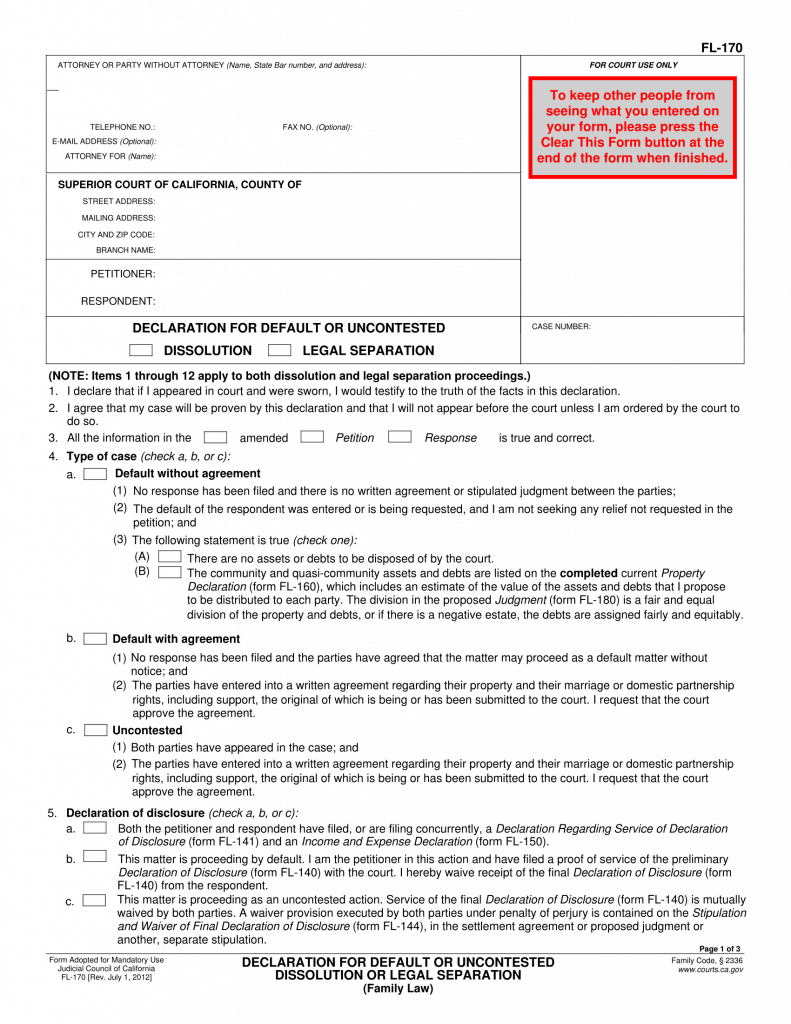
FL-170 is the California Judicial Council form titled “Declaration for Default or Uncontested Dissolution or Legal Separation.” This three-page document serves as your sworn statement under penalty of perjury, informing the court exactly how your divorce case or legal separation is being finalized without a trial.
The form is mandatory when your California divorce or legal separation is proceeding by default (the respondent never filed a Response) or by written agreement (uncontested). The current version is effective January 17, 2020, and you file only one FL-170 per case—submitted by either the petitioner or respondent, not both.
This resource page was created by Pinkham & Associates, APLC, a family law firm in Orange County that handles divorce and legal separation proceedings exclusively. This is educational information, not a court document.
When Do You Need FL-170 in a California Divorce or Legal Separation?
FL-170 tells the judge exactly how your case is being finalized. The form requires you to select one of three scenarios:
- Default without agreement: The respondent never filed a Response (FL-120) within 30 days of service, no settlement agreement exists, and you are seeking court orders on property, debts, custody, and support based solely on your petition and disclosure documents.
- Default with agreement: The respondent did not file a Response, but both parties signed a written Marital Settlement Agreement or stipulated judgment. You are asking the court to approve the judgment based on that agreement.
- Uncontested dissolution: The respondent did file a Response, but you reached a full written agreement covering all issues—property division, child custody, spousal support, and child support. FL-170 confirms everything is addressed.
You typically submit FL-170 together with the proposed judgment (FL-180) and related attachments when ready to finalize. In Orange County Superior Court at the Lamoreaux Justice Center, judgments are frequently rejected when FL-170 is missing or filled out incorrectly. This form is critical to avoid delays.
Where to Get FL-170 (and Why You Should Use the Official Form)
FL-170 is a mandatory use judicial council form, available for free from official sources:
- Download directly from courts.ca.gov by searching “FL-170 Declaration for Default or Uncontested Dissolution”
- Obtain a printed copy from the Family Law clerk’s office at the Orange County Superior Court, Lamoreaux Justice Center (341 The City Drive, Orange, CA 92868)
- Verify any third-party template matches the official version with footer showing “January 17, 2020” or later
- Download a fillable PDF or print a clean copy before filling to avoid messy corrections that trigger court rejection
Key Parts of FL-170 and What the Judge Is Looking For
FL-170 is more than a cover sheet—it is your declaration under penalty of perjury that the court relies on to grant your divorce or legal separation.
- Case caption: Names of parties, case number, and court address must match exactly what appears on your petition and other documents filed with the superior court.
- Case status selection: Identify whether this is default without agreement, default with agreement, or uncontested. Confirm whether the other party appeared or signed a written agreement.
- Property and debts: Declare that all community and quasi community assets and debts are addressed in the proposed judgment and any settlement agreement, ensuring everything is assigned fairly.
- Child custody and visitation: Confirm whether there are minor children, identify existing orders, and state that custody terms are consistent with any UCCJEA declaration.
- Support sections: Indicate whether guideline child support was calculated, whether you are seeking or waiving spousal support, and whether an income and expense declaration (FL-150) or support attachments (FL-342) are included.
- Final declaration and signature: Sign under penalty of perjury. Any false statement can result in sanctions or the judgment being set aside.
How to Properly Complete FL-170 (Step-by-Step Overview)
This checklist provides a plain-language overview for completing FL-170 in your California divorce process and assumes you already understand the basic family law legal terms used in California divorces and separations. It is not a substitute for personalized legal advice.
- Gather key documents first: Petition (FL-100), Response (FL-120) if any, Summons (FL-110), preliminary declaration of disclosure (FL-140, FL-142/FL-160), final declaration of disclosure or waiver provision executed, and proposed judgment (FL-180)
- Fill the case caption exactly as it appears on your petition, including the Lamoreaux Justice Center address for Orange County cases
- Select the correct case status—verify it matches your court docket and judgment paperwork
- Complete sections on property, debts, child custody, child support, and spousal support so declarations match your proposed judgment terms
- Confirm required disclosures were exchanged or that parties mutually waived receipt of final declarations per Family Code §§2105-2107, using the court’s FL-182 Judgment Checklist for dissolution or legal separation as a final cross-check
- Date and sign in blue or black ink; ensure your printed name matches the name used throughout the case
- If support calculations, property characterization, or disclosure requirements are unclear, consult an experienced Orange County family law attorney before filing concurrently with your judgment
Common FL-170 Mistakes That Cause Judgment Rejection (and How to Avoid Them)
Orange County courts frequently reject proposed judgments due to common errors on FL-170:
- Failing to file FL-170 entirely: Always include this form when submitting a default or uncontested divorce judgment
- Checking the wrong box: Marking “uncontested” when no Response was filed creates a mismatch—the status must reflect whether the respondent appeared
- Inconsistencies between documents: Different child support amounts, missing property items, or conflicting custody descriptions between FL-170 and FL-180 trigger rejection
- Incomplete disclosure confirmation: Not stating that preliminary disclosures were exchanged or that final declarations were served or waiver provision was executed
- Signature problems: Unsigned forms, wrong dates, or someone other than the party signing the declaration
- Not using county checklists: Compare your FL-170 and judgment package against Orange County’s family law judgment checklist and review practical family law insights from experienced California divorce attorneys before you submit
If you’ve had a judgment rejected due to common mistakes on FL-170, contact Pinkham & Associates for help with resubmission.
How FL-170 Fits into the Overall California Divorce Process
FL-170 comes near the end of your proceeding, after several required steps and usually after you have already considered your options in light of current Orange County divorce statistics and trends:
- File the Petition (FL-100) and Summons (FL-110), then serve the respondent and wait 30 days for a potential Response
- Exchange preliminary declarations of disclosure (FL-140, FL-142 or FL-160, FL-150) before any default or uncontested judgment can be finalized
- Create a Marital Settlement Agreement or stipulated judgment covering property division, child custody, child support, and spousal support, whether you are pursuing a full dissolution or a judgment of legal separation in Orange County
- Prepare the Judgment (FL-180) with attachments, along with FL-170, and submit the complete package to the court for review
- The court cannot finalize the dissolution until at least six months from the date of service—even if you file earlier
- When FL-170, the judgment, and disclosures are correct, the judge can sign without the parties appearing in most default or uncontested cases
Special Considerations: Children, Support, and High-Asset Cases
While FL-170 is standardized, cases involving children, support, or substantial assets require extra care:
- Child custody: Confirm all parenting time terms are in the judgment; disclose any prior orders from other counties or states for domestic partnership rights or custody matters, especially in same-sex divorce or domestic partnership cases
- Child support: Courts expect guideline calculations attached; FL-170 should indicate whether guideline or non-guideline support is being requested
- Spousal support: An up-to-date income and expense declaration is normally required; indicate whether support is requested, waived, or reserved
- High-asset cases: Errors describing businesses, retirement accounts, or real estate can lead to a negative estate situation or future litigation—even if one person is seeking relief from a fair division
- Default with significant assets: Courts scrutinize fairness carefully in long marriages; FL-170 must accurately confirm all community property is addressed
Why Work with an Orange County Family Law Attorney on FL-170?
While many people attempt DIY divorces, FL-170 frequently triggers rejection when completed without legal guidance. Over 70% of California divorces are uncontested, yet anecdotal court data suggests 20-30% rejection rates due to form errors.
- Pinkham & Associates, APLC focuses exclusively on divorce and family law in Orange County, including default and uncontested judgments, high-asset divorces, and cases involving children
- The firm can review or prepare FL-170 as part of a complete judgment package, reducing costly delays from repeated rejections
- Attorneys provide personalized, strategy-focused advice on whether to proceed by default or uncontested judgment, how to choose the right divorce lawyer in Orange County, and how to present support and custody terms
- Schedule a free consultation to understand what to expect in your first Orange County divorce meeting, have your specific situation evaluated, and get a tailored plan for moving your California divorce or legal separation forward

For continuing education on forms like FL-170 and other issues that arise in Orange County divorces, you can also explore our family law blog with articles on divorce, custody, and support.