


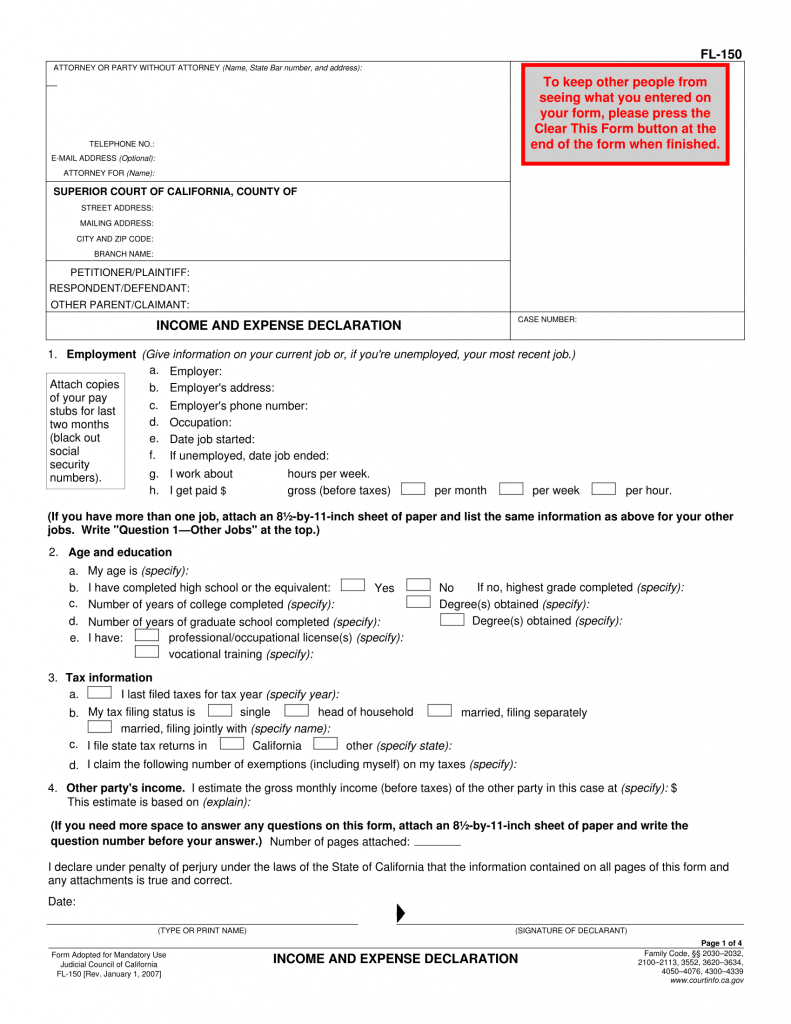
Form FL-150 is one of the most used and most important family law forms in California. The FL-150 is an Income and Expense Declaration. It is a four-page document used in California family law cases to detail finances for the court, and it requires detailed financial information, including income, expenses, assets, and debts, from both parties. The case number must be included at the top right section of the FL-150 form to ensure proper documentation and processing. The form is used anytime you are asking for financial orders, including spousal support, child support, attorney fees, sanctions, and more. It is required when you serve your required Preliminary and Final Declarations of Disclosure on the other party. Preliminaries are required to be served within 60 days after the divorce is filed, and the Final Declarations of Disclosure must be filed later in the process, just before trial. Individuals must provide their personal and contact information, employment details, age, education, tax information, living expenses, assets, and liabilities when filling out the FL-150 form. The FL-150 form includes sections for detailing income sources, outlining monthly expenses, and providing information related to child support obligations. You must report all California income on the form. Debts, such as credit card balances, mortgages, and other financial obligations, must also be disclosed on the FL-150 form. The form requires you to attach copies of supporting documentation, such as pay stubs and tax returns, and failing to attach required documentation is a common mistake. Redacting Social Security numbers on all attached documents is essential to protect privacy.
Also, as long as child or spousal support, or other financial orders are still in place, you have the right to send a request to the other party to fill out an Income and Expense Declaration once per year, even after your divorce is filed, to make sure whether the other side has had an increase or decrease in income which may affect support orders. This right exists while support orders are active to verify income changes. Specifically, the income and expense declaration needs to be taken very, very seriously. This is the most scrutinized and cross-examined form that we use. Also, this form is signed under penalty of perjury. Inaccuracies on the FL-150 form can lead to legal penalties, including fines or being held in contempt of court. If you state your income is $20/hour, when it is $25/hour, you will likely get in trouble if this information comes out in court.
There are questions on the form about expenses (page 3) such as mortgage/rent payment, property taxes, food, child care, health care, restaurant bills, auto care, etc. … Obviously no one knows all their expenses to the penny. However, you will need to give your “best estimate.” You will notice on item 13 three boxes which ask whether the expenses are estimated, actual, and/or proposed needs. I suggest you select estimated simply because your expenses are likely to change month-by-month, and that way, you can’t be held responsible for writing in a very specific number. Miscalculating totals in income and expenses is a frequent error when completing the FL-150 form.
If you are asking for child support and spousal support because you intend to move out and get your own home or apartment, you will want to mark both estimated and proposed needs. Proposed needs are for expenses you do not currently have but expect to have after you move to a new location. A declaration is considered “current” if completed within the last three months, provided no significant facts have changed.
Judges use the information provided in the FL-150 form to make informed decisions regarding support orders and property division for families in communities such as Costa Mesa and the surrounding Orange County area. The FL-150 form must be filled out accurately to avoid potential disputes and ensure the court has a clear understanding of each party’s financial situation, which is critical for clients in cities like Newport Beach facing complex divorce and support issues.
Again keep in mind it is a very serious form, and you will be signing this form under penalty of perjury. Legal assistance can help individuals navigate the complexities of completing the FL-150 form accurately and thoroughly, and choosing the right divorce lawyer in Orange County is an important step in that process. It is important to ensure that all financial information is accurate and complete to avoid potential legal issues, and individuals should review their completed FL-150 form for errors or missing information before submission. A common mistake is leaving sections incomplete or incorrectly filled out on the FL-150 form.
If you have any specific questions, feel free to call us here at Pinkham & Associates, a family law firm in Orange County for a free initial consultation.
— Doug Pinkham, Senior Attorney at Pinkham & Associates, a dedicated family law firm in Orange County.
Introduction to FL-150
The FL-150, or Income and Expense Declaration, is a foundational document in California family law cases. Whether you are seeking child support, spousal support, or any other financial orders, this form is essential for providing the court and the other party with a clear picture of your financial situation. The FL-150 requires you to disclose your income, expenses, and financial obligations, ensuring accurate financial disclosure between both parties. This transparency is critical in family law cases, as it allows the court to make fair and informed decisions regarding support orders and other financial matters. By completing the FL-150 thoroughly and honestly, you help facilitate a smoother legal process and protect your interests in matters involving income, expenses, and support for your child or spouse within broader family law matters such as divorce, custody, and property division.
Income Information
When filling out the FL-150 form, it is vital to provide a complete and truthful account of your income. This includes not only your regular employment income but also any investment income, self-employment income, or other sources of pay. Supporting your income claims with documentation—such as recent pay stubs, bank statements, and your most recently filed taxes—is required to ensure the information is accurate and verifiable. The form also asks you to make a reasonable estimate of the other party’s income, which can often be determined by reviewing their pay stubs, tax returns, or other financial records if available. Remember, the FL-150 is signed under penalty of perjury, so it is crucial to be precise and honest when reporting your income. Any misrepresentation can have serious legal consequences and may negatively impact your case, especially in the context of a contested divorce case in Orange County.
Expense Information
The FL-150 also requires a detailed account of your average monthly expenses. This includes fixed costs like mortgage or rent payments and property taxes, as well as variable expenses such as food, child care, and healthcare. You are expected to estimate your monthly expenses as accurately as possible, understanding that exact figures are not always available. Selecting “estimated” on the form is recommended, as monthly expenses can fluctuate due to changing circumstances. Additionally, the form allows you to indicate “proposed needs”—expenses you anticipate incurring in the near future, such as those related to moving to a new home or changes in your household budget. Providing a thorough and honest estimate of your expenses helps the court understand your financial situation and ensures that any support orders reflect your actual needs, and an experienced Irvine family law attorney can help you prepare this information correctly.
Support Calculations
The information provided on the FL-150 is used by the court to calculate support orders, including child support and spousal support. The court reviews your income, expenses, tax filing status, and financial obligations to determine what level of support is appropriate. It is important to include all relevant financial information, such as the number of dependents, your tax filing status, and any additional income sources. The court may also consider additional expenses, like children’s health care expenses or special hardships, when making its determination. By providing complete and accurate financial information on your FL-150, you help ensure that support calculations are fair and reflect your true financial circumstances, a topic we explore further in our family law blog with articles on support rules and procedures.
Expense Declaration
The expense declaration section of the FL-150 form is where you provide a detailed breakdown of your monthly expenses. This includes both fixed expenses, such as mortgage or rent payments, and variable expenses, like groceries, utilities, and entertainment. You must also disclose any additional income, such as investment income or self-employment income, and attach supporting documents like receipts and bank statements to substantiate your claims. Using tools such as budgeting software, consulting with a financial advisor, or working with an experienced family law firm like Pinkham & Associates can help you create a reasonable estimate of your expenses. Accurate financial disclosure in this section is essential for the court to issue fair support orders and for both parties to understand each other’s financial situation in California family law cases, beginning with properly serving initial documents like the FL-110 family law summons. By taking the time to carefully complete your expense declaration, you help ensure a transparent and equitable process.