


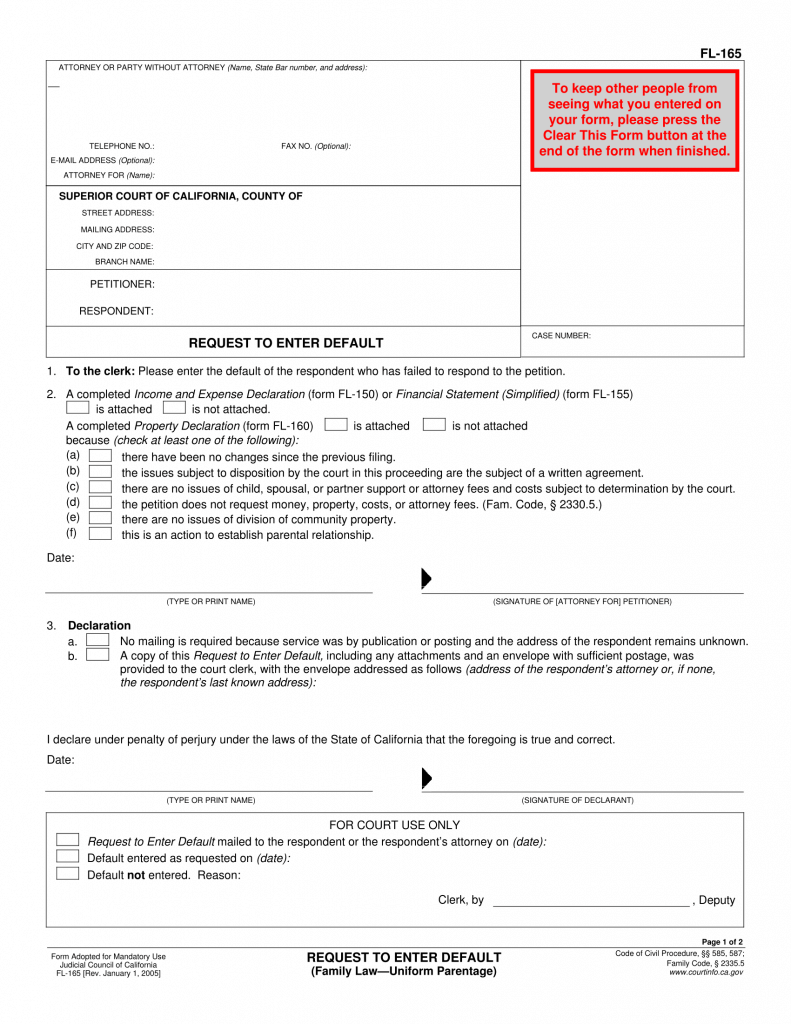
Overview of Form FL-165
FL-165 is the California “Request to Enter Default” form used in family law and Uniform Parentage cases when the other party fails to respond within the required time frame. This page is written by Pinkham & Associates, APLC, an Orange County family law firm, and provides information only—not legal advice.
FL-165 is commonly utilized in parentage matters under the Uniform Parentage Act, as well as divorce, custody, and support cases when a respondent has failed to file a response by the legal deadline. Effective July 1, 2025, FL-165 is the standard form to request that the court enter default and move your case forward.
A default can lead to court orders on parentage, child custody, visitation, and support without the other party’s participation. This makes accuracy and proper service crucial to avoid issues down the road.
What Is FL-165? (Request to Enter Default – Uniform Parentage)
FL-165 is the official “Request to Enter Default (Uniform Parentage)” form required by California courts in parentage cases when the respondent does not respond to the petition in time. In divorce, legal separation, or nullity cases, courts also use this form to record the default of a non-responding spouse or domestic partner.
When the court enters default, it means the case can proceed based solely on the petition and supporting documents because the other party missed their response deadline. The judgment may be based on:
- A written settlement agreement between the parties, or
- The original petition and attached declarations if no agreement exists
The Judicial Council periodically updates FL-165, so always download the current version from courts.ca.gov to ensure your submission isn’t rejected.
When You Need to Use Form FL-165
The basic timeline works like this: after the petitioner files and properly serves a petition for parentage, divorce, or custody, the respondent generally has 30 days to file a response. If no response (FL-220 in parentage cases, FL-120 in divorce) arrives by that date and service was valid, you may ask the superior court to enter default by filing FL-165.
Typical scenarios include:
- An unmarried parent in a Uniform Parentage case where the other parent ignores service
- An absent spouse in an Orange County divorce who fails to respond
- A parent refusing to participate in custody or support proceedings, especially where the court may later consider appointing counsel for the child using forms like FL-323 Order Appointing Counsel for a Child
Special circumstances to consider:
- Service by publication or posting when the respondent’s address is unknown
- Military status protections under the Servicemembers Civil Relief Act
If the respondent is on active military duty, you must address their nonmilitary status or military status before default can be entered. The court will not proceed without this determination.
Key Legal Effects of a Default in Family Law and Parentage Cases
Once the court enters default, the respondent loses the automatic right to file a response and participate in most aspects of the case without first seeking court relief. The court may then issue orders on:
| Area | What the Court Can Decide |
|---|---|
| Parentage | Establishing legal parents |
| Custody | Legal and physical custody arrangements |
| Visitation | Parenting time schedules |
| Support | Child support based on guideline calculations |
| Property | Division of assets in divorce/separation |
| The petition cannot request more or different relief than what was originally stated. A default judgment is limited to what the respondent was put on notice about initially. |
A respondent can sometimes file a motion to set aside a default under CCP 473(b) based on mistake, inadvertence, or excusable neglect—but success isn’t guaranteed. This makes the initial handling of FL-165 extremely important.
How to Complete and File FL-165 Step by Step
Filling out FL-165 requires careful attention to detail. Follow these steps to avoid rejection:
Gather your information first:
- Court name and address (e.g., Orange County Superior Court, Lamoreaux Justice Center, 341 The City Drive, Orange, CA 92868)
- Your case number from the original petition
- Full names of petitioner and respondent
- Date and method of service
Complete the form: For example, after filing your petition and Summons (FL-110), you will use FL-165 if the respondent fails to respond in time.
- Enter attorney or self-represented party information, including mailing address, phone, and email
- Indicate which party has defaulted (typically the respondent)
- Confirm no response was filed within the correct time frame
- Attach a Proof of Service of Summons (or explain service by publication if applicable)
Address military status requirements:
- Verify whether the respondent is in the military using the Department of Defense Manpower Data Center database
- Complete the declaration regarding military status on the form
Attach required documents:
- Property Declaration (FL-160) if property division is involved, and determine whether a Qualified Domestic Relations Order (FL-460) will be necessary to divide retirement accounts
- Financial Statement (FL-150 or FL-155) for cases involving support, and consider whether you will also need to complete a Spousal or Partner Support Declaration (FL-157)
- Copy of the original petition
Sign and file:
- Sign under penalty of perjury and date the form
- Provide a pre-stamped envelope addressed to the respondent’s last known address
- Submit to the court clerk in person, by mail, or via e-filing

After You File FL-165: Next Steps and What to Expect
Filing FL-165 is not the final step—it simply allows your case to move toward a default judgment. Here’s what comes next:
Confirm default entry:
- Review the online docket if available
- Contact the clerk to verify default has been entered in the register of actions
Prepare judgment documents:
- Complete the Judgment form (FL-180)
- Attach child custody and visitation orders, including any stipulation and order for child custody (FL-355) if you and the other parent have reached an agreement
- Include guideline child support calculations and, when required, complete the Child Support Case Registry Form (FL-191)
Mail requirements: If the respondent’s address is known, you may need to mail a copy of the Request to Enter Default and file proof of mailing with the court.
Court hearings: The court may set a default hearing where you must appear, provide evidence (income documents, parenting history), and testify so the judge can make orders in the child’s best interest. Some courts enter judgments based solely on written submissions, but be ready to attend if required.
Respondents who wish to contest orders after default must usually file a motion to set aside within specific time limits.
Common Issues, Mistakes, and How Our Firm Helps
Even small mistakes on FL-165 can delay or derail a default in California family law cases. Watch for these frequent errors:
- Using the wrong version of FL-165
- Miscalculating the 30-day response deadline
- Incomplete or incorrect Proof of Service
- Failing to determine and address military status
- Requesting relief not included in the original petition
Double-check that names, service dates, and case numbers match exactly what appears on your petition and summons to avoid mismatches that cause rejections.
Orange County courts have specific local rules and preferred formats for default packets. Having an experienced Irvine family law attorney familiar with the local bench is helpful. Pinkham & Associates, APLC assists clients by reviewing service, preparing FL-165, assembling complete default judgment packets, attending hearings, and tailoring custody, visitation, and support requests to each client’s goals.
Free Consultation with Pinkham & Associates, APLC
If you’re dealing with parentage, divorce, custody, or support issues in Orange County, contact Pinkham & Associates, APLC for help with FL-165 and other family law forms. Initial consultations are free, confidential, and conducted directly with attorney Doug Pinkham.
For ongoing insights into divorce, custody, and support issues, you can also explore our family law blog.
Reach us by:
- Phone
- Online contact form
- Our Orange County office (convenient for clients in Irvine, Santa Ana, Anaheim, and nearby communities)
Schedule a consultation before filing or responding to FL-165 so you understand the long-term consequences. Our firm focuses exclusively on family law and handles both negotiated resolutions and contested default hearings—whatever your case requires.