


Family Law Forms, California
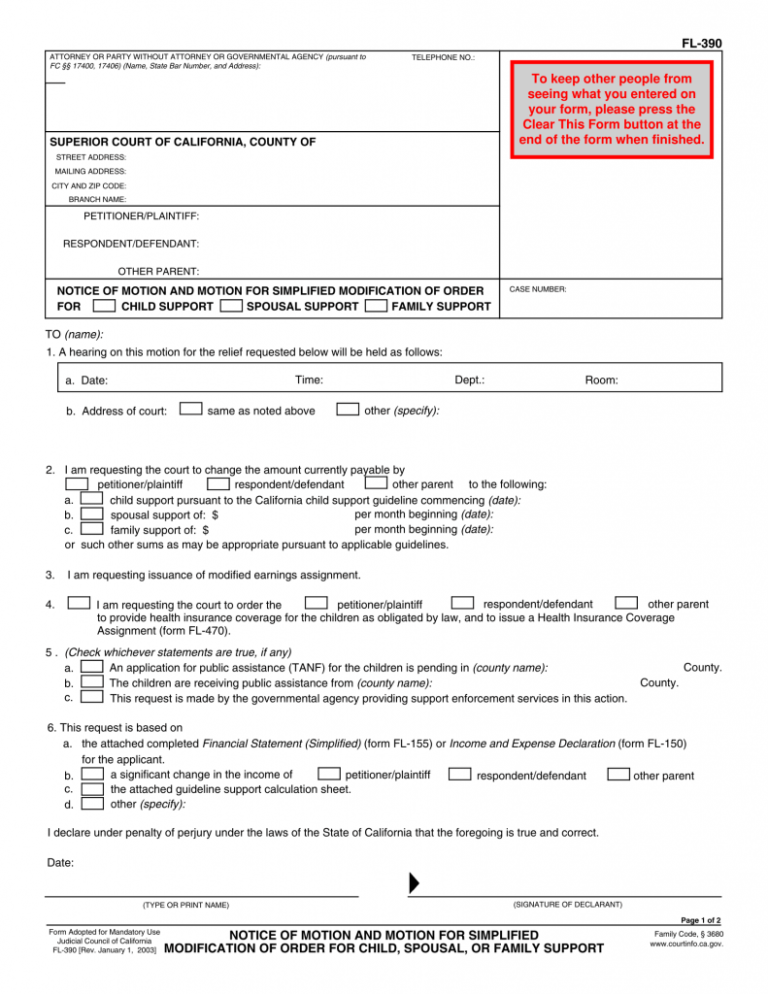
FL 390 – Notice of Motion and Motion For Simplified Modification of Order
If you have an existing child support, spousal support, or family support order in California and your circumstances have changed, you may need to file a request to modify that order. Form FL-390—officially titled “Notice of Motion and Motion for Simplified Modification of Order for Child, Spousal, or Family Support”—is the California Judicial Council form designed for exactly this purpose in qualifying cases.
This page is written from the perspective of Pinkham & Associates, APLC, a boutique family law firm serving Orange County, California. Our goal is to provide you with clear, actionable information about FL-390 so you can determine whether this form applies to your situation and understand the steps involved in using it.
What Is Form FL-390 and When Do You Use It?
FL-390 is the official California court form used when a parent or former spouse wants to change an existing support order. The form was adopted for mandatory use under Family Code section 3680, with the current official revision dating back to January 1, 2003. Despite its age, this form remains the standard vehicle for simplified modification requests in California family courts.
The term “simplified” is important here. This procedure is available only in limited situations where income and support calculations are relatively straightforward. If your case involves complex business valuations, stock options, self-employment income disputes, or high-net-worth asset questions, the simplified process may not be appropriate for your situation.
Common situations where FL-390 may be appropriate include:
- A significant change in either party’s income (job loss, layoff, or promotion)
- A change in parenting time percentages (such as moving from 20% to 50% custody)
- A child turning 18 or graduating from high school
- Changes in health insurance costs or childcare expenses
- Receipt or termination of disability or unemployment benefits
This page is informational only and does not create an attorney-client relationship. The details provided here are meant to help you understand the FL-390 process, but every case is different. If your support order is from a court in Orange County or another California county, contact Pinkham & Associates for a free consultation before you file.

How to Download California Form FL-390
FL-390 is a free public court form that should be downloaded from an official or trusted source to ensure you have the correct, current version.
Step-by-step instructions to download FL-390:
- Open your web browser and navigate to the California Courts website at courts.ca.gov
- Select “Forms & Rules” from the main navigation menu
- Use the search function and type “FL-390”
- Locate the form titled “Notice of Motion and Motion for Simplified Modification of Order for Child, Spousal, or Family Support”
- Click to download the fillable PDF to your device
- Save the file to a location where you can easily access it
The official form is typically available as a fillable PDF. Always confirm you are using the most recent revision by checking the date printed at the bottom of the form. Some third-party websites host older versions from 2003 through 2023, which may contain outdated formatting or fields. Best practice is to compare any form you find with the latest Judicial Council version before use.
You can complete FL-390 in one of two ways:
| Method | Process |
|---|---|
| Digital completion | Fill out the PDF on your computer, then print, sign, and file |
| Manual completion | Print the blank form, complete it by hand in blue or black ink, sign, and file |
| Keep in mind that FL-390 rarely stands alone. Depending on your case and local court rules, you may also need to download and complete forms such as FL-300 (Request for Order), FL-150 (Income and Expense Declaration), or FL-155 (Financial Statement – Simplified). |
Pinkham & Associates can help clients select and complete the correct forms for Orange County courts, including Form FL-150 Income and Expense Declaration, as well as filings at the Lamoreaux Justice Center and other local branches.
When FL-390 Is the Right Form for Your California Support Case
The FL-390 simplified modification procedure is not appropriate in every support case. Understanding when to use this form—and when a different approach is required—can save you time and protect your interests in court.
Eligibility for FL-390 generally requires:
- An existing California court order for child support, spousal support, or family support
- A relatively simple financial situation without complex business income or valuations
- A clear triggering event such as income change, timeshare adjustment, or child emancipation
- No heavily disputed facts about either party’s earnings or expenses
FL-390 vs. FL-300 (Request for Order):
| FL-390 Simplified Modification | FL-300 Request for Order |
|---|---|
| Straightforward income changes | Contested or complex cases |
| Guideline support recalculations | High-asset disputes with discovery |
| Limited evidence required | Expert appraisals may be needed |
| Faster resolution (30-45 days typical) | Longer timeline for contested matters |
| Examples where FL-390 may be appropriate: |
- One parent’s income has dropped 30% or more due to layoff
- A child now spends 50% of time with each parent instead of 20%
- Health insurance costs have increased significantly
- A child has emancipated (turned 18 or graduated high school)
Examples where FL-390 may not be appropriate:
- High net worth couples with multiple real properties
- Business ownership requiring valuation
- Stock options, restricted stock units, or deferred compensation
- Heavily disputed income where discovery is necessary
Orange County judges expect accurate, updated financial information. Misuse of the simplified process—such as attempting to use FL-390 in a case requiring detailed motions and evidence—can delay your case or harm your credibility. If you are unsure whether FL-390 is the right form, consult a local family law attorney before filing, especially if you anticipate a contested family law court appearance.
Step-by-Step Overview: How to Fill Out FL-390
This section provides a general roadmap for completing FL-390. It is not a substitute for personalized legal advice, and you should review your completed form with an attorney if you have any questions.
Caption Section (Top of Form)
The caption identifies your case and the court where it is filed. You will need to provide:
- The county (e.g., “Orange”)
- The courthouse name and address (e.g., “Lamoreaux Justice Center, 341 The City Drive, Orange, CA 92868”)
- Your case number (found on your existing court order)
- The case name, listing Petitioner and Respondent
Party Information
Next, you will complete the section identifying all parties to the case. This includes:
- Petitioner’s name and mailing address
- Respondent’s name and mailing address
- Any Other Parent or Claimant, if applicable
- Contact information as required by your local court
Indicating What Is Being Modified
The form includes checkboxes to indicate whether you are requesting a modification of order for child support, spousal support, family support, or a combination. You must reference the date of the existing order you seek to modify.
Stating the Requested Change
You must clearly state what change you are requesting. Be specific. For example:
- “Reduce child support from $1,200 to $750 per month effective June 1, 2026”
- “Terminate spousal support effective August 1, 2026”
- “Increase child support to reflect Respondent’s 25% income increase”
Explaining the Reason for the Change
Briefly explain why the modification is warranted. Common reasons include:
- Job loss or reduction in hours
- New employment or promotion
- Change in parenting time
- Disability or medical condition affecting income
- Change in childcare or health insurance costs
Note that supporting documents will be attached or filed separately.
Signature and Declaration
You must sign and date the form under penalty of perjury, confirming that the information is true and correct under California law. Your signature must be in ink if the form is printed.
Before filing, review every section for completeness. If you are filling out the form by hand, ensure your handwriting is clear and legible. Incomplete or illegible forms can result in delays or denial of your request.

Required Supporting Forms and Documents in a FL-390 Modification
FL-390 rarely stands alone. Most California support modifications require additional forms and financial documentation to support your request.
Common companion forms include:
| Form | Purpose |
|---|---|
| FL-150 | Income and Expense Declaration (full version) |
| FL-155 | Financial Statement – Simplified (for low-income filers) |
| FL-300 | Request for Order / Notice of Hearing (if required by local court) |
| FL-330 / FL-335 | Proof of Service |
| Typical financial documents to gather: If there is already unpaid support, these records can also support an FL-490 Application to Determine Arrearages. |
- Recent pay stubs (last 2-3 months)
- Last 2 years of federal and state tax returns
- W-2s or 1099s
- Proof of unemployment or disability benefits
- Documentation of childcare costs
- Health insurance premium statements
Orange County courts may have local forms or local rules that apply in addition to statewide Judicial Council forms. For example, some branches require proof of income exchange to be completed within specific deadlines before the hearing date.
Carefully prepared FL-140 Declaration of Disclosure and other financial disclosures can significantly influence the judge’s decision on whether to increase, decrease, or terminate support. Inaccurate or incomplete data may result in an unfavorable order or damage your credibility with the court.
Pinkham & Associates routinely prepares these supporting materials for clients in high-asset and standard support cases throughout Orange County. Our team ensures your documentation is complete and organized for maximum impact.
Filing and Serving FL-390 in California Family Court
Properly filing and serving FL-390 is just as important as filling it out correctly. Errors in this stage can cause significant delays or result in your motion being denied.
Where to file in Orange County:
For family law matters, you will typically file at the Lamoreaux Justice Center located at 341 The City Drive, Orange, CA 92868. Other California counties have their own designated family law filing locations.
Filing process:
- Bring your original signed FL-390 and any required supporting forms to the court clerk
- Pay the applicable filing fee (typically $60-$80 for a motion, though fees may vary)
- If you cannot afford the fee, submit a fee waiver application (forms FW-001 and FW-003)
- Receive a hearing date from the clerk (or confirm the date on your FL-300 if already set)
- Obtain file-stamped copies of all documents for your records
Serving the other party:
After filing, you must serve the other party with copies of all filed documents. California law requires that service be completed by an adult (18 or older) who is not a party to the case. Acceptable service methods include:
- Personal delivery
- Mail (with appropriate additional time for response)
- Court-approved electronic service (where applicable)
A Proof of Service form (FL-330 or FL-335) must be completed by the person who served the documents and then filed with the court before the hearing. Improper service can result in your hearing being continued or your request being denied without prejudice, which may delay issuance of a formal FL-340 Findings and Order After Hearing.
Keep stamped copies of everything you file and serve. Bring these copies to your hearing as evidence of proper procedure.

Preparing for Your FL-390 Hearing in Orange County and Other California Courts
The hearing is where the judge reviews both parties’ evidence and decides whether to modify support. Preparation is essential to presenting your case effectively.
What typically happens at a support modification hearing:
- Each side presents financial evidence (income, expenses, tax records)
- The judge asks questions about changes in circumstances
- Both parties may argue about guideline vs. non-guideline support amounts
- The court reviews calculations from guideline software such as DissoMaster
What to bring to your hearing:
| Category | Documents |
|---|---|
| Income proof | Pay stubs, tax returns, W-2s, 1099s |
| Expense proof | Childcare receipts, health insurance bills |
| Custody documentation | Parenting time calendars, custody order |
| Filed papers | File-stamped copies of FL-390, FL-150, Proof of Service |
| Orange County judges rely heavily on DissoMaster or similar guideline software to determine presumptive support amounts. Accurate income, tax filing status, and timeshare information are crucial inputs. If you provide inaccurate data, the court may view this as a credibility issue. |
Possible hearing outcomes:
- Support amount is increased
- Support amount is decreased
- No change is ordered
- Past-due support (arrears) is addressed with a payment plan
Practice explaining your situation clearly and respectfully before the hearing. If your case involves contested facts or higher-value amounts, consider retaining counsel to represent you, particularly where additional forms such as FL-360 Support Order Under Family Code may be implicated.
Pinkham & Associates appears regularly in Orange County family courts and can represent clients at FL-390 hearings, from initial filings through post-hearing enforcement if needed.
Common Issues and Mistakes in FL-390 Support Modifications
Many self-represented litigants in California run into avoidable problems when using FL-390. Understanding these pitfalls can help you protect your case and achieve better results.
Frequent mistakes include:
- Using an outdated version of FL-390 downloaded from a third-party site
- Failing to attach required financial forms (FL-150 or FL-155)
- Not updating income figures accurately or leaving sections blank
- Providing vague requests (e.g., “lower support”) instead of specific amounts and effective dates
Timing errors:
California law generally limits retroactivity of support modifications to the date the motion is filed. If you wait months after a job loss to file FL-390, you cannot typically receive a reduction for the period before filing. The end result is accumulated arrears that may have been avoidable.
Service problems:
- Serving the other party too late to meet court deadlines
- Using an improper service method
- Failing to file a proper Proof of Service
Orange County courts strictly enforce local rules on service. Missing these requirements can result in your hearing being continued, wasting your time and extending your financial uncertainty.
Misunderstanding the “simplified” procedure:
Some litigants attempt to use FL-390 in complex high-asset cases where full discovery and detailed motions are more appropriate. This approach can backfire, leading to denials or orders that do not reflect the true financial picture.
According to available data, self-represented filers experience 25-30% higher denial rates due to errors in form completion and procedure. Courts may view incomplete or inaccurate information as a credibility issue, which can negatively impact the final order.
Reviewing your forms with an attorney before filing can prevent many of these issues and save time and money in the long run.
How Pinkham & Associates, APLC Can Help With Your FL-390 Case
Pinkham & Associates is a boutique Orange County family law firm focused exclusively on divorce and related family law matters. Our attorneys handle support modification cases regularly, providing clients with direct access to experienced legal counsel throughout the process.
How we assist with FL-390 cases:
- Evaluate whether FL-390 is the correct vehicle for your modification or whether a different approach is better
- Prepare all required forms and supporting documents to meet Orange County court standards
- Calculate guideline support using DissoMaster and review for accuracy
- File and serve your motion in compliance with state and local rules
- Represent you at the hearing and advocate for your requested modification
- Address related issues such as parenting time adjustments, enforcement of prior orders, or modification of custody and visitation terms
We work with clients in both negotiated stipulations and contested hearings. Our experience includes high-asset cases, business-owner income disputes, and complex family support situations requiring careful analysis, built on more than two decades of Orange County family law experience.
Schedule your free consultation:
If you have an existing support order in Orange County or a nearby California community, speak with our team to review your options. We can help you determine whether FL-390 applies to your case, create a strategy for your modification request, and guide you through every step of the process.
You do not have to navigate FL-390 or any California support modification alone. Early legal guidance can significantly affect your final support numbers and long-term financial stability, including how retirement accounts and related orders such as a FL-460 Qualified Domestic Relations Order are handled. Contact Pinkham & Associates today to discuss your case.