

Family Law Forms, California
FL 360 – Request for Hearing and Application to Set Aside Support Order Under Family Code Section 3691
If you need to challenge or change a support order in California, Form FL-360 is often your starting point. This guide walks you through downloading, completing, and filing this critical form in your family law case.
What is California Form FL-360?
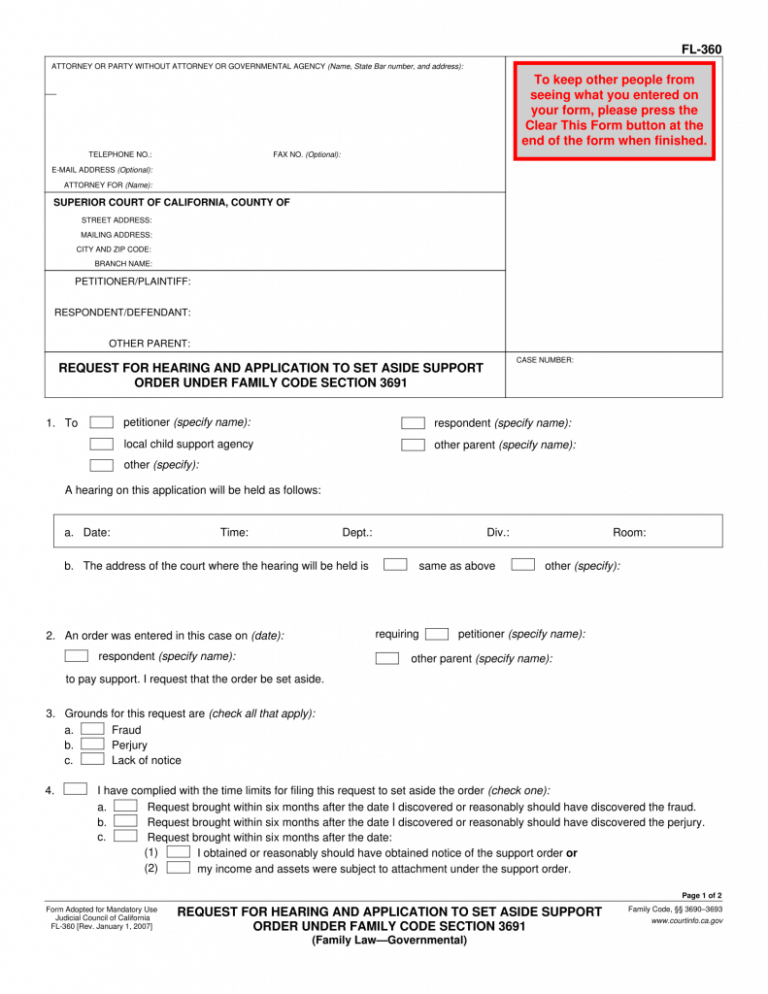
FL-360 is the official California Judicial Council form titled “Request for Hearing and Application to Set Aside Support Order Under Family Code Section 3691.” It allows you to ask the court to cancel, modify, or create a new support order.
- Purpose: Request a hearing to set aside an existing child support, spousal support, or family support order
- Who uses it: Parties in California family court proceedings, often involving local child support agencies (LCSAs)
- Why it matters: Successfully filing can eliminate arrears or correct unfair payment amounts
- Statewide application: Mandatory in all California superior courts, including Orange County
- Accessibility: You can download a current, fillable FL-360 directly from the California Courts website
How to Download FL-360 in California (Step-by-Step)
The safest source is the official California Courts website, and the form is free.
- Open your browser and go to www.courts.ca.gov
- Click on “Forms & Rules” in the navigation menu
- Search “FL-360” in the search bar
- Locate and click the PDF titled “Request for Hearing and Application to Set Aside Support Order Under Family Code Section 3691”
- Verify the revision date in the bottom-left corner to confirm you have the current version
- Alternatively, obtain a printed copy from the family law clerk’s office or self-help center at your local superior court
Third-party sites may offer versions for various years, but always confirm the form matches the official Judicial Council version before filing.
When and Why You Would Use FL-360
FL-360 applies in specific situations—not every support case requires it.
- Setting aside a default order: You never received proper notice of the original hearing
- Correcting errors: The support calculation relied on incorrect income information or perjured statements
- Fraud or mistake: Hidden assets or financial details surfaced after the order was entered
- Post-judgment disputes: Challenging orders involving LCSAs like Orange County Department of Child Support Services
Strict time limits apply under Family Code sections 3690-3693. For example, requests based on fraud typically must be filed within six months of discovery. Using FL-360 correctly can significantly change the amount you owe or receive in California family court, particularly when you are also addressing past-due balances through an FL-490 Application to Determine Arrearages.
How to Fill Out FL-360: Key Sections and Practical Tips
This section provides general educational guidance—every case is unique, and other required forms like the FL-110 Summons in California family law cases may also play a role in your matter.
- Caption area: Enter your case number, court name (e.g., “Superior Court of California, County of Orange”), and parties’ names exactly as they appear on existing court documents
- Check the appropriate boxes: Indicate whether you’re requesting a new order or seeking to set aside an existing one
- Identify the order: Specify the date, department, and type of support (child, spousal, or family), and whether you will need attachments like the FL-343 Family Support Order Attachment
- State your grounds: Reference the applicable Family Code section and select reasons such as lack of notice, mistake, or fraud, especially in cases involving division of retirement assets where a Qualified Domestic Relations Order (FL-460) may also be necessary
- Provide facts: Include clear details—dates, amounts, and new financial information—in the narrative sections
- Attach supporting documents: Pay stubs, tax returns, proof of service problems; label attachments clearly (e.g., “Attachment 5 – Income Documentation”)
- Sign and date: Complete all required declarations under penalty of perjury
Serving and Filing FL-360: What Happens After You Complete the Form
Completing the form is only one step—it must be properly filed and served.
- Filing: Bring the signed original and copies to the family law clerk at the appropriate superior court (such as the Orange County Lamoreaux Justice Center at 341 The City Drive, Orange, CA 92868)
- Fees: Pay the applicable filing fee or request a waiver using forms FW-001/FW-003
- Service: Have a person over 18 who is not a party serve the filed FL-360 on the other party (and any involved LCSA), and be prepared to file responsive documents such as an FL-320 Responsive Declaration to Request for Order when appropriate
- Proof of Service: The server must complete FL-330 (personal service) or FL-335 Proof of Service by Mail and file it with the court
- Deadlines matter: Service must occur within the required timeframe before the hearing date
- Local rules: Follow any county-specific requirements, such as courtesy copies to chambers in Orange County
What to Expect at the FL-360 Hearing in California Family Court
After filing and service, the court schedules a hearing where a judge decides the outcome.
- Both parties (and the LCSA, if involved) may appear and present evidence about income, expenses, and grounds for the request
- The judge will apply California law, focusing on Family Code sections and whether procedural requirements were met
- Possible outcomes: Denial, partial grant, full set-aside, or issuance of a new support order, which may later be incorporated into related documents such as an FL-355 Stipulation and Order for Child Custody
- Bring organized documents, copies of filed forms, pay records, and supporting correspondence
- Arrive early on your hearing date
- Having a family law attorney can improve your presentation, especially in complex or high-asset matters
Working with Pinkham & Associates, APLC on an FL-360 in Orange County
Pinkham & Associates, APLC is a boutique divorce and family law firm based in Orange County, California focusing exclusively on divorce and family law matters—including support orders and FL-360 motions. The firm helps clients evaluate whether FL-360 is appropriate, calculate accurate support, and prepare evidence for court.
Clients have direct access to experienced family law counsel, including attorney Doug Pinkham, for strategy, negotiations, and court appearances. The firm handles complex, high-asset support cases and contested modifications involving local child support agencies.
How to Get Help with Your FL-360 Today
- Call the firm’s office or submit an online contact form to schedule a consultation
- Gather key documents: current and prior support orders, pay stubs, tax returns, and any court notices
- Consultations are confidential and focused on realistic outcomes in California family court
If you’re facing a deadline, don’t wait—contact Pinkham & Associates today by phone or email for personalized legal guidance on your FL-360 matter and to understand how to choose the right divorce lawyer in Orange County.