


Family Law Forms, California
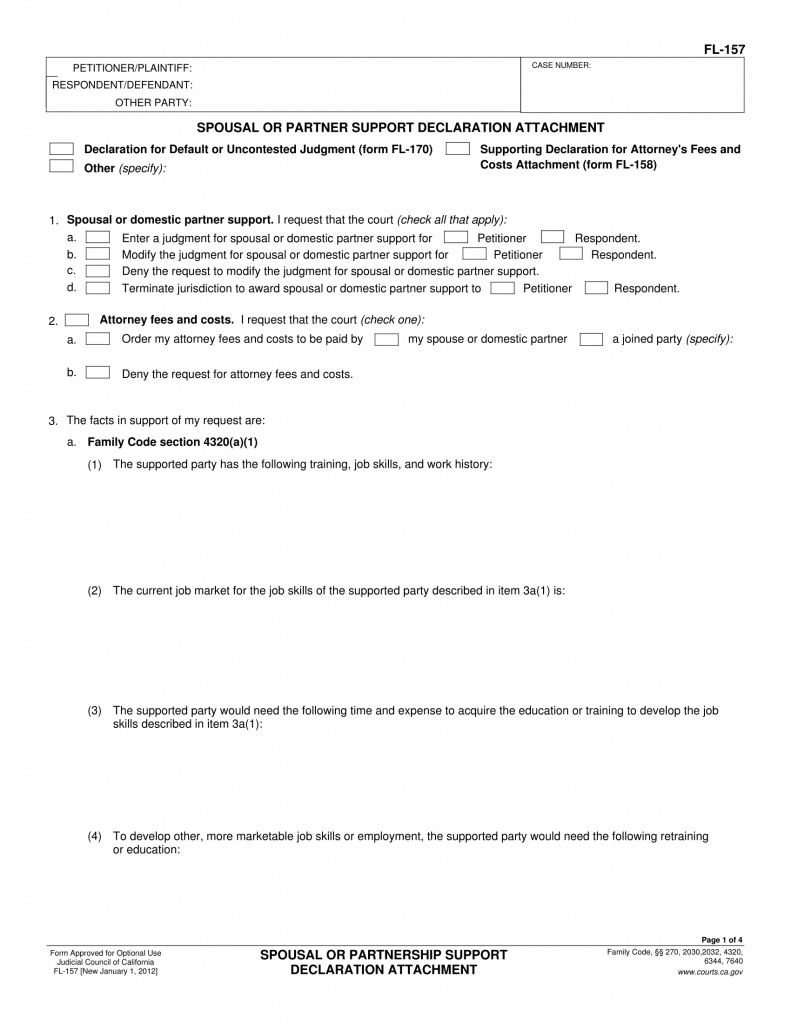
FL 157 – Spousal or Partner Support Declaration Attachment
If you’re navigating a California divorce or legal separation involving support, the FL-157 form will likely be part of your paperwork. Here’s what you need to know to complete it correctly.
What is Form FL-157?
The FL-157, officially titled Spousal or Domestic Partner Support Declaration Attachment, is a Judicial Council form used in California family law cases. It provides the court with detailed facts supporting your request for spousal or partner support.
This form is never filed alone. Instead, you attach it to other documents like the FL-170 (Declaration for Default or Uncontested Judgment) or a Responsive Declaration to Request for Order. The current version became effective January 1, 2021 and remains in use through 2026.
- Used in divorces, legal separations, and domestic partnership cases
- Required throughout California, including Orange County courts
- Accompanies primary forms like FL-300 or FL-170
When Do You Need to Use FL-157?
You’ll need the FL-157 whenever asking the court to make, modify, or terminate spousal or domestic partner support orders. The form lets the judge understand the facts behind your request.
Typical situations include:
- Initial divorce or legal separation judgments
- Default or uncontested judgments using FL-170
- Requests for Order (FL-300) involving support
- Post-judgment modifications based on changed circumstances
Either party—the support payor or payee—may use this form. Many Orange County judicial officers routinely expect FL-157 to address Family Code section 4320 factors, even when not technically mandatory.
How FL-157 Fits Into Your California Divorce or Support Case
The FL-157 works alongside other required forms. A typical packet includes the Request for Order (FL-300), Income and Expense Declaration (FL-150), FL-157, and supporting documents like pay stubs and tax returns.
Think of it this way: FL-150 shows your numbers, while FL-157 tells your story. It explains factors like marriage length, standard of living, earning capacity, and health issues that affect support.
Judges rely heavily on FL-157 information when deciding whether requested support is fair—especially in contested or high-asset cases.
Key Legal Factors You Must Address on FL-157
The form walks you through California Family Code section 4320 factors:
- Marriage or partnership length (under or over 10 years matters)
- Each party’s income and earning capacity
- Current employment and job skills
- Age and health of both parties
- Marital standard of living
- Domestic violence history
- Contributions to the other spouse’s education or career
- Documented needs versus ability to pay
Failing to provide clear, specific facts can result in lower support awards or hearing delays.
Step-by-Step Overview: How to Complete FL-157 Correctly
This is general information, not legal advice. Consult a California family law attorney for personalized guidance.
Before you begin, gather:
- Pay stubs from at least the last two months
- Recent federal and California tax returns
- Profit-and-loss statements (if self-employed)
- Documents showing major expenses or health issues
Complete the caption by filling in the county, court address, case number, and party names. Check whether you’re petitioner or respondent.
Respond to each section by describing your work history, current income (cross-reference your FL-150), efforts toward self-support, health limitations, and any safety concerns.
Use specific dates and dollar amounts—avoid vague descriptions. Sign under penalty of perjury and attach additional pages labeled clearly if needed.
Common Mistakes to Avoid With FL-157
Errors weaken your request and can damage credibility:
- Leaving sections blank without explanation
- Providing income figures inconsistent with FL-150 or stubs
- Using emotional statements instead of factual information
- Failing to explain employment changes since separation
- Attaching unsupported expense claims without documentation
- Not addressing negative facts like voluntary income reduction
Have an experienced family law attorney review your form before filing.
How and Where to File FL-157 in a California Case
The FL-157 attaches to other forms—it’s never submitted alone. Assemble your complete packet (FL-300, FL-150, FL-157, exhibits), make copies, and file with the family law clerk at your county courthouse.
In Orange County, many cases go through Lamoreaux Justice Center. Filing may be done in person, by mail, or electronically where available. After filing, ensure proper service on the other party before your hearing date.
Keep stamped copies and proof of service for your records.
Why Legal Help Matters When Preparing FL-157
While you can complete FL-157 yourself, the form shapes how the court understands both parties’ financial situations. In complex cases or long-term marriages, misstatements can affect support orders for years.
A knowledgeable California family law attorney helps identify persuasive facts, organize evidence, and ensure all 4320 factors are addressed.
How Pinkham & Associates, APLC Can Assist You With FL-157
Pinkham & Associates, APLC offers free initial consultations for individuals in Orange County needing help with spousal or domestic partner support issues and provides ongoing education through its family law blog with divorce and support resources.
During your consultation, you’ll speak directly with an experienced family law attorney about spousal, child, or family support order attachment issues including:
- Reviewing draft forms for accuracy
- Organizing financial documents
- Drafting persuasive statements tied to Family Code 4320 factors
- Preparing for your hearing
Contact the firm by phone or email to schedule your free consultation.
Preparing for Your Consultation About FL-157
- Bring copies of existing court orders
- Gather income documentation (recent pay stubs, tax returns, self-employment records)
- Prepare draft versions of FL-157, FL-150, or the simplified Financial Statement (FL-155) if applicable
- Write down your relationship timeline (marriage date, separation date, key financial events, and any bifurcation of marital status (FL-347) issues)
- List specific questions about your situation, including any concerns about initial filings like the family law summons (FL-110) or ongoing child support case registry (FL-191) requirements
Follow these steps and you’ll be ready to develop a tailored strategy for your case with Pinkham & Associates.