


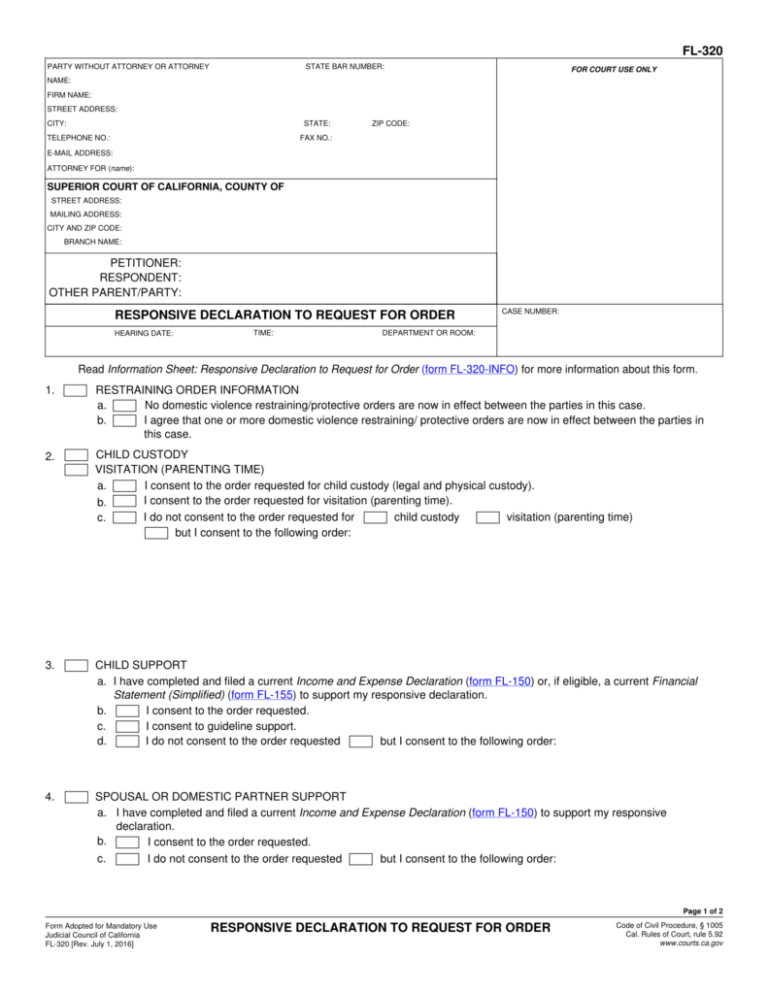
When the other party files a Request for Order in your family law case, you need to respond. Form FL-320 is how you do it. At Pinkham & Associates, APLC, we help Orange County clients prepare, file, and argue this responsive declaration every week.
What Is Form FL-320 (Responsive Declaration to Request for Order)?
Form FL 320 is the California Judicial Council document titled “Responsive Declaration to Request for Order.” You use it to respond to an FL-300 Request for Order in divorce, legal separation, parentage, or post-judgment cases.
This form lets you agree, partially agree, or disagree with what the other party is asking the court to order. Common issues include child custody, visitation, child support, spousal support, and attorney’s fees.
When Do You Need to Use FL-320 in a California Divorce or Family Law Case?
You file FL-320 whenever you receive an FL-300 and want to contest or add to the request. Common situations include:
- Temporary custody or parenting time disputes
- Move-away requests
- Child or spousal support changes
- Attorney’s fees requests
- Enforcement or modification of prior orders
At Orange County’s Lamoreaux Justice Center, parties regularly use this form in both divorce and parentage cases. Failing to respond can result in the judge granting orders without your input.
Deadlines and Service Rules for FL-320 in California
Timing matters. Under California Rules of Court, your FL-320 must be filed and served at least 9 court days before the hearing, and you will usually need a properly completed Proof of Service by Mail (FL-335). Court days exclude weekends and judicial holidays.
Someone over 18 who is not a party must typically serve the documents. If you need immediate protections for safety or child welfare, a Temporary Emergency Court Order using FL-305 may also be appropriate. If you’re within two weeks of your hearing, reach out to our firm immediately to check your options.
How to Fill Out Form FL-320 Step by Step
Start with the case caption: names, case number, and court. Add the hearing date, time, and department.
Next, use the check boxes to indicate whether you agree or disagree with each request from the FL-300. Describe your position clearly. When the court ultimately rules, those rulings are usually reflected in a Findings and Order After Hearing (FL-340). When you need more space, add attachments and label them properly.
Write factual declarations chronologically. Avoid emotional narratives. Support claims with documents like pay stubs or school records. Sign under penalty of perjury and double-check all page numbers.
Using FL-320 Specifically for Child Custody and Visitation
Parents commonly use FL-320 to contest custody or visitation requests. In some high-conflict or complex matters, the court may issue an Order Appointing Counsel for a Child (FL-323). You can attach Judicial Council forms FL-311 and the FL-341 series to propose detailed parenting plans.
Include weekday schedules, weekends, holidays, school breaks, and exchange logistics. In move-away or high-conflict cases, courts give significant weight to clear, child-focused proposals. For abduction concerns, consider FL-312.
Using FL-320 for Support, Fees, and Other Financial Issues
When responding to support or fee requests, you must typically file an Income and Expense Declaration (FL-150) with current pay stubs and tax returns, and in some cases a Family Support Order Attachment (FL-343) will be used to detail the support terms.
Use FL-320 to explain disagreements about income, timeshare percentages, or expenses. You can also request attorney’s fees to create equal litigation footing under Family Code sections 2030-2032. Complex situations involving business ownership, RSUs, or dividing retirement accounts with a Qualified Domestic Relations Order (FL-460) require careful analysis.
How Pinkham & Associates, APLC Helps With FL-320 in Orange County
FL-320 is not just a form—it’s a key advocacy document. Our firm reviews the opposing FL-300, analyzes applicable law, and drafts tailored responses with supporting declarations.
We handle preparation, service, filing, and courtroom argument, starting from the initial Summons in a California family law case (FL-110) through post-judgment enforcement. Clients work directly with experienced family law attorneys throughout the process.
Common Mistakes on FL-320 and How to Avoid Them
Frequent errors include missing the 9-court-day deadline, improper service, failing to attach FL-150, leaving sections blank, and writing emotional narratives without facts. In divorce cases, parties also commonly mishandle their Declaration of Disclosure obligations using FL-140.
Before filing, confirm: signatures complete, attachments numbered, proof of service ready, and local rules followed.
Frequently Asked Questions About FL-320
Must I file FL-320 if I agree with everything? Filing is optional but can clarify your position for the judge.
Can I file after the deadline? You may request a continuance or ask to be heard, but outcomes vary.
Can I make counter-requests? Generally, you need a separate FL-300 for new requests beyond responding, and in some cases parties may use an Appearance, Stipulations, and Waivers form (FL-130) to streamline the process.
Next Steps: Talk to an Orange County Family Law Attorney
Receiving an FL-300 is stressful. Don’t ignore it. Depending on the issues, you may also need to consider a Request for Separate Trial (FL-315) on particular questions. Calendar your deadline immediately.
Pinkham & Associates, APLC offers free consultations to review your case and create a response strategy. We focus exclusively on family law throughout Orange County. A well-prepared FL-320 can significantly improve how the judge sees your side.